- 528 pages
- English
- ePUB (mobile friendly)
- Available on iOS & Android
eBook - ePub
Computer Vision Technology in the Food and Beverage Industries
About this book
The use of computer vision systems to control manufacturing processes and product quality has become increasingly important in food processing. Computer vision technology in the food and beverage industries reviews image acquisition and processing technologies and their applications in particular sectors of the food industry.Part one provides an introduction to computer vision in the food and beverage industries, discussing computer vision and infrared techniques for image analysis, hyperspectral and multispectral imaging, tomographic techniques and image processing. Part two goes on to consider computer vision technologies for automatic sorting, foreign body detection and removal, automated cutting and image analysis of food microstructure. Current and future applications of computer vision in specific areas of the food and beverage industries are the focus of part three. Techniques for quality control of meats are discussed alongside computer vision in the poultry, fish and bakery industries, including techniques for grain quality evaluation, and the evaluation and control of fruit, vegetable and nut quality.With its distinguished editor and international team of expert contributors, Computer vision technology in the food and beverage industries is an indispensible guide for all engineers and researchers involved in the development and use of state-of-the-art vision systems in the food industry.
- Discusses computer vision and infrared techniques for image analysis, hyperspectral and multispectral imaging, tomographic techniques and image processing
- Considers computer vision technologies for automatic sorting, foreign body detection and removal, automated cutting and image analysis of food microstructure
- Examines techniques for quality control and computer vision in various industries including the poultry, fish and bakery, fruit, vegetable and nut industry
Information
Part I
An introduction to computer vision in the food and beverage industries
1
Computer vision and infrared techniques for image acquisition in the food and beverage industries*
M.Z. Abdullah, Universiti Sains Malaysia, Malaysia
Abstract:
Computer vision systems are ideally suited for routine inspection and quality assurance tasks which are common in the food and beverages industries. Backed by powerful machine intelligence and state-of-the-art electronic technologies, machine vision provides a mechanism by which the human thinking process is simulated artificially. Depending on the nature of application and the sensitivity needed to perform the inspection, an image can be acquired at different wavelengths, extending from visible to invisible electromagnetic spectrum. In this chapter the basic electronics needed to acquire an image at three different wavelengths are described. The spectrums covered include the visible, ultrasonic and infrared spectrums. The limitations and drawbacks of each system are also briefly discussed.
Key words
electromagnetic spectrum
image acquisition system
computer vision
illumination system
ultrasound
thermographic imaging
charge-coupled device (CCD) camera
1.1 Introduction
In making a physical assessment of agricultural materials and foodstuffs, images are undoubtedly the preferred method for representing concepts to the human brain. Many of the quality factors affecting foodstuffs can be determined by visual inspection and image analysis. Such inspections determine market price and to some extent the ‘best-if-used-before-date’. Traditionally, quality inspection is performed by trained human inspectors who approach the problem of quality assessment in two ways: seeing and feeling. In addition to being costly, this method is highly variable and decisions are not always consistent between inspectors or from day to day. This is, however, changing with the advent of electronic imaging systems and with rapid decline in costs of computers, peripherals and other digital devices. Moreover, the inspection of foodstuffs for various quality factors is a very repetitive task, which is also very subjective in nature. In this type of environment machine vision systems are ideally suited for routine inspection and quality assurance tasks. Backed by powerful artificial intelligence systems and the state-of-the-art electronic technologies, machine vision provides a mechanism in which the human thinking process is simulated artificially. To-date machine vision has extensively been applied to solve various food engineering problems, ranging from simple quality evaluation of food products to complicated robot guidance applications (Abdullah et al., 2000; Pearson, 1996; Tao et al., 1995). Despite the general utility of machine vision images as a first-line inspection tool, their capabilities for more in-depth investigation are fundamentally limited. This is due to the fact that images produced by vision camera are formed using a narrow band of radiation, extending from 10− 4 m to 10− 7 m in wavelength. Due to this, scientists and engineers have invented camera systems that allow patterns of energy from virtually any part of the electromagnetic spectrum to be visualized. Camera systems such as computed tomography (CT), magnetic resonance imaging (MRI), nuclear magnetic resonance (NMR), single photon emission computed tomography (SPECT) and positron emission tomography (PET) operate at shorter wavelengths ranging from 10− 8 m to 10− 13 m. The details are covered in Chapter 3. On the opposite side of the electromagnetic spectrum, there are infrared (IR) and radio cameras which enable visualization to be performed at wavelengths greater than 103 m and 106 m, respectively. All these imaging modalities rely on acquisition hardware featuring an array or ring of detectors which measure the strength of some form of radiation, either due to reflection or after the signal has passed transversely through the object. Perhaps one thing that these camera systems have in common is the requirement to perform digital image processing of the resulting signals using modern computing power. While digital image processing is usually assumed to be the process of converting radiant energy in three-dimensional (3-D) world into a two-dimensional (2-D) radiant array of numbers, this is certainly not so when the detected energy is outside the visible part of the spectrum. The reason is that the technology used to acquire the imaging signals are quite different depending on the camera modalities. The aim of this chapter is, therefore, to give a brief review of the present state-of-the-art of image acquisition technologies which have found many applications in the food industry.
Section 1.2 summarizes the electromagnetic spectrum which is useful in image formation. Section 1.3 includes a summary of the principle of operation of the machine vision technology, followed by illumination and electronics requirements. Other imaging modalities, particularly the acquisition technologies operating at the non-visible range are also briefly discussed. In particular, technologies based on ultrasound and IR are addressed, followed by some of their successful applications in food engineering found in literatures. Section 1.4, which is the final conclusions section, addresses likely future developments in this exciting field of electronic imaging.
1.2 The electromagnetic spectrum
As discussed earlier, images are derived from the electromagnetic radiation in both visible and non-visible range. Radiation energy travels in space at the speed of light, in the form of sinusoidal waves with known wavelengths. Arranged from shorter to longer wavelengths, the electromagnetic spectrum provides information on frequency as well as energy distributions of the electromagnetic radiation. Figure 1.1 gives the electromagnetic spectrum of all electromagnetic waves.
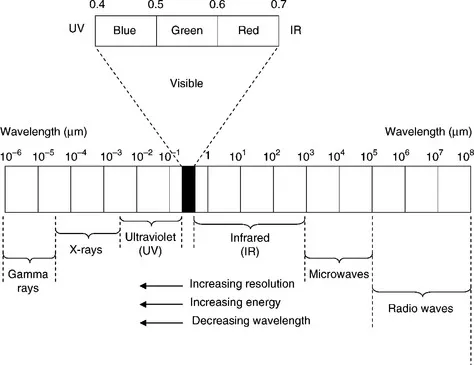
Fig. 1.1 The electromagnetic spectrum comprising the visible and non-visible range.
Referring to Fig. 1.1, the gamma rays with wavelengths less than 0.1 nm constitute the shortest wavelengths of the electromagnetic spectrum. Traditionally, gamma radiation is important for medical and astronomical imaging, leading to the development of various types of anatomical imaging modalities such as the CT, MRI, SPECT and PET. In CT the radiation is projected into the target from diametrically opposed source, while with others it originates from the target – by simulated emission in the case of MRI and through the use of radio-pharmaceuticals in SPECT and PET. On the other hand, the longest waves are radiowaves, which have wavelengths of many kilometres. The well-known ground-probing radar (GPR) and other microwave-based imaging modalities operate in this frequency range. Located in the middle of the electromagnetic spectrum is the visible range, consisting of a narrow portion of the spectrum, from 400 nm (blue) to 700 nm (red). The popular charge coupled device (CCD) camera operates in this spectrum range. IR light lies between the visible and microwave portions of the electromagnetic band. Just like the visible light, IR has wavelengths that range from near (shorter) IR to far (longer) IR. The latter belongs to the thermally sensitive region which makes it useful in imaging applications that rely on heat signature. One example of such an imaging device is the indium–gallium–arsenide (InGaAs)-based near infrared (NIR) camera which gives optimum response from the 900 nm to 1700 nm band (Doebelin, 1996). Ultraviolet (UV) has shorter wavelength than visible light. Similar to IR...
Table of contents
- Cover image
- Title page
- Table of Contents
- Copyright
- Contributor contact details
- About the editor
- Woodhead Publishing Series in Food Science, Technology and Nutrition
- Part I: An introduction to computer vision in the food and beverage industries
- Part II: Computer vision applications in food and beverage processing operations/technologies
- Part III: Current and future applications of computer vision for quality control and processing of particular products
- Index
Trusted by 375,005 students
Access to over 1.5 million titles for a fair monthly price.
Study more efficiently using our study tools.
Frequently asked questions
Yes, you can cancel anytime from the Subscription tab in your account settings on the Perlego website. Your subscription will stay active until the end of your current billing period. Learn how to cancel your subscription
No, books cannot be downloaded as external files, such as PDFs, for use outside of Perlego. However, you can download books within the Perlego app for offline reading on mobile or tablet. Learn how to download books offline
We are an online textbook subscription service, where you can get access to an entire online library for less than the price of a single book per month. With over 1.5 million books across 990+ topics, we’ve got you covered! Learn about our mission
Look out for the read-aloud symbol on your next book to see if you can listen to it. The read-aloud tool reads text aloud for you, highlighting the text as it is being read. You can pause it, speed it up and slow it down. Learn more about Read Aloud
Yes! You can use the Perlego app on both iOS and Android devices to read anytime, anywhere — even offline. Perfect for commutes or when you’re on the go.
Please note we cannot support devices running on iOS 13 and Android 7 or earlier. Learn more about using the app
Please note we cannot support devices running on iOS 13 and Android 7 or earlier. Learn more about using the app
Yes, you can access Computer Vision Technology in the Food and Beverage Industries by D-W Sun in PDF and/or ePUB format, as well as other popular books in Tecnologia e ingegneria & Visione artificiale e riconoscimento di schemi. We have over 1.5 million books available in our catalogue for you to explore.