
eBook - ePub
The Flagellar World
Electron Microscopic Images of Bacterial Flagella and Related Surface Structures
- 160 pages
- English
- ePUB (mobile friendly)
- Available on iOS & Android
eBook - ePub
The Flagellar World
Electron Microscopic Images of Bacterial Flagella and Related Surface Structures
About this book
The Flagellar World is a unique publication. The product of years of research and data collection by the author, this book is a pictorial guide to flagella in a variety of organisms. Each EM image is accompanied by a short description of the system in each organism. These never-before-seen pictures represent a wide variety of flagella, including Legionella pneumophila, Escherichia coli, Pseudomonas aeruginosa, and many others. Researchers in microbiology, immunology, and parasitology will find this a fascinating and useful resource.
- A unique publication with many never before seen EM images of flagella
- A historical document of years of research on flagella
- Fills a specific niche that shows flagella in several varied organisms
Information
Chapter 1
Actinoplanes missouriensis — Swimming Spores with Flagella
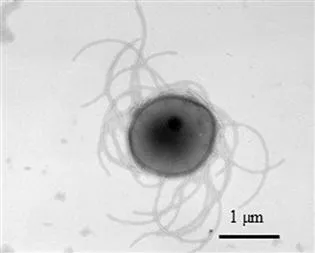
Actinoplanes missouriensis is a Gram-positive, soil-inhabiting, filamentous bacterium that characteristically produces spores within a terminal sporangium. Spores are released from sporangia upon contact with water and start swimming by means of flagella. Average number of flagella per spore is 15. The swimming speed of the A. missouriensis cell is as high as 135 μm/s. Actinoplanes spores eventually grow into mycelia and form sporangia again under adverse conditions.
Keywords
Actinoplanes; spores; sporangium; peritrichous flagella; mycelia
| Phylum | Actinobacteria |
| Class | Actinobacteridae |
| Order | Actinomycetales |
| Family | Micromonosporaceae |
| Genus | Actinoplanes |
| Species | A. missouriensis |
Actinoplanes missouriensis is a Gram-positive, soil-inhabiting, filamentous bacterium that characteristically produces spores within a terminal sporangium. Spores are released from sporangia upon contact with water (containing soil extracts) and actively swim by means of flagella, which are completed when the spore is matured. The swimming speed of an A. missouriensis cell is as high as 135 μm/s. Compare this speed with that of the fast swimmer in the sea (Chapter 22).
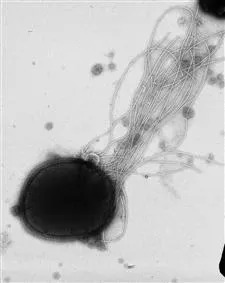
A. missouriensis flagella grow from one side of the spore rather than from all over, indicating that the spore flagella are not peritrichous, but either polar or lateral despite its round cell body (see Topic: Flagellar position and shape). This kind of flagella arrangement also appears in M. voltae (see Chapter 32).
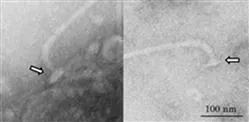
The basal body is composed of MS rings, but is missing the outer PL rings: a common feature for Gram-positive Firmicutes. The filament is composed of a single kind of flagellin with the MW of 44 kDa.
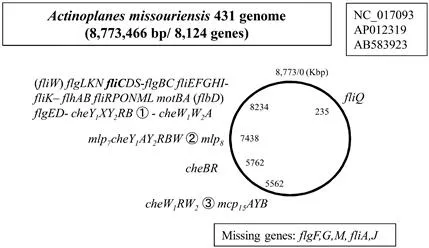
The genome of A. missouriensis 431 strain consists of a single 8.7-Mbp chromosome. Flagellar genes form a compact cluster at 8,234 bp on the chromosome. Almost all flagella structural genes except those for the rod proteins are found in the compact cluster. There are 3 complete sets of che genes. More than 20 mcp, mlp (mcp-like-protein) genes are scattered all over the chromosome.
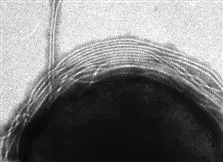
The average number of flagella per spore is 15, and the average length of filaments is 1.89 μm, which covers the circumference of the cell body. Release of spores from sporangia starts upon contact with water. 10 minutes after contact, numerous spores had flagella which looked to be forming several layers around the spore. Actinoplanes spores eventually grow into mycelia and form sporangia again under adverse conditions.
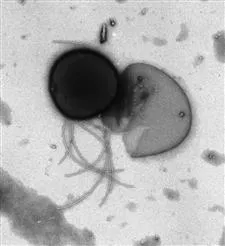
Two types of spores were observed in the preparation of PTA-negatively-stained samples: one appears darkly stained, and the other is lightly stained (lower). The latter appears to be a membranous empty sheath with a large crevice in the middle of the body, indicating that flagellar assembly has already been completed in the sheath. Flagellated spores hatch and leave an empty sheath behind.
Chapter 2
Aliivibrio fischeri — Light-Organ Symbiont in the Bobtail Squid
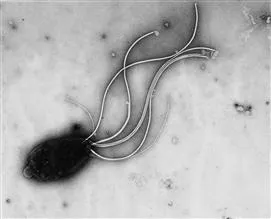
Aliivibrio (formerly Vibrio) fischeri is a Gram-negative, marine bacterium. A. fischeri has a symbiotic relationship with the bobtail squid (Euprymna scolopes), in which it produces bioluminescence in the host’s luminous organ. Each cell possesses several polar flagella. The filament is composed of six flagellins (FlaA–F). Flagellar genes form one of the most compact clusters on the genome.
Keywords
Vibrio fischeri; polar flagella; bioluminescence; the bobtail squid; lux operon
| Phylum | Proteobacteria |
| Class | Gammaproteobacteria |
| Order | Vibrionales |
| Family | Vibrionaceae |
| Genus | Aliivibrio |
| Species | A. fischeri |
Aliivibrio (formerly Vibrio) fischeri is a Gram-negative, marine bacterium. A. fischeri has a symbiotic relationship with the bobtail squid (Euprymna scolopes), in which it produces bioluminescence from the host’s luminous organ. The light emission is cont...
Table of contents
- Cover image
- Title page
- Table of Contents
- Copyright
- Preface
- Introduction
- Chapter examples
- Chapter 1. Actinoplanes missouriensis — Swimming Spores with Flagella
- Chapter 2. Aliivibrio fischeri — Light-Organ Symbiont in the Bobtail Squid
- Chapter 3. Azospirillum brasilense — A Bushy Hook of the Polar Flagellum
- Chapter 4. Bacillus subtilis — The Representative of Gram-Positive Bacteria
- Topic 1: Gene Regulation
- Topic 2: Gene Arrangement
- Topic 3: Mot Proteins
- Topic 4: Flagellin size
- Topic 5: Flagella and Pathogenicity
- Topic 6: Flagellar Position and Shape
- Topic 7: History of Salmonella SJW Strains
- Topic 8: Hook length
- Topic 9: Multiple Flagellins
- Appendix
- References
- Index
Trusted by 375,005 students
Access to over 1.5 million titles for a fair monthly price.
Study more efficiently using our study tools.
Frequently asked questions
Yes, you can cancel anytime from the Subscription tab in your account settings on the Perlego website. Your subscription will stay active until the end of your current billing period. Learn how to cancel your subscription
No, books cannot be downloaded as external files, such as PDFs, for use outside of Perlego. However, you can download books within the Perlego app for offline reading on mobile or tablet. Learn how to download books offline
Perlego offers two plans: Essential and Complete
- Essential is ideal for learners and professionals who enjoy exploring a wide range of subjects. Access the Essential Library with 800,000+ trusted titles and best-sellers across business, personal growth, and the humanities. Includes unlimited reading time and Standard Read Aloud voice.
- Complete: Perfect for advanced learners and researchers needing full, unrestricted access. Unlock 1.5M+ books across hundreds of subjects, including academic and specialized titles. The Complete Plan also includes advanced features like Premium Read Aloud and Research Assistant.
We are an online textbook subscription service, where you can get access to an entire online library for less than the price of a single book per month. With over 1.5 million books across 990+ topics, we’ve got you covered! Learn about our mission
Look out for the read-aloud symbol on your next book to see if you can listen to it. The read-aloud tool reads text aloud for you, highlighting the text as it is being read. You can pause it, speed it up and slow it down. Learn more about Read Aloud
Yes! You can use the Perlego app on both iOS and Android devices to read anytime, anywhere — even offline. Perfect for commutes or when you’re on the go.
Please note we cannot support devices running on iOS 13 and Android 7 or earlier. Learn more about using the app
Please note we cannot support devices running on iOS 13 and Android 7 or earlier. Learn more about using the app
Yes, you can access The Flagellar World by Shin-Ichi Aizawa in PDF and/or ePUB format, as well as other popular books in Biological Sciences & Biology. We have over 1.5 million books available in our catalogue for you to explore.