eBook - ePub
The Performance of Concentrated Solar Power (CSP) Systems
Analysis, Measurement and Assessment
- 298 pages
- English
- ePUB (mobile friendly)
- Available on iOS & Android
eBook - ePub
The Performance of Concentrated Solar Power (CSP) Systems
Analysis, Measurement and Assessment
About this book
The Performance of Concentrated Solar Power (CSP) Systems: Analysis, Measurement, and Assessment offers a unique overview of the information on the state-of-the-art of analysis, measurement, and assessment of the performance of concentrated solar power (CSP) components and systems in a comprehensive, compact, and complete manner.
Following an introductory chapter to CSP systems and the fundamental principles of performance assessment, individual chapters explore the component performance of mirrors and receivers. Further expert-written chapters look at system performance assessment, durability testing, and solar resource forecasting for CSP systems. A final chapter gives an outlook on the actual methods and instruments for performance and durability assessment that are underdevelopment.
The Performance of Concentrated Solar Power (CSP) Systems: Analysis, Measurement, and Assessment is an essential reference text for research and development professionals and engineers working on concentrated solar power systems, as well as for postgraduate students studying CSP.
- Presents a unique, single literature source for a complete overview of the performance assessment tools and methods currently used for concentrated solar power (CSP) technology
- Written by a team of experts in the field of CSP
- Provides information on the state-of-the-art of modeling, measurement, and assessment of the performance of CSP components and systems in a comprehensive, compact, and complete manner
Information
1
Introduction to CSP systems and performance
P. Heller German Aerospace Center (DLR), Cologne, Germany
Abstract
This chapter introduces into the principles of concentrated solar power (CSP) technologies, its main components as well as typical plant concepts. It covers the main technologies, i.e., solar tower, parabolic trough, linear Fresnel, and dish/engine systems and discusses the importance of performance assessment for each, always under the aspect of the market demand for such assessment. This introduction also provides the historical background from the first commercial plants until the market size of 5 GW in 2016. Also, the development of research and test infrastructure and key R&D projects are presented, highlighting their role in developing methods, tools, or infrastructure for performance assessment. A general overview on the CSP markets and the expectation for the future growths of the sector is given. Finally, the main important research laboratories are presented which provide knowledge and services for performance assessment of the technology.
Keywords
Concentrated solar power; Trough; Tower; Linear Fresnel; Dish; History; Applications; Solar plants; Laboratories; Meteorological stations; Markets
1.1 General introduction to CSP
Concentrated solar power (CSP) systems are characterized by focusing solar radiation with the help of reflectors onto a receiver, where the radiation is absorbed and transferred to heat. A heat transfer fluid (HTF) carries the heat from the receiver to a heat engine, i.e., a steam or gas turbine, connected to an electrical power generator (see Fig. 1.1). Instead of producing electricity, the heated HTF can also be used to drive a thermochemical process to produce, e.g., hydrogen, syngas, or even fertilizer.


Using CSP technology for electricity production is the most mature application, counting in 2016 with a market size of approx. 5 GW installed power [2]. Therefore, this book focuses only on concentrated solar energy for electricity production. Since the key for further deployment of the technology is the performance of commercial systems, this book has the goal to present all important information about the methods, instruments, and infrastructures to assess the performance of commercial CSP components and plants. Fig. 1.1 shows the four major CSP technologies: parabolic trough, linear Fresnel, tower, and dish systems.
1.1.1 History of CSP
The history of CSP technology goes back to ancient Greece and China, where mirrors or glass were already used to make fire. In the early 20th century, when simple machines had already been invented, the first plant based on parabolic trough technology for pumping water was established in Meadi, Egypt by the American Frank Shuman [3].
At the end of the 1970s, after the oil crises in 1973 and 1979/80, the first research projects were started to replace fossil fuels for electricity generation by solar energy. These focused on research and development of the technology in order to demonstrate the technical feasibility. In Europe, an activity of the International Energy Agency IEA led to the development of a parabolic trough and a solar tower demonstration facility in Almeria, Spain, planned and built by several countries: Germany, Spain, Italy, Belgium, Greece, Sweden, Switzerland, and the United States. The project was named a Small Solar Power System (SSPS), and was later integrated with new installations to the Plataforma Solar de Almería (PSA), today Europe's largest test site for CSP. The working group of IEA was later named SolarPACES [4].
At the same time, several commercial projects started, such as CESA-1 in Spain and THEMIS in France [4]. These were mainly based on evaporating and superheating steam to drive steam turbines in the power level of 1–2 MW. Since shortly after commissioning of these plants, the oil price went down again and the expectations for competitive commercial applications of CSP did not become reality, they were operated commercially for only a few years. They were then shut down or handed over to research institutes with the objective to work on the technology's cost reduction to become cost competitive in the future.
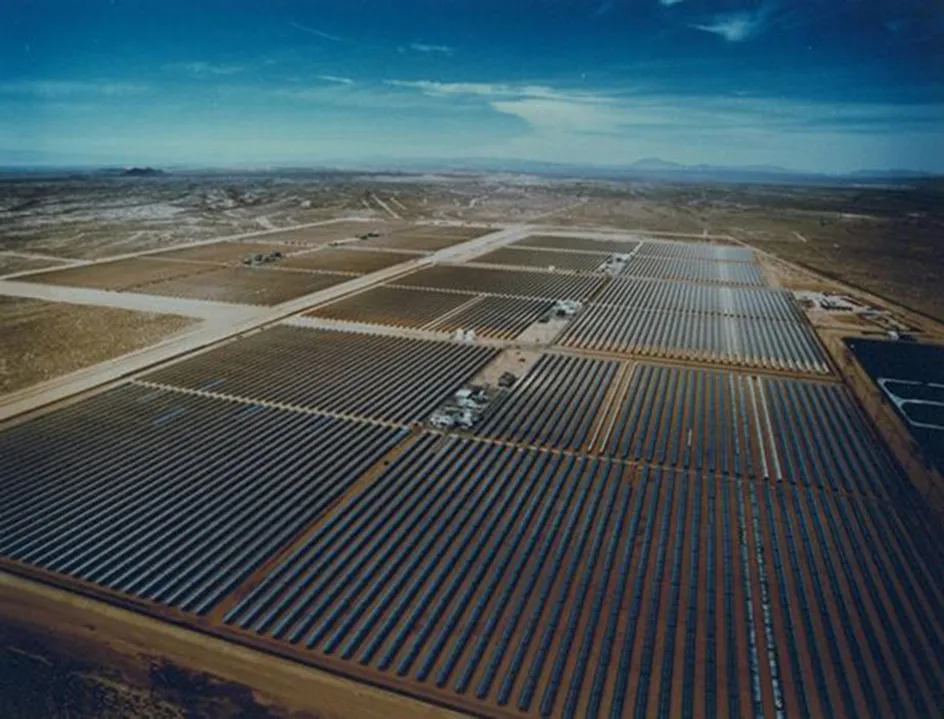
In 1981, the United States planned to have the first power tower plant with steam turbine technology, i.e., Solar-1, 10 MW, operated in Barstow, California. A little later, the first larger deployment of CSP became reality. In 1984, the SEGS-1 plant (Solar Electric Generation Station) was built in the Mojave desert in California. It consists of parabolic trough technology heating a thermal oil and superheating steam to produce electricity with a steam turbine with a generator. In the following years, several new plants were built leading to an installed capacity of 354 MW (i.e., SEGS-II to SEGS-IX). For many years, even after the bankruptcy of the developing company LUZ Power Generation in 1991 [17], these plants were the only commercial installations of CSP. Their nominal power was successively increased from plant to plant, i.e., from 14 MW in SEGS-1 to 80 MW in SEGS-IX (Fig. 1.2).
With the help of the Global Environmental Facility of the World Bank, three commercial integrated solar combined cycle (ISCCS) power plants were built in Egypt (Kuraymat), Morocco (Ain Benimatar), and Algeria (Hassi R'Mel) [18].
In 2004 [19,20], Spain introduced a feed-in tariff for CSP, and by this was initiating the construction of approximately 1.3 GW of capacity, built in the years 2007–14 (18). Motivated by the good experience in California and Spain, and by the desire to reduce fossil fuel consumption in order to lower CO2 emissions, many countries started to implement commercial CSP projects.
1.1.2 First CSP test infrastructures
Initiated by the oil crisis of the 1970s and...
Table of contents
- Cover image
- Title page
- Table of Contents
- Copyright
- List of contributors
- 1: Introduction to CSP systems and performance
- 2: Principles of CSP performance assessment
- Part One: CSP component performance
- Part Two: CSP system performance
- Part Three: Performance degradation and durability of CSP components
- Part Four: Methods and instruments under development
- Index
Trusted by 375,005 students
Access to over 1.5 million titles for a fair monthly price.
Study more efficiently using our study tools.
Frequently asked questions
Yes, you can cancel anytime from the Subscription tab in your account settings on the Perlego website. Your subscription will stay active until the end of your current billing period. Learn how to cancel your subscription
No, books cannot be downloaded as external files, such as PDFs, for use outside of Perlego. However, you can download books within the Perlego app for offline reading on mobile or tablet. Learn how to download books offline
Perlego offers two plans: Essential and Complete
- Essential is ideal for learners and professionals who enjoy exploring a wide range of subjects. Access the Essential Library with 800,000+ trusted titles and best-sellers across business, personal growth, and the humanities. Includes unlimited reading time and Standard Read Aloud voice.
- Complete: Perfect for advanced learners and researchers needing full, unrestricted access. Unlock 1.5M+ books across hundreds of subjects, including academic and specialized titles. The Complete Plan also includes advanced features like Premium Read Aloud and Research Assistant.
We are an online textbook subscription service, where you can get access to an entire online library for less than the price of a single book per month. With over 1.5 million books across 990+ topics, we’ve got you covered! Learn about our mission
Look out for the read-aloud symbol on your next book to see if you can listen to it. The read-aloud tool reads text aloud for you, highlighting the text as it is being read. You can pause it, speed it up and slow it down. Learn more about Read Aloud
Yes! You can use the Perlego app on both iOS and Android devices to read anytime, anywhere — even offline. Perfect for commutes or when you’re on the go.
Please note we cannot support devices running on iOS 13 and Android 7 or earlier. Learn more about using the app
Please note we cannot support devices running on iOS 13 and Android 7 or earlier. Learn more about using the app
Yes, you can access The Performance of Concentrated Solar Power (CSP) Systems by Peter Heller in PDF and/or ePUB format, as well as other popular books in Technology & Engineering & Renewable Power Resources. We have over 1.5 million books available in our catalogue for you to explore.