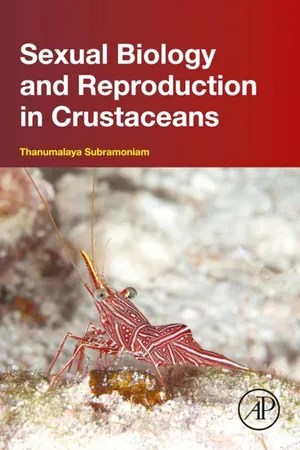
- 526 pages
- English
- ePUB (mobile friendly)
- Available on iOS & Android
eBook - ePub
Sexual Biology and Reproduction in Crustaceans
About this book
Sexual Biology and Reproduction in Crustaceans covers crustacean reproduction as it deals with the structural morphology of the gamete-producing primary sex organs, such as the testis and ovary, the formation and maturation of gametes, their fusion during fertilization, and embryonic development that lead to the release of larvae. Constituting a diverse assemblage of animals, crustaceans are best known by their common representatives, such as shrimps, lobsters, and crabs, but also include many more less familiar, but biologically important forms.
This work covers the variety of ways in which both male and female gametes are produced by evolving different sexual systems in crustaceans, the range of reproductive systems, and the accordingly, and highly diverse, mechanistic modes of sex determination. In addition, the book features such topics as genetic and environmental determinants in sex determination pattern, variability of mechanisms of fertilization among different species, the origin of different mating systems, the associated mating and brooding behaviors, and the adaptive ability to different environmental conditions with discussion on the evolutionary ecology of social and sexual systems in certain species, which have shown eusocial tendencies, similar to social insects.
Marine species occupying diversified ecological niches in tropical and temperate zones reproduce under definitive environmental conditions. Therefore, reproductive ecology of different crustaceans inhabiting different ecological niches also constitutes another important aspect of the work, along with yolk utilization and embryogenesis leading to release of different larval forms, which reflect on their aquatic adaptability.
- Forms a valuable source of recent references on the current research in crustacean reproductive physiology
- Covers various mating and breeding systems, providing illustrative examples for sexual selection, parental care of developing eggs and embryos, and the evolution of other reproductive behaviors
- Features contributions written in the form of review articles, enabling readers to not only gain information in the respective subject, but also help them stimulate ideas in their chosen field of research
- Includes a glossary created by the author to define technical terms
- Demonstrates the ability of crustacean species to serve as useful model systems for other organisms, to investigate issues related to sexual conflict, mate choice, and sperm competition
- Discusses techniques in endocrine research to help researchers in aquaculture develop protocols in the control of reproduction
Information
Subtopic
Biologia marinaChapter 1
Sex Determination
Abstract
Crustaceans are known to have three major categories of sex determination: genetic sex determination, environmental sex determination, and cytoplasmic sex determination. Heterogametic mechanisms of sex determination are common in crustaceans, but studies of natural sex inversion revealed the existence of a polygenic system, with both a major factor and numerous other sex factors. Temperature, photoperiod, food availability, and parasitism are the major environmental factors that have control over genetic sex determination. In cytoplasmic sex determination, which is known to exist in a few groups, such as isopods and amphipods, the presence of a particular cytoplasmic element triggers the development of a particular sex, usually female, regardless of other factors. The causative agents of this maternally inherited sex ratio distortion are Wolbachia endosymbionts. By Wolbachia infection, the feminization of genetic ZZ males into phenotypic ZZ females occurs, along with sex ratio distortion toward females. These endosymbionts can also impact upon host sex determination through genetic conflict, resulting in selection of host nuclear genes resisting the symbiont effect. Hormonal induction of sex determination has also been proposed for methyl farnesoate that is capable of programming daphnid embryos to develop into males and hence is likely the endocrine factor responsible for initiating the sexual reproductive phase of this cladoceran.
Keywords
Cytoplasmic sex determination; Environmental sex determination; Genetic sex determination; Hormonal regulations; Polygenic sex determination
1.1. Introduction
Sex determination in animals is an integral part of reproduction. In general, sex determination describes the genetic and environmental processes that influence sex differentiation, whereas sex differentiation is the physical realization of these events in terms of testicular or ovarian development (Mittwoch, 1996). In other words, sex determination is concerned primarily with the determination of gonadal sex and the associated physiological processes that support gonadal development and function. Sex determination systems use different genes and regulatory mechanisms to establish activities in males and females to control a shared gene switch that regulates sexual development (Zarkower, 2001). The most highly evolved systems for sex determination in animals feature a single segregating pair of sex chromosomes that determine the sex, viz., XX/XY, as in placental mammals. Sex-determining genes, located in sex chromosomes, determine the cytodifferentiation of the indeterminate gametes to bring about sexual dimorphism into male and female gametes (see Bull, 1983).
In Crustacea, sex determination is a complex process, involving a large network of interactions among genes as well as between environment and genes. The genes so far discovered to be involved in gonad differentiation pathway are predominantly transcription factors. For example, DMRT-1, DSX-1, and SOX-9, responsible for the induction and regulation of gene expression, emphasize the importance of regulatory factors in development and differentiation of the gonad (Farazmand et al., 2010; Zarkower, 2001; Kato et al., 2010). In Crustacea, target genes for these transcription factors are not known, but could well be responsible for gonad differentiation. Similarly, the genes and the target cells involved in the temperature-dependent sex determination also remain to be established in Crustacea. On the contrary, in vertebrates, these genes are related to temperature-dependent modulation of aromatase activity (Kettlewell et al., 2000).
Crustaceans exhibit diversified mechanisms of sex determination but conform to the common genetically controlled sex determination pattern, found in other animals. Interestingly, genetic determination of sex in Crustacea varies vastly ranging from the most primitive, weak polygenic system to strong chromosomal sex determination. Sex determination can even differ markedly within a species and between closely related species in Crustacea. Significantly, different epigenetic factors (temperature and photoperiod) are known to exercise a strong influence on genetic sex-determining processes, yielding a wide variety of sexualization in these arthropods. Cytoplasmic sex determination is yet another system, found exclusively in crustaceans, with ...
Table of contents
- Cover image
- Title page
- Table of Contents
- Copyright
- Dedication
- Preface
- Acknowledgments
- Chapter 1. Sex Determination
- Chapter 2. Sex Differentiation
- Chapter 3. Sexual Systems
- Chapter 4. Mating Systems
- Chapter 5. Mating Behavior
- Chapter 6. Sex Pheromones
- Chapter 7. Reproductive Cycle and Environmental Control
- Chapter 8. Oogenesis
- Chapter 9. Endocrine Regulation of Vitellogenesis
- Chapter 10. Yolk Utilization and Embryonic Nutrition
- Chapter 11. Spermatogenesis
- Chapter 12. Spermatophore and Sperm Transfer Mechanisms
- Chapter 13. Accessory Reproductive Glands
- Chapter 14. Fertilization
- Glossary
- References
- Index
Trusted by 375,005 students
Access to over 1.5 million titles for a fair monthly price.
Study more efficiently using our study tools.
Frequently asked questions
Yes, you can cancel anytime from the Subscription tab in your account settings on the Perlego website. Your subscription will stay active until the end of your current billing period. Learn how to cancel your subscription
No, books cannot be downloaded as external files, such as PDFs, for use outside of Perlego. However, you can download books within the Perlego app for offline reading on mobile or tablet. Learn how to download books offline
Perlego offers two plans: Essential and Complete
- Essential is ideal for learners and professionals who enjoy exploring a wide range of subjects. Access the Essential Library with 800,000+ trusted titles and best-sellers across business, personal growth, and the humanities. Includes unlimited reading time and Standard Read Aloud voice.
- Complete: Perfect for advanced learners and researchers needing full, unrestricted access. Unlock 1.5M+ books across hundreds of subjects, including academic and specialized titles. The Complete Plan also includes advanced features like Premium Read Aloud and Research Assistant.
We are an online textbook subscription service, where you can get access to an entire online library for less than the price of a single book per month. With over 1.5 million books across 990+ topics, we’ve got you covered! Learn about our mission
Look out for the read-aloud symbol on your next book to see if you can listen to it. The read-aloud tool reads text aloud for you, highlighting the text as it is being read. You can pause it, speed it up and slow it down. Learn more about Read Aloud
Yes! You can use the Perlego app on both iOS and Android devices to read anytime, anywhere — even offline. Perfect for commutes or when you’re on the go.
Please note we cannot support devices running on iOS 13 and Android 7 or earlier. Learn more about using the app
Please note we cannot support devices running on iOS 13 and Android 7 or earlier. Learn more about using the app
Yes, you can access Sexual Biology and Reproduction in Crustaceans by Thanumalaya Subramoniam in PDF and/or ePUB format, as well as other popular books in Tecnologia e ingegneria & Biologia marina. We have over 1.5 million books available in our catalogue for you to explore.