eBook - ePub
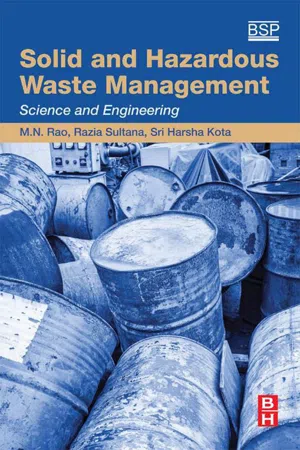
Solid and Hazardous Waste Management
Science and Engineering
- 344 pages
- English
- ePUB (mobile friendly)
- Available on iOS & Android
eBook - ePub
About this book
Solid and Hazardous Waste Management: Science and Engineering presents the latest on the rapid increase in volume and types of solid and hazardous wastes that have resulted from economic growth, urbanization, and industrialization and how they have challenged national and local governments to ensure effective and sustainable management of these waste products.
The book offers universal coverage of the technologies used for the management and disposal of waste products, such as plastic waste, bio-medical wastes, hazardous wastes, and e-wastes.
- Covers both traditional and new technologies for Identifying and categorizing the source and nature of the waste
- Provides methods for the safe disposal of municipal solid wastes, plastic waste, bio-medical wastes, hazardous wastes, and e-wastes
- Presents technologies that can be used for transportation and processing (including resource recovery) of the waste
- Discusses reclamation, reuse, and recovery of energy from MSW
Information
Chapter 1
Introduction
Abstract
Due to rapid development, urbanization, and population growth, problems pertaining to the effective management of solid wastes have escalated to a great extent. There are five distinct facets to the management of solid wastes:
1. identifying and categorizing the source and nature of the waste
2. segregation, storage, and collection of the waste
3. transport of the waste
4. processing (including resource recovery) of the waste
5. ultimate disposal of the waste
In this book, several environmental technologies are presented, covering the following issues:
1. municipal solid waste
2. plastic waste
3. biomedical waste
4. hazardous waste
5. electronic waste
The techniques used to manage wastes, such as volume reduction technologies (mechanical, physical, and chemical), and treatment and disposal of waste technologies (biodegradation, solidification, stabilization, disinfection, destruction, dismantling, etc.), are presented.
Keywords
Solid waste management; treatment technologies; disposal; municipal; plastic; biomedical; hazardous; electronic wastes
Problems associated with the management of solid and hazardous waste in developing countries are diverse and complex. Rapid development, urbanization, and population growth, problems pertaining to the effective management of solid waste, have escalated to a great extent. There are five distinct facets to the management of solid wastes:
1. identifying and categorizing the source and nature of the waste
2. segregation, storage, and collection of the waste
3. transport of the waste
4. processing (including resource recovery) of the waste
5. ultimate disposal of the waste
Until recently disposal was the only technical and economical option that could be taken in the management of these wastes. The technology for resource recovery and recycling was not considered because of its economical impracticability and its low quality for use as raw material in production. However, the time has come when recycling needs to be considered as a strong alternative against disposal for the reasons that the present waste management techniques are not adequate to prevent environmental pollution. Technology development is key to ensure environmental protection and legal compliance. Environmental policy includes the will to use cleaner technologies or best-available technologies. Skills and competences of the labor force have to be sufficiently updated and balanced with technology used. Objectives and targets have to be designed taking into account environmental performance (planned and actual) and technology changes. Operational control and noncompliance management require a periodic assessment and review of the technological means. The auditing process and team shall correspond to the technology development of the organization. Several environmental technologies are presented, covering the following issues:
1. Municipal solid waste
2. Plastic waste
3. Biomedical waste
4. Hazardous waste
5. Electronic waste
Waste management is one of the most important environmental problems of the world. Various different technologies exist to apply to management of the waste that human activities generate. The best option to combat the waste accumulation problems is always a reduction in generation of wastes, then the reuse of wastes, and finally the recycling of wastes. Recent advancement is to recover. Sometimes it is necessary to treat and dispose the wastes.
The techniques used to manage wastes are of three types:
• volume reduction technologies (mechanical, physical, and chemical)
• treatment and disposal of waste technologies (biodegradation, solidification, stabilization, disinfection, destruction, dismantling, etc.)
• ultimate disposal of wastes
Quantification, characterization and categorization, and technologies to manage the above wastes are presented in the following chapters.
Chapter 2
Municipal Solid Waste
Abstract
This chapter covers organizational requirements, quantity, characteristics, and technologies for municipal solid waste management.
Design, layout, selection, and operating methodology of landfills is dealt with in detail. Methods of composting are discussed. Incineration technologies including mass burn, modular combustion unit, refuse-derived fuel (RDF), pyrolysis/gasification, slurry carb process, and plasma pyrolysis/plasma arc processes are presented. The advantages and disadvantages of different technological options are discussed. Tools and equipment required in managing wastes are mentioned. The need for reclamation, reuse, and recovery of energy from municipal solid wastes is emphasized and the processes involved are presented. Socioeconomic considerations of resource recovery are discussed. Rules governing the management are quoted.
Keywords
Municipal solid wastes; characteristics; landfills; incineration; RDF; recovery of resources
2.1 Introduction to Municipal Solid Waste
Municipal solid waste includes commercial and residential wastes generated in a municipal or notified area in either solid or semisolid form excluding industrial hazardous wastes but including treated biomedical wastes.
The amount of municipal solid waste generated in various cities varies from 0.3 to 0.6 kg/capita/day. It has been estimated that there is potential for preparing 8 million tonnes of agricultural manure per year from urban waste in India. At present, less than 25% of the available potential is being exploited. Disposal of urban refuse by composting is a practical solution since it not only takes care of the sanitation problems but also provides a useful agricultural input in the form of soil conditioners as nitrogen, phosphorus, and potassium (NPK) nutrients. Semimechanical plants, where composting is in windrows, is more suitable for Indian conditions. There are several composting plants in different cities, e.g., Hyderabad, Delhi, Mumbai, Ahmedabad, Chandigarh, etc. A great deal of research is being done in the country on the recovery of energy from solid wastes. The costs of garbage and rubbish disposal often exceed 20 percent of the municipal budgets of cities. There is an urgent need to reduce these costs while at the same time extending the levels of services throughout urban areas. This may be accomplished through integrated systems for resource recovery and reuse, in which existing waste disposal and recycling practices are extended and optimized.
There are many impediments to the full adoption of Western technology for a solution to the problems of India:
1. Wastes generated in the developing countries tend to be of low calorific value, high in organic putrescible content and moisture, and are subject to seasonal variations.
2. In the tropical region there are sudden climatic changes, which have to be accounted for in planning solid waste management schemes.
3. Municipal solid waste disposal costs often exceed 20 percent of municipal budgets. Labor and energy absorb the major portion of the operation costs. More than one percent of the national workforce may be employed in these tasks, and in these services absorb up to one percent of the nation’s gross national product (GNP). Thus solid waste management...
Table of contents
- Cover image
- Title page
- Table of Contents
- Copyright
- About the Author
- Preface
- Chapter 1. Introduction
- Chapter 2. Municipal Solid Waste
- Chapter 3. Plastic Waste
- Chapter 4. Biomedical Waste
- Chapter 5. Hazardous Waste
- Chapter 6. Electronic Waste
- Chapter 7. Soil Remediation Technologies
- Chapter 8. Waste Minimization
- Chapter 9. Environment Impact Assessment
- Chapter 10. Landfill Gases
- Bibliography
- Index
Trusted by 375,005 students
Access to over 1.5 million titles for a fair monthly price.
Study more efficiently using our study tools.
Frequently asked questions
Yes, you can cancel anytime from the Subscription tab in your account settings on the Perlego website. Your subscription will stay active until the end of your current billing period. Learn how to cancel your subscription
No, books cannot be downloaded as external files, such as PDFs, for use outside of Perlego. However, you can download books within the Perlego app for offline reading on mobile or tablet. Learn how to download books offline
Perlego offers two plans: Essential and Complete
- Essential is ideal for learners and professionals who enjoy exploring a wide range of subjects. Access the Essential Library with 800,000+ trusted titles and best-sellers across business, personal growth, and the humanities. Includes unlimited reading time and Standard Read Aloud voice.
- Complete: Perfect for advanced learners and researchers needing full, unrestricted access. Unlock 1.5M+ books across hundreds of subjects, including academic and specialized titles. The Complete Plan also includes advanced features like Premium Read Aloud and Research Assistant.
We are an online textbook subscription service, where you can get access to an entire online library for less than the price of a single book per month. With over 1.5 million books across 990+ topics, we’ve got you covered! Learn about our mission
Look out for the read-aloud symbol on your next book to see if you can listen to it. The read-aloud tool reads text aloud for you, highlighting the text as it is being read. You can pause it, speed it up and slow it down. Learn more about Read Aloud
Yes! You can use the Perlego app on both iOS and Android devices to read anytime, anywhere — even offline. Perfect for commutes or when you’re on the go.
Please note we cannot support devices running on iOS 13 and Android 7 or earlier. Learn more about using the app
Please note we cannot support devices running on iOS 13 and Android 7 or earlier. Learn more about using the app
Yes, you can access Solid and Hazardous Waste Management by M.N. Rao,Razia Sultana,Sri Harsha Kota in PDF and/or ePUB format, as well as other popular books in Technology & Engineering & Environmental Management. We have over 1.5 million books available in our catalogue for you to explore.