eBook - ePub
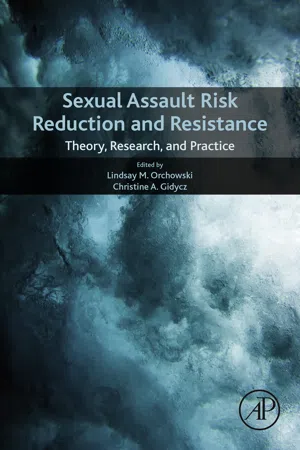
Sexual Assault Risk Reduction and Resistance
Theory, Research, and Practice
- 470 pages
- English
- ePUB (mobile friendly)
- Available on iOS & Android
eBook - ePub
Sexual Assault Risk Reduction and Resistance
Theory, Research, and Practice
About this book
Sexual Assault Risk Reduction and Resistance explores the theory, research, and practice of sexual assault risk reduction, resistance education, and self-defense programs for women and other vulnerable groups, including sexual minorities, individuals with disabilities, and those with histories of victimization. Following an ecosystemic perspective, the book examines individual risk and protective factors for sexual victimization, as well as peer-, family-, community- and societal-level factors that influence risk for sexual violence and inform the content of programs.
This volume brings together leading researchers and practitioners to operationalize sexual assault risk reduction approaches and highlights the rationale and need for risk reduction in the context of other sexual assault prevention efforts. The volume provides an overview of the history of this sexual assault prevention approach and addresses current controversies and questions in the field. The authors outline risk and protective factors for victimization and discuss how these factors guide risk reduction efforts. The volume also outlines the theory and effectiveness of current sexual assault risk reduction and resistance practices and addresses special populations and future directions.
- Reviews theoretical approaches to sexual assault risk reduction
- Summarizes program outcome studies
- Delineates feminist self-defense approaches
- Details what it means for prevention to be "trauma informed"
- Considers how to provide risk reduction without victim-blaming
- Confronts current controversies in the field of sexual assault risk reduction
- Details how prevention can address the role of alcohol in sexual violence
- Discusses international prevention efforts
Information
Section 1
Fundamental Concepts of Sexual Assault Risk Reduction
Chapter 1
Sexual Assault Risk Reduction: Current State and Historical Underpinnings
Christine A. Gidycz Ohio University, Athens, OH, United States
Abstract
This chapter provides a brief overview of the history of women’s programs designed to reduce sexual victimization with an emphasis on evidenced-based programming. Despite accumulating evidence for the effectiveness of women’s programming to reduce sexual assault, there are barriers to its widespread implementation, which are also discussed in the chapter. Finally, suggestions for future work, including the importance of coordinated efforts to reduce sexual assault, are discussed.
Keywords
Sexual victimization; Empowerment self-defense; Women’s sexual assault prevention programs
…sexual assault prevention programming remains a confused, scattered, and sporadic enterprise with little scientific underpinning. McCall (1993, p. 277)
The current state of rape prevention programming adds little to our knowledge about prevention. Schewe and O’Donohue (1993, p. 668)
The above quotes accurately reflect the state of sexual assault prevention programming from almost three decades ago. Programming that either targeted women or included them in prevention efforts was really in its infancy. Consistent with the sentiments of Schewe and O’Donohue (1993) and McCall (1993), efforts to address the victimization of women were not particularly well thought out, nor was their evidence to support their effectiveness. Early efforts to target women were problematic at least partially because a sound empirical and theoretical base that would provide suggestions for program content was lacking. At the same time, our culture was permeated by rape myths that suggested that women were responsible for their own victimization experiences and that if society could change women’s behaviors, rates of victimization would decrease. However, over the past 30 years, although rape myths still permeate our society (e.g., Edwards, Turchik, Dardis, Reynolds, & Gidycz, 2011), there have been significant developments within the field that have created a database to draw upon for evidence-based women’s program content and consequently increasing evidence to support the effectiveness of such efforts.
In this chapter, the author provides a brief overview of the history of programming efforts with women and highlights both significant developments in this area and demonstrated successes. She draws upon some key empirical findings as well as important theoretical developments. The chapter concludes with some suggestions for future work.
Early Programming Issues
There have been a variety of approaches utilized that have targeted women in order to prevent sexual victimization. Traditionally, self-defense courses (many offered by police departments) have been taught, and such courses typically emphasized physical defense primarily against strangers. As discussed in Rozee and Koss (2001), police publications have also traditionally focused on publicizing strategies such as avoiding dark alleys or parking in well-lit places. Rozee and Koss (2001), however, argued that teaching such precautionary measures is not particularly useful because these are strategies that women already engage in to try to prevent stranger assaults and most assaults are, in fact, committed by people who the victims know. Further, as outlined in the chapter by Jocelyn Hollander in this volume, as well as others (e.g., Rozee & Koss, 2001), other efforts to target women were rooted in the feminist movement of the late 1960s and early 1970s. Empowerment self-defense programs were an outgrowth of such efforts, and they possess distinct characteristics including placing violence in a social context as well as a focus on the empowerment of women, rather than in any way trying to restrict their freedom. In such programs, women are also provided with a toolbox to use to respond to a range of aggressive acts, and the blame for assaults is placed on the perpetrators. In fact, explicit efforts are geared toward reducing victim blame.
Furthermore, likely at least partially in response to Koss, Gidycz, and Wisniewski’s (1987) landmark study on college campuses, where high rates of sexual victimization were reported by women as well as high rates of sexual perpetration by men, those working on college campuses also began to design and evaluate prevention programs. Koss et al.’s (1987) study, as well as other subsequent studies, had some key findings that likely influenced the content of subsequent programming. For example, across studies it was found that the vast majority of women who were victimized were assaulted by people who were known to them. Additionally, characteristics of the assaults differed in some important ways from typical stranger assaults; for example, acquaintance assaults were generally less violent, occurred often when the victim, perpetrator, or both were drinking, and multiple victimizations were more the rule than the exception (e.g., Koss, Dinero, & Seibel, 1988; Koss et al., 1987). Such assaults also often occurred in the context of social situations such as parties or at bars and on dates (Abbey, Ross, McDuffie, & McAuslan, 1996). These findings were important for subsequent work on college campuses, which includes both mixed-sex programming and programming specifically targeting women.
Mixed-Sex Audiences
Beginning in the 1990s, there was a proliferation of program evaluation studies that assessed sexual assault prevention programs for mixed-sex audiences (see Orchowski, Gidycz, & Murphy, 2010 for a review). Thus, most typically, facilitators attempted to meet the needs of women through such conjoint programming. Although not necessarily explicitly noted, at least part of the rationale for offering joint programming is that there was a belief that sexual victimization resulted at least in some instances from “sexual miscommunication” and societal double standards for men and women (e.g., Muehlenhard & Hollabaugh, 1988). At the same time, the author believes that researchers and educators simply really did not have a well-thought-out plan for intervention, and thus, such joint programming reflected the “shotgun” approach to prevention that had been discussed by others at the time (Schewe & O’Donohue, 1993). Universities also traditionally have invested limited resources in sexual assault prevention, and such an approach was also more economical. Given that sexual assault research that sought to identify risk factors and correlates of sexual assault was still in its infancy, such disorganized (but at times well-meaning) approaches are also somewhat understandable. In short, such programs were brief, psychoeducational, atheoretical, and generally inconsistent with what we know about the key components of effective prevention (Nation et al., 2003). Given this, it is also not surprising that a number of reviews concluded that such programs were of limited effectiveness in terms of changing attitudes over the long term, and with a few exceptions (Gidycz et al., 2001), researchers did not even attempt to assess whether such programs decreased the rates of victimization or perpetration.
In addition to the empirical evidence suggesting that joint programs were generally ineffective, there were also some philosophical problems about including women in joint programming efforts (Gidycz, Rich, & Marioni, 2002). Such program content had the potential to benefit one sex over the other, was challenging to deliver due to different goals for men and women, and had the potential to be ethically problematic. For example, was it appropriate to teach women skills to reduce a perpetrator’s attack in the presence of potential perpetrators? These challenges, coupled with the general lack of efficacy for joint programming efforts, provided some of the impetus for a renewed focus on women’s programs. At the same time, further impetus for women’s programming was provided by an evolving research and theoretical literature that served to inform the content of such programs.
Women’s Programming Efforts
1990–2000
Although there were studies in the 1970s and 1980s that sought to evaluate programming for women (e.g., White & Nichols, 1981), more rigorous evaluation studies began in the 1990s. Given that the research literature addressing risk factors and correlates of victimization was still somewhat underdeveloped, it is not surprising that early programming efforts were still rather brief and somewhat atheoretical with findings that were inconsistent. For example, Hanson and Gidycz (1993) created a brief, one-hour-long psychoeducational program for women that demonstrated participants in the program without a history of victimization were less likely to be victimized following the program than women in the control group without a history of victimization. However, for those women with a victimization history, the program was ineffective. A follow-up investigation, however, that evaluated a modified version of the program in an attempt to increase its effectiveness for women with histories of victimization found that the program was ineffective in reducing the risk of victimization of women with and without histories of victimization. Following this (as reviewed in more detail in the chapter by Senn, Hollander, & Gidycz), the researchers began to add to the existing psychoeducational programs a feminist self-defense component, and the results were promising across a number of domains. Such programs have most typically been labeled risk reduction programs or sexual assault resistance programs.
2000–Present
As discussed in a number of chapters within this volume (Senn, Hollander, & Gidycz; Hollander; Messman-Moore & McConnell), the research over the past 20 years has provided evidence for the effectiveness of programming for women across various domains. The vast majority of programs where effectiveness has been demonstrated include a feminist or empowerment self-defense program. A number of positive benefits to programming have been documented including increases in (a) feelings of self-efficacy to avoid an assault (e.g., Gidycz et al., 2015; Hollander, 2014; Senn, Gee, & Thake, 2011); (b) the likelihood that women will engage in a range of active resistance tactics (e.g., Hollander, 2014; Orchowski, Gidycz, & Raffle, 2008; Senn et al., 2011); (c) assertive communication (Gidycz et al., 2015; Hollander, 2014); and (d) the use of self-protective strategies (Gidycz et al., 2015; Orchowski et al., 2008). Further, such programming has also been found to decrease feelings of self-blame in those who are victimized following the program (e.g., Gidycz et al., 2015) and rates of sexual victimization (e.g., Hollander, 2014; Orchowski et al., 2008; Senn et al., 2015).
It is thus clear that over a relatively brief period of time, researchers who have been involved in women’s programming have helped to bring order to the state of confusion that was described about the prevention area by McCall (1993) 25 years ago. In short, the field has witnessed the development of programming for women that is based on sound empirical research and theoretical developments. Some key work that laid the foundation for the programming successes that have been found include the theoretical work by Nurius and Norris (1996). Their cognitive ecological model of women’s resistance to male aggression (described more fully in the chapter by Norris, Zawacki, Davis, and George) provided key theorizing that led developers of women’s programming to really address the unique needs of the vast majority of women who are assaulted by acquaintances. This model highlights the psychological barriers to resistance that a woman encounters when faced with a potential a...
Table of contents
- Cover image
- Title page
- Table of Contents
- Copyright
- Dedication
- Contributors
- Acknowledgments
- Introduction
- Section 1: Fundamental Concepts of Sexual Assault Risk Reduction
- Section 2: Risk and Protective Factors for Victimization
- Section 3: Theory and Research of Effective Risk Reduction and Resistance Programs
- Section 4: Special Topics
- Index
Trusted by 375,005 students
Access to over 1.5 million titles for a fair monthly price.
Study more efficiently using our study tools.
Frequently asked questions
Yes, you can cancel anytime from the Subscription tab in your account settings on the Perlego website. Your subscription will stay active until the end of your current billing period. Learn how to cancel your subscription
No, books cannot be downloaded as external files, such as PDFs, for use outside of Perlego. However, you can download books within the Perlego app for offline reading on mobile or tablet. Learn how to download books offline
Perlego offers two plans: Essential and Complete
- Essential is ideal for learners and professionals who enjoy exploring a wide range of subjects. Access the Essential Library with 800,000+ trusted titles and best-sellers across business, personal growth, and the humanities. Includes unlimited reading time and Standard Read Aloud voice.
- Complete: Perfect for advanced learners and researchers needing full, unrestricted access. Unlock 1.5M+ books across hundreds of subjects, including academic and specialized titles. The Complete Plan also includes advanced features like Premium Read Aloud and Research Assistant.
We are an online textbook subscription service, where you can get access to an entire online library for less than the price of a single book per month. With over 1.5 million books across 990+ topics, we’ve got you covered! Learn about our mission
Look out for the read-aloud symbol on your next book to see if you can listen to it. The read-aloud tool reads text aloud for you, highlighting the text as it is being read. You can pause it, speed it up and slow it down. Learn more about Read Aloud
Yes! You can use the Perlego app on both iOS and Android devices to read anytime, anywhere — even offline. Perfect for commutes or when you’re on the go.
Please note we cannot support devices running on iOS 13 and Android 7 or earlier. Learn more about using the app
Please note we cannot support devices running on iOS 13 and Android 7 or earlier. Learn more about using the app
Yes, you can access Sexual Assault Risk Reduction and Resistance by Lindsay M. Orchowski,Christine Gidycz in PDF and/or ePUB format, as well as other popular books in Psychology & Social Psychology. We have over 1.5 million books available in our catalogue for you to explore.