- 336 pages
- English
- ePUB (mobile friendly)
- Available on iOS & Android
eBook - ePub
About this book
This important book provides a guide to the fundamentals and latest developments in smart technology for textiles and clothing. The contributors represent a distinguished international panel of experts and the book covers many aspects of cutting edge research and development.Smart fibres, fabrics and clothing starts with a review of the background to smart technology and goes on to cover a wide range of the material science and fibre science aspects of the technology including: Electrically active polymeric materials and the applications of nonionic polymer gel and elastomers for artificial muscles; Thermally sensitive fibres and fabrics; Cross-linked polyol fibrous substrates stimuli-responsive interpenetrating polymer network hydrogel; Permeation control through stimuli-responsive polymer membranes; optical fibre sensors, hollow fibre membranes for gas separation; integrating fibre-formed components into textile structures; Wearable electronic and photonic technologies; Adaptive and responsive textile structures (ARTS); Biomedical applications including the applications of scaffolds in tissue engineeringIt is essential reading for academics in textile and materials science departments, researchers, designers and engineers in the textiles and clothing product design field. Product managers and senior executives within textile and clothing manufacturing will also find the latest insights into technological developments in the field valuable and fascinating.
Information
1
Smart technology for textiles and clothing – introduction and overview
Xiaoming Tao
1.1 Introduction
Since the nineteenth century, revolutionary changes have been occurring at an unprecedented rate in many fields of science and technology, which have profound impacts on every human being. Inventions of electronic chips, computers, the Internet, the discovery and complete mapping of the human genome, and many more, have transformed the entire world. The last century also brought tremendous advances in the textile and clothing industry, which has a history of many thousands of years. Solid foundations of scientific understanding have been laid to guide the improved usage and processing technology of natural fibres and the manufacturing of synthetic fibres. We have learnt a lot from nature. Viscose rayon, nylon, polyester and other synthetic fibres were invented initially for the sake of mimicking their natural counterparts. The technology has progressed so that synthetic fibres and their products surpass them in many aspects. Biological routes for synthesizing polymers or textile processing represent an environmentally friendly, sustainable way of utilizing natural resources. Design and processing with the aid of computers, automation with remote centralized or distributed control, and Internet-based integrated supply-chain management systems bring customers closer to the very beginning of the chain than ever before.
Looking ahead, the future promises even more. What new capacities should we expect as results of future developments? They should at least include terascale, nanoscale, complexity, cognition and holism. The new capability of terascale takes us three orders of magnitude beyond the present general-purpose and generally accessible computing capabilities. In a very short time, we will be connecting millions of systems and billions of information appliances to the Internet. Technologies allowing over one trillion operations per second are on the agenda for research. The technology in nanoscales will take us three orders of magnitude below the size of most of today’s human-made devices. It will allow us to arrange atoms and molecules inexpensively in most of the ways permitted by physical laws. It will let us make supercomputers that fit on the head of a fibre, and fleets of medical nanorobots smaller than a human cell to eliminate cancers, infections, clogged arteries and even old age. Molecular manufacturing will make exactly what it is supposed to make, and no pollutants will be produced.
We are living in this exciting era and feeling the great impacts of technology on the traditional textiles and clothing industry, which has such a long history. Traditionally, many fields of science and engineering have been separate and distinct. Recently, there has been considerable movement and convergence between these fields of endeavour and the results have been astonishing. Smart technology for materials and structures is one of these results.
What are smart materials and structures? Nature provides many examples of smart structures. The simple single-celled living creature may highlight the fundamentals. As shown in Fig. 1.1, various environmental conditions or stimuli act on the outer layer. These conditions or stimuli may be in the form of force, temperature, radiation, chemical reactions, electric and magnetic fields. Sensors in the outer layer detect these effects, and the resulting information is conveyed for signal processing and interpretation, at which point the cell reacts to these environmental conditions or stimuli in a number of ways, such as movement, changing chemical composition and reproductive actions. Nature has had billions of years and a vast laboratory to develop life, whereas humankind has just begun to create smart materials and structures.
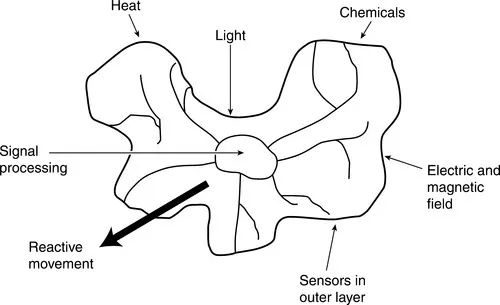
1.1 A single cell living creature is an example of smart structures.
Smart materials and structures can be defined as the materials and structures that sense and react to environmental conditions or stimuli, such as those from mechanical, thermal, chemical, electrical, magnetic or other sources. According to the manner of reaction, they can be divided into passive smart, active smart and very smart materials. Passive smart materials can only sense the environmental conditions or stimuli; active smart materials will sense and react to the conditions or stimuli; very smart materials can sense, react and adapt themselves accordingly. An even higher level of intelligence can be achieved from those intelligent materials and structures capable of responding or activated to perform a function in a manual or pre-programmed manner.
Three components may be present in such materials: sensors, actuators and controlling units. The sensors provide a nerve system to detect signals, thus in a passive smart material, the existence of sensors is essential. The actuators act upon the detected signal either directly or from a central control unit; together with the sensors, they are the essential element for active smart materials. At even higher levels, like very smart or intelligent materials, another kind of unit is essential, which works like the brain, with cognition, reasoning and activating capacities. Such textile materials and structures are becoming possible as the result of a successful marriage of traditional textiles/cl...
Table of contents
- Cover image
- Title page
- Table of Contents
- Copyright page
- Foreword
- Contributors
- Acknowledgements
- 1: Smart technology for textiles and clothing – introduction and overview
- 2: Electrically active polymer materials – application of non-ionic polymer gel and elastomers for artificial muscles
- 3: Heat-storage and thermo-regulated textiles and clothing
- 4: Thermally sensitive materials
- 5: Cross-linked polyol fibrous substrates as multifunctional and multi-use intelligent materials
- 6: Stimuli-responsive interpenetrating polymer network hydrogels composed of poly(vinyl alcohol) and poly(acrylic acid)
- 7: Permeation control through stimuli-responsive polymer membrane prepared by plasma and radiation grafting techniques
- 8: Mechanical properties of fibre Bragg gratings
- 9: Optical responses of FBG sensors under deformations
- 10: Smart textile composites integrated with fibre optic sensors
- 11: Hollow fibre membranes for gas separation
- 12: Embroidery and smart textiles
- 13: Adaptive and responsive textile structures (ARTS)
- 14: Wearable technology for snow clothing
- 15: Bioprocessing for smart textiles and clothing
- 16: Tailor-made intelligent polymers for biomedical applications
- 17: Textile scaffolds in tissue engineering
- Index
Trusted by 375,005 students
Access to over 1.5 million titles for a fair monthly price.
Study more efficiently using our study tools.
Frequently asked questions
Yes, you can cancel anytime from the Subscription tab in your account settings on the Perlego website. Your subscription will stay active until the end of your current billing period. Learn how to cancel your subscription
No, books cannot be downloaded as external files, such as PDFs, for use outside of Perlego. However, you can download books within the Perlego app for offline reading on mobile or tablet. Learn how to download books offline
Perlego offers two plans: Essential and Complete
- Essential is ideal for learners and professionals who enjoy exploring a wide range of subjects. Access the Essential Library with 800,000+ trusted titles and best-sellers across business, personal growth, and the humanities. Includes unlimited reading time and Standard Read Aloud voice.
- Complete: Perfect for advanced learners and researchers needing full, unrestricted access. Unlock 1.5M+ books across hundreds of subjects, including academic and specialized titles. The Complete Plan also includes advanced features like Premium Read Aloud and Research Assistant.
We are an online textbook subscription service, where you can get access to an entire online library for less than the price of a single book per month. With over 1.5 million books across 990+ topics, we’ve got you covered! Learn about our mission
Look out for the read-aloud symbol on your next book to see if you can listen to it. The read-aloud tool reads text aloud for you, highlighting the text as it is being read. You can pause it, speed it up and slow it down. Learn more about Read Aloud
Yes! You can use the Perlego app on both iOS and Android devices to read anytime, anywhere — even offline. Perfect for commutes or when you’re on the go.
Please note we cannot support devices running on iOS 13 and Android 7 or earlier. Learn more about using the app
Please note we cannot support devices running on iOS 13 and Android 7 or earlier. Learn more about using the app
Yes, you can access Smart Fibres, Fabrics and Clothing by Xiaoming Tao in PDF and/or ePUB format, as well as other popular books in Technology & Engineering & Industrial Engineering. We have over 1.5 million books available in our catalogue for you to explore.