- 650 pages
- English
- ePUB (mobile friendly)
- Available on iOS & Android
eBook - ePub
Asphalt Materials Science and Technology
About this book
Asphalt is a complex but popular civil engineering material. Design engineers must understand these complexities in order to optimize its use. Whether or not it is used to pave a busy highway, waterproof a rooftop or smooth out an airport runway, Asphalt Materials Science and Technology acquaints engineers with the issues and technologies surrounding the proper selection and uses of asphalts. With this book in hand, researchers and engineering will find a valuable guide to the production, use and environmental aspect of asphalt.
- Covers the Nomenclature and Terminology for Asphalt including: Performance Graded (PG) Binders, Asphalt Cement (AC), Asphalt-Rubber (A-R) Binder, Asphalt Emulsion and Cutback Asphalt
- Includes Material Selection Considerations, Testing, and applications
- Biodegradation of Asphalt and environmental aspects of asphalt use
Information
Part I
Asphalt Science
Outline
Chapter 1
Nomenclature and Terminology
Abstract
The term asphalt is a term that had been maligned and used loosely to describe a variety of naturally occurring and manufactured substances. In fact, there have been many terms that have been used historically to describe asphalt or bitumen and while there have been valiant attempts to define bitumen and asphalt, confusion still exists because of the lack of understanding of the nature of the origin and/or the production of the various materials.
It is the purpose of this chapter to bring common sense to the confusion by offering explanations of definitions that are in keeping with the origin and nature of the various types of bitumen, asphalt, tar, and pitch. For the purposes of this text, the term asphalt is used to describe the refinery product and the term bitumen is used to describe the naturally occurring substance.
Keywords
Asphalt cement; asphalt concrete; asphalt emulsion; cold mix asphalt concrete; cutback asphalt; hot mix asphalt concrete; oxidized asphalt; penetration-grade asphalt; refinery asphalt; bitumen; asphaltite; asphaltoid; pyrobitumen; wax; tar; pitch; aggregate
1.1 Introduction
In the modern sense of the word, asphalt is a derivative of petroleum and was first used more than 5000 years ago when it was recognized that the higher boiling (non-volatile under the conditions of use) derivatives of petroleum (asphalt) could be used for caulking, water proofing, adhesives for jewelry, and as a mastic for construction purposes. There is also documented use of asphalt for medicinal purposes or for punishment—it is recorded in the Code of Hammurabi a miscreant could be punished by having hot bitumen (sometimes called natural asphalt) from one of the nearby seepages poured over his (or her) head. Approximately 2000 years ago, Arabian scientists developed methods for the distillation of petroleum that were introduced into Europe by way of Spain. Interest in petroleum was also documented in China, where petroleum was encountered when drilling for salt, and appears in documents of the third century AD. The Baku region of northern Persia was also reported (by Marco Polo in 1271–1273) to have a commercial petroleum industry. Of course, it must be realized that there may be vast differences between commercial operations in the thirteenth century and commercial operations in the twentieth century!
Interest in petroleum continued up to modern times with an increasing interest in nafta (naphtha) when it was discovered that this material could be used as an illuminant and as a supplement to asphalt incendiaries in warfare. The nafta of that time was obtained from shallow wells or by the destructive distillation of asphalt. This may perhaps be equated to modern-day coking operations (Speight, 2014), in which the overall objective of the process is to convert the non-volatile residua into liquid fuels. The modern oil industry began in 1859 with the discovery and subsequent commercialization of petroleum in Pennsylvania (Bell, 1945). It is from this time that the modern petroleum industry evolved into its present form and the use of asphalt expanded phenomenally.
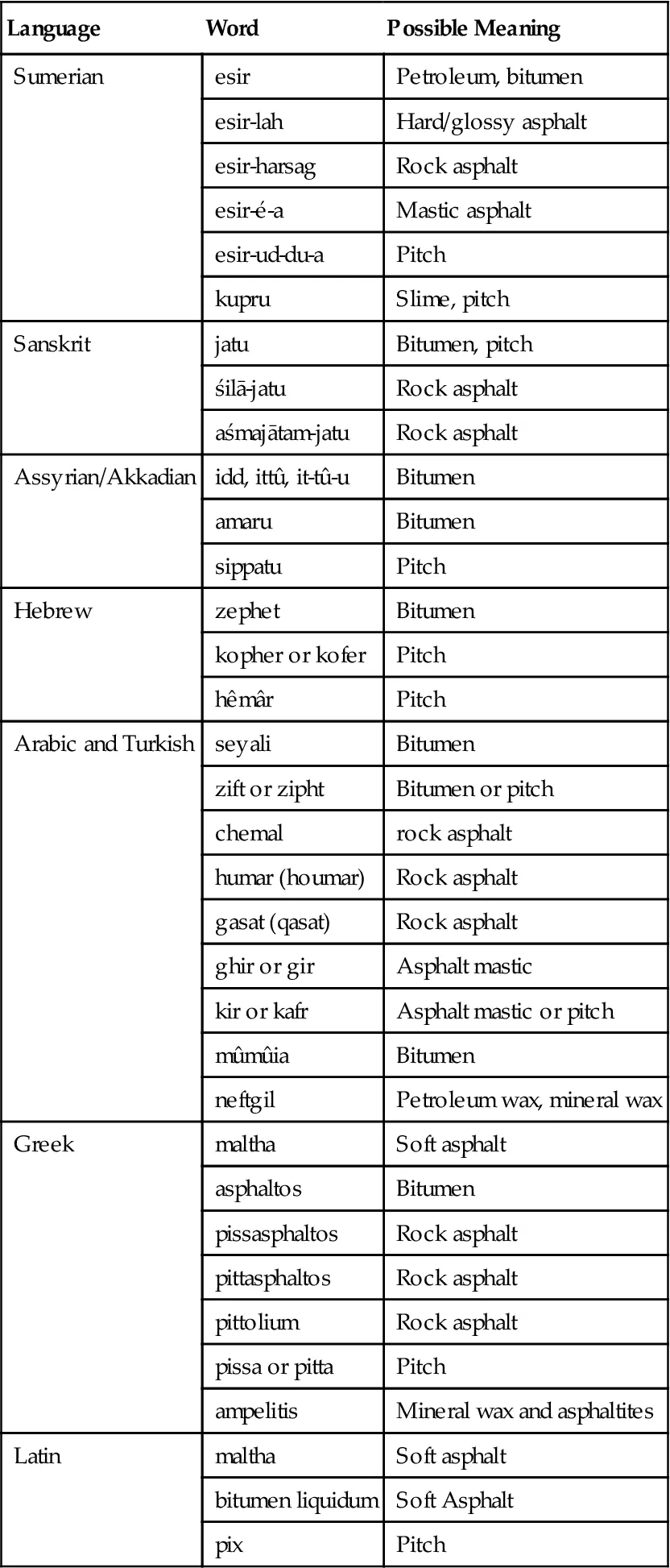
Asphalt is the product of a refinery operation whereby a residuum is treated by air blowing or by a solvent method to produce a product that meets specifications for a variety of road/highway construction and other uses. However, the term asphalt is a term that had been maligned and used loosely to describe a variety of naturally occurring and manufactured substances or in some cases the end product of refining that was considered to be of limited use. In some cases, coal tar was mixed with asphalt for waterproofing and road paving purposes, which was also a means of removing coal tar and converting it into a product of commercial importance. However, there have been many terms (some favorable, some unfavorable) that have been used historically to describe asphalt or bitumen (Table 1.1) and while there have been valiant attempts to define bitumen and asphalt (Abraham, 1945; Barth, 1962; Zakar, 1971; Speight, 1992, 2014), confusion still exists because of the lack of understanding of the nature of the origin and/or the production of the various materials. It is the purpose of this chapter to bring common sense to the confusion by offering explanations of definitions that are in keeping with the origin and nature of the various types of bitumen, asphalt, tar, and pitch. For the purposes of this text, the term asphalt is used to describe the refinery product and the term bitumen is used to describe the naturally occurring material.
Table 1.1
Linguistic Origins of Words Related to the Various Aspects of Petroleum Science and Technology
| Language | Word | Possible Meaning |
| Sumerian | esir | Petroleum, bitumen |
| esir-lah | Hard/glossy asphalt | |
| esir-harsag | Rock asphalt | |
| esir-é-a | Mastic asphalt | |
| esir-ud-du-a | Pitch | |
| kupru | Slime, pitch | |
| Sanskrit | jatu | Bitumen, pitch |
| śilā-jatu | Rock asphalt | |
| aśmajātam-jatu | Rock asphalt | |
| Assyrian/Akkadian | idd, ittû, it-tû-u | Bitumen |
| amaru | Bitumen | |
| sippatu | Pitch | |
| Hebrew | zephet | Bitumen |
| kopher or kofer | Pitch | |
| hêmâr | Pitch | |
| Arabic and Turkish | seyali | Bitumen |
| zift or zipht | Bitumen or pitch | |
| chemal | rock asphalt | |
| humar (houmar) | Rock asphalt | |
| gasat (qasat) | Rock asphalt | |
| ghir or gir | Asphalt mastic | |
| kir or kafr | Asphalt mastic or pitch | |
| mûmûia | Bitumen | |
| neftgil | Petroleum wax, mineral wax | |
| Greek | maltha | Soft asphalt |
| asphaltos | Bitumen | |
| pissasphaltos | Rock asphalt | |
| pittasphaltos | Rock asphalt | |
| pittolium | Rock asphalt | |
| pissa or pitta | Pitch | |
| ampelitis | Mineral wax and asphaltites | |
| Latin | maltha | Soft asphalt |
| bitumen liquidum | Soft Asphalt | |
| pix | Pitch |
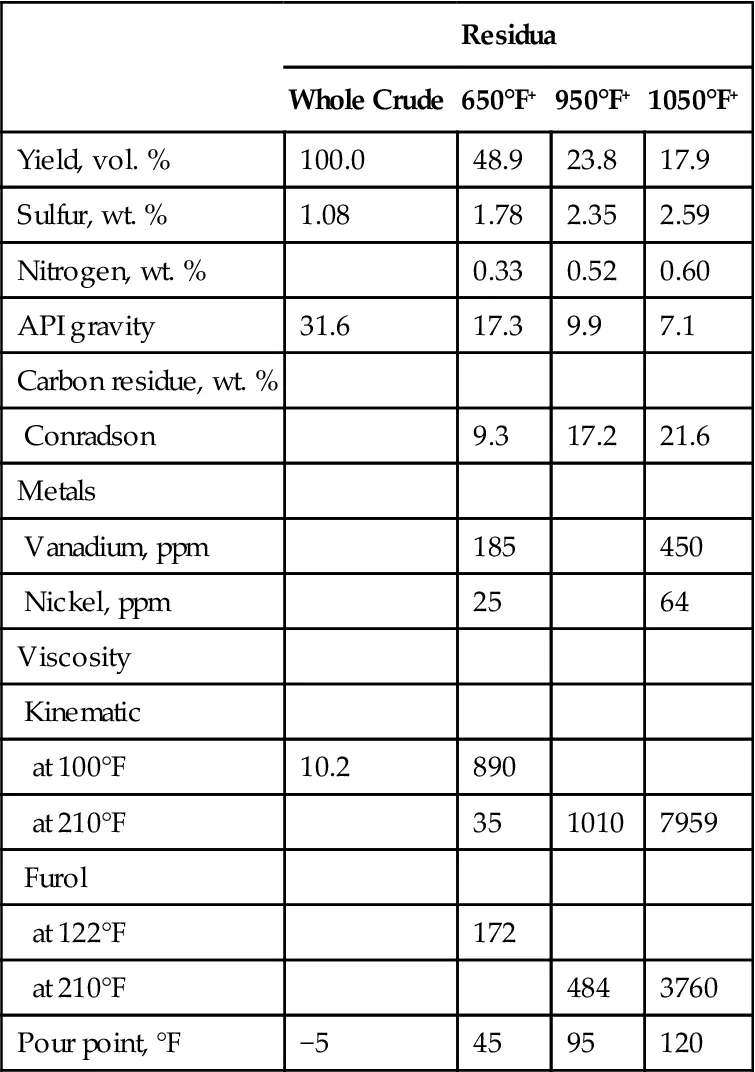
Asphalt production from crude petroleum as a product of refineries in the early twentieth century and the increasing popularity of the automobile served to greatly expand the asphalt industry. Typically, asphalt is produced from a petroleum residuum. A residuum or resid (pl. residua, resids) is the non-distillable fraction of petroleum (Table 1.2) (Speight, 2014). Distillation temperatures are ordinarily limited to temperatures below the onset of thermal degradation (<350°C, <660°F) but it is possible to recover gas oils with true boiling points up to 565°C (1050°F) by vacuum distillation but maintaining the actual distillation temperature below the limits given above. The shifting product demand to lighter products coupled with the influx of heavy oil (which has high proportions of residua) into refineries has caused attention to be focused on the conversion of residua to distillate products. In the past, residua were used primarily as industrial fuels or asphalt precursors (Speight, 2011, 2014).
Table 1.2
Properties of Tia Juana Crude Oil and the 650°F, 950°F, and 1050°F Residua
| Residua | ||||
| Whole Crude | 650°F+ | 950°F+ | 1050°F+ | |
| Yield, vol. % | 100.0 | 48.9 | 23.8 | 17.9 |
| Sulfur, wt. % | 1.08 | 1.78 | 2.35 | 2.59 |
| Nitrogen, wt. % | 0.33 | 0.52 | 0.60 | |
| API gravity | 31.6 | 17.3 | 9.9 | 7.1 |
| Carbon residue, wt. % | ||||
| Conradson | 9.3 | 17.2 | 21.6 | |
| Metals | ||||
| Vanadium, ppm | 185 | 450 | ||
| Nickel, ppm | 25 | 64 | ||
| Viscosity | ||||
| Kinematic | ||||
| at 100°F | 10.2 | 890 | ||
| at 210°F | 35 | 1010 | 7959 | |
| Furol | ||||
| at 122°F | 172 | |||
| at 210°F | 484 | 3760 | ||
| Pour point, °F | −5 | 45 | 95 | 120 |
Asphalt may be residual (straight-run) asphalt, which is made up of the non-volatile hydrocarbons in the feedstock, along with similar materials produced by thermal alteration during the distillation sequences, or they may be produced by air blowing residua. Alternatively, asphalt may be the residuum from a vacuum distillation unit. In either case, the properties of the asphalt are, essentially, the properties of the residuum (Speight and Ozum, 2002; Parkash, 2003; Hsu and Robinson, 2006; Gary et al., 2007; Speight, 2014). If the properties are not suitable for the asphalt product to meet specifications, changing the properties by, for example, blowing is necessary.
With the development of gasoline-powered and diesel-powered engines there arose a need for better roadways—the wagon and stagecoach tracks of pervious eras were totally unsuitable for vehicular travel. As a result of the need for better roadways, the fundamentals of a good roadway design evolved and the requirements were (i) proper design and (ii) proper construction so that the roadway would remain in good usable condition for several years with only minimal maintenance. In addition, as the twentieth century evolved, the roadway had to be suitable for traffic loads under all weather conditions for a specified design life and so the achievements of the early roadway design and construction led to more reliable roadways and, hence, more comfortable means of transportation.
This was achieved by: (i) choice of a suitable asphalt binder, (ii) choice of a suitable mineral aggregate, (iii) stabilizing and strengthening of the sub-grade to provide a stable base and sub-base layers above the subgrade, (iv) providing adequate water drainage, because water can weaken soils and asphalt pavements, and (v) construction of a roadway surface and structure that has sufficient depth to structurally carry all expected traffic loads for a period of time. In addition, the full strength and prevention of water penetration into the pavement and its base must also be assured. Finally, the roadway surface (the wearing course) must resist wear, deformation, and weather, and remain skid-resistant.
In relation to asphalt, the definitions of petroleum and associated mate...
Table of contents
- Cover image
- Title page
- Table of Contents
- Copyright
- Preface
- Conversion Factors
- Part I: Asphalt Science
- Part II: Asphalt Technology
- Appendix 1. ASTM International Paving Standards and Road Standards
- Appendix 2. List of ASTM International and AASHTO Test Methods Related to Asphalt Testing (Listed by Subject)
- Glossary
- Index
Trusted by 375,005 students
Access to over 1.5 million titles for a fair monthly price.
Study more efficiently using our study tools.
Frequently asked questions
Yes, you can cancel anytime from the Subscription tab in your account settings on the Perlego website. Your subscription will stay active until the end of your current billing period. Learn how to cancel your subscription
No, books cannot be downloaded as external files, such as PDFs, for use outside of Perlego. However, you can download books within the Perlego app for offline reading on mobile or tablet. Learn how to download books offline
Perlego offers two plans: Essential and Complete
- Essential is ideal for learners and professionals who enjoy exploring a wide range of subjects. Access the Essential Library with 800,000+ trusted titles and best-sellers across business, personal growth, and the humanities. Includes unlimited reading time and Standard Read Aloud voice.
- Complete: Perfect for advanced learners and researchers needing full, unrestricted access. Unlock 1.5M+ books across hundreds of subjects, including academic and specialized titles. The Complete Plan also includes advanced features like Premium Read Aloud and Research Assistant.
We are an online textbook subscription service, where you can get access to an entire online library for less than the price of a single book per month. With over 1.5 million books across 990+ topics, we’ve got you covered! Learn about our mission
Look out for the read-aloud symbol on your next book to see if you can listen to it. The read-aloud tool reads text aloud for you, highlighting the text as it is being read. You can pause it, speed it up and slow it down. Learn more about Read Aloud
Yes! You can use the Perlego app on both iOS and Android devices to read anytime, anywhere — even offline. Perfect for commutes or when you’re on the go.
Please note we cannot support devices running on iOS 13 and Android 7 or earlier. Learn more about using the app
Please note we cannot support devices running on iOS 13 and Android 7 or earlier. Learn more about using the app
Yes, you can access Asphalt Materials Science and Technology by James G. Speight in PDF and/or ePUB format, as well as other popular books in Technology & Engineering & Civil Engineering. We have over 1.5 million books available in our catalogue for you to explore.