- 410 pages
- English
- ePUB (mobile friendly)
- Available on iOS & Android
eBook - ePub
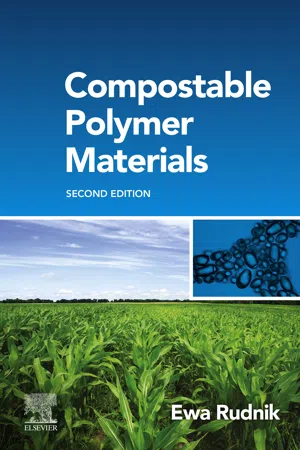
Compostable Polymer Materials
About this book
Compostable Polymer Materials, Second Edition, deals with the environmentally important family of polymers designed to be disposed of in industrial and municipal compost facilities after their useful life. These compostable plastics undergo degradation and leave no visible, distinguishable, or toxic residue. Environmental concerns and legislative measures taken in different regions of the world make composting an increasingly attractive route for the disposal of redundant polymers.This book covers the entire spectrum of preparation, degradation, and evironmental issues related to compostable polymers. It emphasizes recent studies concerning compostability and ecotoxilogical assessment of polymer materials. It descibes the thermal behavior, including flammability properties, of compostable polymers. It also explores possible routes of compostable polymers waste disposal through an ecological lens. Finally, the book examines the economic factors at work, including price evolution over the past decade, the current market, and future perspectives. Compostable Polymer Materials is an essential resource for graduate students and scientists working in chemistry, materials science, ecology, and environmental science.
- Provides a comprehensive study of the composting process
- Details methods of compostable polymers preparation, including properties, processing and applications
- Presents the state-of-the-art knowledge on ecotoxicity testing and biodegradation under real composting conditions of compostable polymers, as well as biodegradation in various environments, such as marine environments and anaerobic conditions
- Discusses the evolution of waste management in Europe and the United States, as well as the status of MSW disposal and treatment methods in countries such as China and Brazil
- Overviews biodegradation studies under real composting conditions of products made of compostable polymers, e.g. bags, bottles, cutletry
- Analyzes evolution of market development, including price of compostable polymers during the last decade
Trusted by 375,005 students
Access to over 1.5 million titles for a fair monthly price.
Study more efficiently using our study tools.
Information
Chapter 1
Introduction
Abstract
The rise in the rate of plastics production over the last decades has aroused environmental concerns. The trends in management of municipal solid waste (MSW) generation in different regions of the world were summarized. The status of MSW disposal/treatment methods, including composting was reviewed in different countries. Data on the generation and disposal of waste in Europe (in the reference period 1995–2016) and United States (in the reference period 1960–2012) were reported. The Waste Management Hierarchy, most preferably approach taken, includes waste prevention, re-use, recycling and other recovery (e.g. energy recovery). Landfilling is regarded as the least desirable option. Composting as organic recycling is attractive alternative for reducing plastics waste, especially suitable for those segments of conventional plastics in which recycling is difficult or economically non feasible.
Keywords
Municipal solid waste; Recycling; Composting; Statistics; Compostable polymers
Polymer materials with a range of excellent properties like mechanical properties, low density, durability and low cost, have been widely used in the daily needs of contemporary society from simple packaging to heavy construction, playing important role in the improvement and quality of life. However, due to their persistence in the environment, polymer materials present the danger to our ecosystems.
With continuous growth for more than 50 years, global production of plastics in 2016 rose to 335 million tonnes – a 4% increase compared to 2015 [1]. However, this increased use of plastics is accompanied by a rapid accumulation of solid waste and plastics litter, which, due to their resistance to biodegradation, have a deleterious effect on the environment as an obvious contributor to pollution.
The world-wide increase in plastics waste has involved, within the global vision of environmental protection and sustainability, a great deal of actions and strategies aimed at minimizing the negative impact of the increasing production and consumption of polymer materials.
In general, waste strategies taken in different regions in the world are similar and are based on the prevention and recycling of waste. For example, Japan has extensive legislation related to waste and other sustainable production and consumption policies under the ‘3R-reducing, re-using and recycling’ umbrella.
The strategy of the EU to cope with waste is to:
- • prevent waste in the first place;
- • recycle waste;
- • optimize the final disposal of waste.
In response to the growing challenges of waste production and management, the European Parliament and the Council have adopted a certain number of Directives to ensure that waste is recovered or disposed of without impairing the environment and human health.
According to European Directive on packaging and packaging waste [2] the management of packaging and packaging waste should include at first priority, prevention of packaging waste and, as additional fundamental principles, reuse of packaging, recycling and others forms of recovering packaging waste and, hence, reduction of the final disposal of such waste (Fig. 1.1).
Prevention means the reduction of the quantity and of the harmfulness for the environment of:
- • materials and substances contained in packaging and packaging waste,
- • packaging and packaging waste at production process level and at marketing, distribution, utilization and elimination stages, in particular by developing ‘clean’ productions and technology.
Reuse is defined as any operation by which packaging, which has been conceived and designed to accomplish within its life cycle a minimum number of trips or rotations, is refilled or used for the same purpose for which it was conceived, with or without the support of the auxiliary products present on the market enabling the packaging to be refilled.
Recovery includes operations provided for in Annex II. B to Directive 75/442/EEC on waste [3], e.g. use as a fuel or other means to generate energy, recycling/reclamation of organic substances which are not used as solvents (including composting and other biological transformation processes).
Energy recovery means the use of combustible packaging waste as a means to generate energy through direct incineration with or without other waste but with recovery of the heat.
Recycling is defined as the reprocessing in a production process of the waste materials for the original purpose or for other purposes including organic recycling but excluding energy recovery.
Disposal operations include deposit into or onto land (e.g. landfilling), incineration etc.

The use of compostable plastics is one of valuable recovery option (biological or organic recycling). According to EU Directive on Packaging and Packaging waste [2] organic recycling means the aerobic (composting) or anaerobic (biomethanization) treatment, under controlled conditions and using micro-organisms, of the biodegradable parts of packaging waste, which produces stabilized organic residues or methane. Landfill is not considered as a form of organic recycling.
The Waste Management Hierarchy, i.e. minimization, recovery and transformation, and land disposal have been adopted by most developed countries with strategies used depending on such factors like population density, transportation infrastructure, socioeconomic and environmental regulations.
1.1. Situation in Europe
Current EU waste policy is based on a concept known as the waste hierarchy. This means that, ideally, waste should be prevented and what cannot be prevented should be re-used, recycled and recovered as much as feasible, with landfill being used as little as possible. The long-term goal is for the EU to become a recycling society.
Despite the intensive efforts of some countries to reduce the amounts of waste, the quantity of solid waste is significantly increasing within the European Union.
In Europe (EU-27), nearly 300 million tonnes of municipal solid waste are generated yearly, which corresponds to over 500 kg per capita per year (2012 data) [4]. On average, in 2012, almost 40% of MSW was landfilled, while material recycling (including composting) and incineration with energy recovery counted for about 40% and 20%, respectively.
From 1995 to 2003 municipal waste generation in the European Union (EU 25) has constantly grown by about 2% per year from 204 million tonnes (457 kg/person) in 1995 to 243 million tonnes (534 kg/person) in 2003 [5].
Between 2000 and 2009 municipal waste treatment in the EU changed significantly. By 2009, 38.2% of municipal waste was placed in landfills, compared with 57.6% in 2000 [6]. This 4.5% annual reduction from 2000 to 2009 supports the objectives of the EU directive on the landfill of waste. During the same period, the amount of municipal waste incinerated, recycled or composted increased substantially. Incineration rose from 16% in 2000 to over 20% in 2009, representing an average annual growth of 2.8%. Similarly, recycling rose by an average of 4.7% per year from about 16% in 2000 to over 23% in 2009. Composting showed the biggest average increase of 5.5% per yea...
Table of contents
- Cover image
- Title page
- Table of Contents
- Copyright
- Preface
- Chapter 1. Introduction
- Chapter 2. Compostable polymer materials – definitions, structures and methods of preparation
- Chapter 3. Properties and applications
- Chapter 4. Thermal and thermooxidative degradation
- Chapter 5. Composting methods and legislation
- Chapter 6. Biodegradability testing of compostable polymer materials under laboratory conditions
- Chapter 7. Biodegradation of compostable polymer materials under real conditions
- Chapter 8. Biodegradation of compostable polymers in various environments
- Chapter 9. Ecotoxicological assessment of compostable polymer materials
- Chapter 10. Environmental impact of compostable polymer materials
- Chapter 11. Waste treatment of bio-based compostable polymers
- Chapter 12. Perspectives
- Index
Frequently asked questions
Yes, you can cancel anytime from the Subscription tab in your account settings on the Perlego website. Your subscription will stay active until the end of your current billing period. Learn how to cancel your subscription
No, books cannot be downloaded as external files, such as PDFs, for use outside of Perlego. However, you can download books within the Perlego app for offline reading on mobile or tablet. Learn how to download books offline
Perlego offers two plans: Essential and Complete
- Essential is ideal for learners and professionals who enjoy exploring a wide range of subjects. Access the Essential Library with 800,000+ trusted titles and best-sellers across business, personal growth, and the humanities. Includes unlimited reading time and Standard Read Aloud voice.
- Complete: Perfect for advanced learners and researchers needing full, unrestricted access. Unlock 1.5M+ books across hundreds of subjects, including academic and specialized titles. The Complete Plan also includes advanced features like Premium Read Aloud and Research Assistant.
We are an online textbook subscription service, where you can get access to an entire online library for less than the price of a single book per month. With over 1.5 million books across 990+ topics, we’ve got you covered! Learn about our mission
Look out for the read-aloud symbol on your next book to see if you can listen to it. The read-aloud tool reads text aloud for you, highlighting the text as it is being read. You can pause it, speed it up and slow it down. Learn more about Read Aloud
Yes! You can use the Perlego app on both iOS and Android devices to read anytime, anywhere — even offline. Perfect for commutes or when you’re on the go.
Please note we cannot support devices running on iOS 13 and Android 7 or earlier. Learn more about using the app
Please note we cannot support devices running on iOS 13 and Android 7 or earlier. Learn more about using the app
Yes, you can access Compostable Polymer Materials by Ewa Rudnik in PDF and/or ePUB format, as well as other popular books in Technology & Engineering & Materials Science. We have over 1.5 million books available in our catalogue for you to explore.