- 312 pages
- English
- ePUB (mobile friendly)
- Available on iOS & Android
eBook - ePub
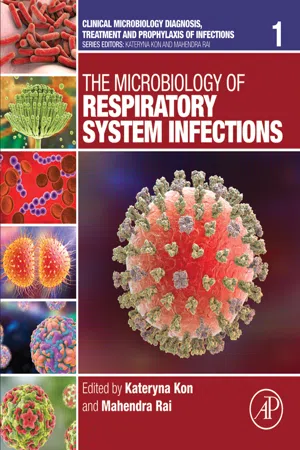
The Microbiology of Respiratory System Infections
About this book
The Microbiology of Respiratory System Infections reviews modern approaches in the diagnosis, treatment, and prophylaxis of respiratory system infections. The book is very useful for researchers, scientists, academics, medical practitioners, graduate and postgraduate students, and specialists from pharmaceutical and laboratory diagnostic companies. The book has been divided into three sections according to the types of respiratory pathogens.
The first section contains reviews on the most common and epidemiologically important respiratory viruses, such as influenza virus, severe acute respiratory system coronavirus, and recently discovered Middle East respiratory syndrome coronavirus.
The second section is devoted to bacterial and fungal pathogens, which discusses etiology and pathogenesis including infections in patients with compromised immune system, and infections caused by fungal pathogens, such as Aspergillus and Pneumocystis.
The third section incorporates treatment approaches against different types of bacterial infections of the lower respiratory tract. This section reviews classical antimicrobial and phytomedical approaches as well as the application of nanotechnology against respiratory pathogens.
- Offers the most up to date information on the microbiology of lower respiratory system infections
- Features contributors from across the world, presenting questions of interest to readers of both developed and developing countries
- Reviews the most common and epidemiologically important respiratory viruses
- Discusses the etiology and pathogenesis of bacterial and fungal pathogens including infections in patients with compromised immune system, and infections caused by fungal pathogens, such as Aspergillus and Pneumocystis
Information
Chapter 1
Influenza virus infections: clinical update, molecular biology, and therapeutic options
G. Franci*
L. Palomba*
A. Falanga**
C. Zannella*
V. D’Oriano*
L. Rinaldi†
S. Galdiero**
M. Galdiero*
* University of Naples Federico II, Department of Experimental Medicine, Naples, Italy
** University of Naples Federico II, Department of Pharmacy, Naples, Italy
† Second University of Naples, Internal Medicine of Clinic Hospital of Marcianise, Department of Medicine, Surgery, Neurology, Geriatric and Metabolic Diseases, ASL Caserta, Italy
* University of Naples Federico II, Department of Experimental Medicine, Naples, Italy
** University of Naples Federico II, Department of Pharmacy, Naples, Italy
† Second University of Naples, Internal Medicine of Clinic Hospital of Marcianise, Department of Medicine, Surgery, Neurology, Geriatric and Metabolic Diseases, ASL Caserta, Italy
Abstract
The viral family Orthomyxoviridae comprises five genera, but only two are of medical relevance in humans, namely: influenza A and B viruses. Influenza A viruses are further divided into subtypes, based on the antigenic properties of the surface glycoproteins hemagglutinin and neuraminidase. Influenza A virus is a single-stranded, enveloped RNA virus with 8 RNA segments. The initial target of Influenza A infection is the respiratory epithelium and the virus life cycle is initiated by the binding of viral HA to receptors on host cells, which triggers endocytosis of the virus. Once internalized, viral ribonucleoprotein complexes are released into the cytoplasm, transported to the nucleus, where viral replication occurs through the synthesis of new viral components which are transported to the plasma membrane, where the new viruses are formed and exit the infected cell. On average, influenza viruses infect 5–10% of human populations each year, but in some geographical areas or age groups these percentages can heavily increase, especially when a novel influenza virus finds a human population that lacks a suitable neutralizing immune response. We do not yet have an entire understanding of the elements and mechanisms that are fundamental for allowing influenza virus transmission, pandemics generation, and establishment of novel lineages. Influenza virus evolution and consequent pandemics is coarsely driven by two mechanisms: mutations in the viral genome, and reassortment, which is the rearrangement of the eight influenza A viral RNA segments in cells infected with at least two different viruses. Currently, infections due to influenza A virus are responsible for considerable morbidity and mortality worldwide and the loss of life and economic costs are awesome during annual influenza virus epidemics, and can be frightening during worldwide outbreaks of novel strains (pandemics). The present chapter will discuss molecular biology of influenza A viruses together with influenza infections clinical featu...
Table of contents
- Cover
- Title page
- Table of Contents
- Copyright
- List of Contributors
- Preface
- Chapter 1: Influenza virus infections: clinical update, molecular biology, and therapeutic options
- Chapter 2: Influenza viral infection in the respiratory system—potential ways of monitoring
- Chapter 3: SARS coronavirus infections of the lower respiratory tract and their prevention
- Chapter 4: The middle east respiratory syndrome coronavirus respiratory infection: an emerging infection from the arabian peninsula
- Chapter 5: Respiratory infections of the human bocavirus
- Chapter 6: Circulation of respiratory pathogens at mass gatherings, with special focus on the Hajj pilgrimage
- Chapter 7: Indoor air pollution due to mycoflora causing acute lower respiratory infections
- Chapter 8: Is there a link between environmental allergens and parasitism?
- Chapter 9: Respiratory infections in immunosuppressed patients
- Chapter 10: Metallo-beta-lactamase producer Pseudomonas aeruginosa: an opportunistic pathogen in lungs
- Chapter 11: Mycobacterium tuberculosis: clinical and microbiological aspects
- Chapter 12: Pulmonary aspergillosis: diagnosis and treatment
- Chapter 13: Laboratory diagnosis of Pneumocystis jirovecii pneumonia
- Chapter 14: Antimicrobial approaches against bacterial pathogens which cause lower respiratory system infections
- Chapter 15: Nanotechnological applications for the control of pulmonary infections
- Chapter 16: Volatile oils: Potential agents for the treatment of respiratory infections
- Chapter 17: Current therapeutics and prophylactic approaches to treat pneumonia
- Subject Index
Trusted by 375,005 students
Access to over 1.5 million titles for a fair monthly price.
Study more efficiently using our study tools.
Frequently asked questions
Yes, you can cancel anytime from the Subscription tab in your account settings on the Perlego website. Your subscription will stay active until the end of your current billing period. Learn how to cancel your subscription
No, books cannot be downloaded as external files, such as PDFs, for use outside of Perlego. However, you can download books within the Perlego app for offline reading on mobile or tablet. Learn how to download books offline
Perlego offers two plans: Essential and Complete
- Essential is ideal for learners and professionals who enjoy exploring a wide range of subjects. Access the Essential Library with 800,000+ trusted titles and best-sellers across business, personal growth, and the humanities. Includes unlimited reading time and Standard Read Aloud voice.
- Complete: Perfect for advanced learners and researchers needing full, unrestricted access. Unlock 1.5M+ books across hundreds of subjects, including academic and specialized titles. The Complete Plan also includes advanced features like Premium Read Aloud and Research Assistant.
We are an online textbook subscription service, where you can get access to an entire online library for less than the price of a single book per month. With over 1.5 million books across 990+ topics, we’ve got you covered! Learn about our mission
Look out for the read-aloud symbol on your next book to see if you can listen to it. The read-aloud tool reads text aloud for you, highlighting the text as it is being read. You can pause it, speed it up and slow it down. Learn more about Read Aloud
Yes! You can use the Perlego app on both iOS and Android devices to read anytime, anywhere — even offline. Perfect for commutes or when you’re on the go.
Please note we cannot support devices running on iOS 13 and Android 7 or earlier. Learn more about using the app
Please note we cannot support devices running on iOS 13 and Android 7 or earlier. Learn more about using the app
Yes, you can access The Microbiology of Respiratory System Infections by Kateryna Kon,Mahendra Rai in PDF and/or ePUB format, as well as other popular books in Biological Sciences & Physiology. We have over 1.5 million books available in our catalogue for you to explore.