eBook - ePub
Patient Derived Tumor Xenograft Models
Promise, Potential and Practice
- 486 pages
- English
- ePUB (mobile friendly)
- Available on iOS & Android
eBook - ePub
Patient Derived Tumor Xenograft Models
Promise, Potential and Practice
About this book
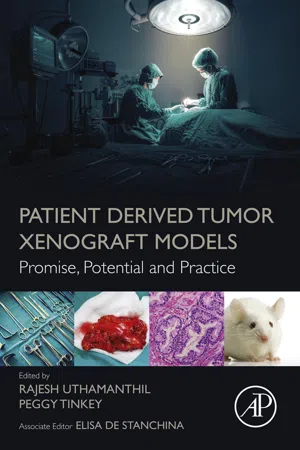
Patient Derived Tumor Xenograft Models: Promise, Potential and Practice offers guidance on how to conduct PDX modeling and trials, including how to know when these models are appropriate for use, and how the data should be interpreted through the selection of immunodeficient strains.
In addition, proper methodologies suitable for growing different type of tumors, acquisition of pathology, genomic and other data about the tumor, potential pitfalls, and confounding background pathologies that occur in these models are also included, as is a discussion of the facilities and infrastructure required to operate a PDX laboratory.
- Offers guidance on data interpretation and regulatory aspects
- Provides useful techniques and strategies for working with PDX models
- Includes practical tools and potential pitfalls for best practices
- Compiles all knowledge of PDX models research in one resource
- Presents the results of first ever global survey on standards of PDX development and usage in academia and industry
Information
Topic
MedicineSection III
PDX Models for Tumors of Various Organ Systems
Chapter 1
Pediatric and Adult Brain Tumor PDX Models
A.D. Strand1, E. Girard1, and J.M. Olson1,2,3 1Fred Hutchinson Cancer Research Center, Seattle, WA, United States 2Seattle Children’s Research Institute, Seattle, WA, United States 3University of Washington, Seattle, WA, United States
Abstract
Pediatric and adult brain tumors represent dozens of distinct molecular and pathological cancer types. In human patients, brain tumors may have disrupted, intact, or partially intact blood–brain barriers, which greatly influences the concentration of most therapeutic agents in the tumor cells. The unique microenvironment of the brain also influences the extent to which brain tumors are responsive or resistant to therapeutics. These and other challenges have resulted in decades of failed human clinical trials. Numerous orthotopic and flank patient-derived mouse models have been developed to help address these important translational oncology issues in the preclinical setting.
Keywords
Brain tumors; Ependymoma; Glioma; Medulloblastoma; Patient-derived xenografts
Background
Brain cancer is a uniquely frightening and personal disease, as it strikes at the tissue that controls both our body and personal identity. Treatment remains a challenge for a variety of reasons. Attempts to spare normal brain, particularly in pediatric cancer, often limit surgical and radiologic options. The blood–brain barrier (BBB) prevents most chemicals, including drugs that are intended to be therapeutic, from entering the brain. Even if therapies can get past the BBB, many types of brain cancer are intrinsically chemo- and radioresistant.
Currently, 90% of therapeutic drug candidates that look promising in the laboratory fail in human clinical trials, which suggest that our brain cancer models need improvement. Tissue culture cell lines have long served as the primary model system. The limitations of tissue culture lines have long been recognized, so in vivo alternatives, mainly laboratory mice, have come to the fore. Genetically engineered mouse models allow clinical researchers to study several types of brain cancer. However, the creation of relevant genetically engineered mouse models is time-consuming and requires a great deal of understanding of the biology of cancer. Cell line xenografts are commonly used, but carry the limitations of cells that have been grown under nonphysiologic tissue culture conditions for prolonged periods. Patient-derived xenograft (PDX) models offer a way to create models representing types of cancer that are less well understood, with the added feature (or flaw) that the model represents an individual’s unique tumor. The generation of genomically curated PDX mouse models and careful translational experiments may modernize nonclinical pharmacology studies in a manner that reduces the failure rate of human clinical trials that include children or adults with brain tumors.
In the case of brain cancers, pediatric and adult cancers have distinct biological differences and require different models. Anatomically the brain is separated into a top (supratentorial) and bottom (infratentorial) compartment. In adults, most tumors are supratentorial. In contrast to adult tumors, most pediatric tumors occur in the posterior fossa (cerebellum or brainstem), which are located in the infratentorial compartment. Adult brain cancers occur after the brain is fully developed. In this setting, cancer is largely a disease of aging and most cancers are glial in origin. Pediatric brain cancer is a developmental disease and tumors of neural origin are more common in children.
Because the brain lacks pain receptors and because glioma cells are highly migratory, adult brain tumors are often quite advanced at the time of diagnosis. The extent of surgical resection makes a significant difference in patient outcome, with patients undergoing >90% resection experiencing a significant survival advantage.1,2 It is assumed that radiation and chemotherapy are more effective for microscopic disease than bulky disease, hence outcomes are improved when most of the bulky tumor is removed, even when microscopic disease remains.
Although brain tumors are relatively uncommon, representing only 1.4% of all cancers, brain tumors further challenge drug hunters because of their diversity; there are over 20 types of adult brain cancer and over 20 types of pediatric brain cancer—with essentially no biological overlap between the two age groups even in cancers of the same type.
Diagnosis and classification of pediatric brain tumors represent a particular quandary for neuro-oncologists at this point in time because molecular studies imply that pathology-based classification may have conflated multiple distinct types of brain tumors. As tumor categories that were already rare become further split into molecular subtypes, it will be more difficult to conduct statistically meaningful human clinical trials. For that reason, PDX mice will be critical for prioritizing and advancing effective therapeutics.
Methodologies and Models
Technical Considerations
Xiao-nan Li at Texas Children’s Hospital modernized techniques to create orthotopic PDX models of pediatric brain tumors.3,30 He recognized that it was essential to implant the tumors rapidly after the cells were separated from their blood supply in human patients. Engraftment rates in his hands approached 80% when cells were implanted within 2 h of resection versus approximately 20–30% for cells that were separated from the blood supply for longer periods.3 Brain tumor cells generally survive poorly once disconnected from endogenous blood supply, so time is of essence when creating these models.
Although each laboratory has preferences as to whether tumor tissue fragments or disperse single-cell suspensions should be implanted, there are no data that clearly indicates that o...
Table of contents
- Cover image
- Title page
- Table of Contents
- Copyright
- List of Contributors
- Biographies
- Foreword
- Preface
- Section I. Mouse Xenograft Models of Cancer
- Section II. Components of a PDX Program
- Section III. PDX Models for Tumors of Various Organ Systems
- Section IV. PDX Models in Cancer Research and Therapy Around the World
- Section V. Challenges & Future of PDX Models
- Index
Trusted by 375,005 students
Access to over 1.5 million titles for a fair monthly price.
Study more efficiently using our study tools.
Frequently asked questions
Yes, you can cancel anytime from the Subscription tab in your account settings on the Perlego website. Your subscription will stay active until the end of your current billing period. Learn how to cancel your subscription
No, books cannot be downloaded as external files, such as PDFs, for use outside of Perlego. However, you can download books within the Perlego app for offline reading on mobile or tablet. Learn how to download books offline
Perlego offers two plans: Essential and Complete
- Essential is ideal for learners and professionals who enjoy exploring a wide range of subjects. Access the Essential Library with 800,000+ trusted titles and best-sellers across business, personal growth, and the humanities. Includes unlimited reading time and Standard Read Aloud voice.
- Complete: Perfect for advanced learners and researchers needing full, unrestricted access. Unlock 1.5M+ books across hundreds of subjects, including academic and specialized titles. The Complete Plan also includes advanced features like Premium Read Aloud and Research Assistant.
We are an online textbook subscription service, where you can get access to an entire online library for less than the price of a single book per month. With over 1.5 million books across 990+ topics, we’ve got you covered! Learn about our mission
Look out for the read-aloud symbol on your next book to see if you can listen to it. The read-aloud tool reads text aloud for you, highlighting the text as it is being read. You can pause it, speed it up and slow it down. Learn more about Read Aloud
Yes! You can use the Perlego app on both iOS and Android devices to read anytime, anywhere — even offline. Perfect for commutes or when you’re on the go.
Please note we cannot support devices running on iOS 13 and Android 7 or earlier. Learn more about using the app
Please note we cannot support devices running on iOS 13 and Android 7 or earlier. Learn more about using the app
Yes, you can access Patient Derived Tumor Xenograft Models by Rajesh Uthamanthil,Peggy Tinkey,Elisa de Stanchina in PDF and/or ePUB format, as well as other popular books in Medicine & Medical Theory, Practice & Reference. We have over 1.5 million books available in our catalogue for you to explore.