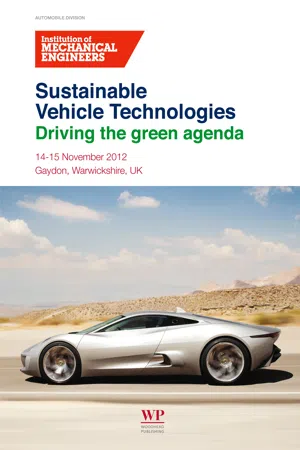
eBook - ePub
Sustainable Vehicle Technologies
Driving the Green Agenda
- 248 pages
- English
- ePUB (mobile friendly)
- Available on iOS & Android
eBook - ePub
About this book
This book contains the papers from the IMechE's Sustainable Vehicle Technologies 2012 conference. An innovative technical conference organised by the Automobile Division of the IMechE, it follows on from the 2009 Low Carbon Vehicle conference, which established a high standard with presentations primarily focussed on powertrain technology. The conference examines the latest advances in technology with a view towards understanding the consequences of carbon dioxide reduction over the entire vehicle lifecycle. Papers cover all aspects of the finite resources available for vehicle production, operation and recycling.
- Presents the papers from this leading conference
- Covers life time emissions and sustainability over the entire product life-cycle
- Considers all areas of environmental pollution in addition to the goals for delivering low-carbon vehicles
Information
Fuels
Ammonia as a hydrogen energy carrier and its application to internal combustion engines
M. Koike, H. Miyagawa, T. Suzuoki and K. Ogasawara, Toyota Central R&D Labs., Inc., Japan
Abstract
Anhydrous liquid ammonia offers a considerable advantage over hydrogen in that it has a large volumetric energy density. The total amount of energy that would be expended for its production and transportation to consumers is estimated to be less than that for liquid hydrogen transportation, even if the lower heating value loss is considered. From a storage viewpoint, these advantages would be particularly beneficial to those vehicles carrying large amounts of freight.Although ammonia has a low flame velocity for use in internal combustion engines, an auto-thermal-cracker helps the engine to run stably. No knocking has been observed even when the engine was operated under charged conditions.
1 Introduction
Energy security and environmental preservation have been long-term challenges since the 1970s. Recent concerns related to climate change, growing demands for energy as a result of the rapid economic development of emerging nations, and the peak oil crisis make these issues much more serious. Much effort is being expended in various fields. As well as extensive measures aimed at attaining energy savings, many kinds of energy options have been proposed to replace fossil fuels with other sources of renewable energy. Bio-fuels and electricity produced by solar, wind, and geothermal energy are typical examples and they have gradually come to shoulder part of the world’s total energy demand.
However, the global energy demand is extremely large. The total demand for energy was over 5×10²⁰ J, roughly 20% of it was for transportation, in 2010(1). Oil accounted for about one third of this. Renewable energies only accounted for 7% of the total and more than 90% came from hydroelectricity.
Taking a long-term view, the number of options should be narrowed down so that end users have a manageable number of choices, even if primary energy sources diversify.
There is a strong possibility that electricity and hydrogen will play an important role in the future when most energy will be come from renewable resources, with most expected to come from solar energy. Hydrogen is also expected to be used as a chemical energy carrier of electricity. The largest disadvantage of hydrogen is its small volumetric energy density making its storage a difficult problem for transport, distribution and vehicle applications.
This paper addresses the use of anhydrous ammonia as a hydrogen carrier. Ammonia is easily liquefied under mild conditions and has a large weight fraction of hydrogen. As the synthesis technology was developed in the early 20th century and has been improving over the years, there are already numerous large-scale production plants worldwide, producing over 130 million metric tons in 2010.
Firstly, we will address the amount of energy that is expended in transporting and distributing both hydrogen and ammonia to refilling stations, as well as the differences in portability of the two fuels in vehicles. We will not consider the production of hydrogen here, but will assume that hydrogen will be produced in a remote location and will inevitably require long distance transportation.
This paper considers internal combustion engines as a direct application for ammonia. From the viewpoint of combustion, ammonia differs from conventional hydrocarbon fuels in several aspects. Practical and theoretical studies of ammonia combustion have been conducted over several decades (2-4). Their findings have pointed to ammonia being a potential alternative fuel for internal combustion engines. The practical and numerical studies described in this report focus on combustion stability improvement through the use of an on-board ammonia cracker and improved power output through charging.
2 Energy expended in transporting fuel to consumers
Table 1 lists the gravimetric and volumetric energy densities of hydrogen and ammonia. The “expended energy” is the energy consumed from hydrogen under ambient conditions to compressed hydrogen, liquefied hydrogen and liquefied ammonia. There are some reports about production energy (5-10). Feasibility study (5) regarding ammonia production reveals that a plant for 1000 t-NH3/day consumes 1.4 MJ/kg-NH3. As the change in the lower heating value (LHV) through ammonia synthesis is 2.6 MJ/kg-NH3, the total amount of energy loss is 4.0 MJ/kg-NH3. A similar capacity liquefaction plant of hydrogen (around 200 t-H2/day) would consume at least 30 MJ/kg-H2 (7), although any existing facilities are not so large and consume more energy than that. The European report (8) says the average energy expended is 74.4 MJ/kg-H2. The Mizuho-Toyota report (9) states 43.2 MJ/kg-H2. 30 MJ/kg-H2 is adopted in Table 1. According to the DOE report (10), around 10 MJ/kg-H2 is needed to compress hydrogen to 20 MPa that is used in current trailer trucks.
Table 1
Energy densities and expended energy for each state

The figures are divided by the energy content of the final fuel.
2.1 Long-distance distribution
If hydrogen is produced from solar or wind power sources, there will only be certain areas where large-scale mass production is possible, and they will likely be far from most energy consumers. Therefore, energy distribution will probably be achieved through a combination of tanker ships and trucks. As no large-capacity liquid hydrogen tankers are currently operating, our estimates of the amount of energy needed for transportation by sea is based on the figures for LNG tankers. The energy expended is reported to be less than 0.1 of the energy in the LNG being carried, although this actually depends on the capacity of the tanker and the distance covered. If the same shipping capacity were to be available and the amount of energy consumed for transportation were to be the same, then 1.5 times as much energy could be transported as liquid ammonia, relative to liquid hydrogen. Incidentally, the fuel consumption per unit energy would be approximately 2.5 times greater than LNG for liquid hydrogen shipping and 1.7 times greater for ammonia shipping. According to European estimates, the energy expended for LNG transport by sea is about 0.09 of the energy being transported. If we apply this to the shipping of liquid hydrogen and ammonia, the expended energy would be 0.22 and 0.15, respectively. According to the Mizuho-Toyota report, the energy is estimated to be 0.036, which would give figures of 0.09 and 0.06 for hydrogen and ammonia, respectively.
The same considerations can be applied to ground transportation. According to the European figures, liquid hydrogen tanker trucks consume about 0.03 of the energy they are carrying. For the same volumetric amount of ammonia, the truck would be carrying 1.5 times as much energy, such that the energy consumption per transported energy would be reduced to 0.02. An additional advantage is that pipelines are already in place that could be used for ammonia transportation.
Besides, additional energy is required when liquid hydrogen is supplied to vehicles as compressed gas at a pressure of 70 MPa. This is estimated to be between 0.07 and 0.1. Ultimately, in the case of ammonia, the total amount of energy expended through synthesis, liquefaction and transportation by shipping and trucking to end users accounts for between 0.3 and 0.4 (averag...
Table of contents
- Cover image
- Title page
- Table of Contents
- Copyright
- LCA
- Fuels
- Duty Cycle
- Energy Usage Reduction
- Propulsion (Energy Efficiency)
- Propulsion
- Author Index
Trusted by 375,005 students
Access to over 1.5 million titles for a fair monthly price.
Study more efficiently using our study tools.
Frequently asked questions
Yes, you can cancel anytime from the Subscription tab in your account settings on the Perlego website. Your subscription will stay active until the end of your current billing period. Learn how to cancel your subscription
No, books cannot be downloaded as external files, such as PDFs, for use outside of Perlego. However, you can download books within the Perlego app for offline reading on mobile or tablet. Learn how to download books offline
Perlego offers two plans: Essential and Complete
- Essential is ideal for learners and professionals who enjoy exploring a wide range of subjects. Access the Essential Library with 800,000+ trusted titles and best-sellers across business, personal growth, and the humanities. Includes unlimited reading time and Standard Read Aloud voice.
- Complete: Perfect for advanced learners and researchers needing full, unrestricted access. Unlock 1.5M+ books across hundreds of subjects, including academic and specialized titles. The Complete Plan also includes advanced features like Premium Read Aloud and Research Assistant.
We are an online textbook subscription service, where you can get access to an entire online library for less than the price of a single book per month. With over 1.5 million books across 990+ topics, we’ve got you covered! Learn about our mission
Look out for the read-aloud symbol on your next book to see if you can listen to it. The read-aloud tool reads text aloud for you, highlighting the text as it is being read. You can pause it, speed it up and slow it down. Learn more about Read Aloud
Yes! You can use the Perlego app on both iOS and Android devices to read anytime, anywhere — even offline. Perfect for commutes or when you’re on the go.
Please note we cannot support devices running on iOS 13 and Android 7 or earlier. Learn more about using the app
Please note we cannot support devices running on iOS 13 and Android 7 or earlier. Learn more about using the app
Yes, you can access Sustainable Vehicle Technologies by Institution of Mechanical Engineers in PDF and/or ePUB format, as well as other popular books in Biological Sciences & Environmental Science. We have over 1.5 million books available in our catalogue for you to explore.