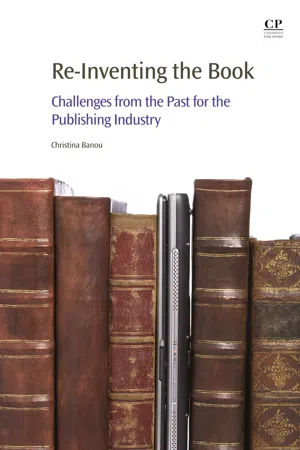
eBook - ePub
Re-Inventing the Book
Challenges from the Past for the Publishing Industry
- 163 pages
- English
- ePUB (mobile friendly)
- Available on iOS & Android
eBook - ePub
About this book
Re-Inventing the Book: Challenges from the Past for the Publishing Industry chronicles the significant changes that have taken place in the publishing industry in the past few decades and how they have altered the publishing value chain and the structure of the industry itself.
The book examines and discusses how most publishing values, aims, and strategies have been common since the Renaissance. It aims to provide a methodological framework, not only for the understanding, explanation, and interpretation of the current situation, but also for the development of new strategies.
The book features an overview of the publishing industry as it appears today, showing innovative methods and trends, highlighting new opportunities created by information technologies, and identifying challenges. Values discussed include globalization, convergence, access to information, disintermediation, discoverability, innovation, reader engagement, co-creation, and aesthetics in publishing.
- Describes common values and features in the publishing industry since the Renaissance/invention of printing
- Proposes a methodological framework that helps users understand current publishing issues and trends
- Focuses on reader engagement and participation
- Proposes and discusses the publishing chain, not only as a value chain, but also as an information chain
- Considers the aesthetics of publishing, not only for the printed book, but also for digital material
Information
1
Introduction
The continuing revolution of Gutenberg
Abstract
Taking as the key element that the publishing industry seems to be at a constant turning point, the chapter initially provides an overview of current issues, values, features and challenges of nowadays publishing industry, arguing that the origins of current trends can be traced to the past. One of the aims of the book is the methodological and theoretical background to explain and interpret current issues and trends, to explore opportunities, and to develop publishing strategies and policies. The revolution that started with Gutenberg is still continuing as the demand for access to information, the desire for knowledge dissemination and the need for friendly books are common features between the past and the present. Then, the aims of the book are further explored and its structure described.
Keywords
Book; Innovation; Methodological framework; Publishing; Publishing industry
1.1. The continuing revolution of Gutenberg: the publishing industry at a turning point
The love for books may be the starting point when readers talk about them; this love probably transforms the publishing activity into a semifictional and ‘romantic’ process where the author writes a book, the publisher reads this manuscript and then oversees the entire production activity, the editor edits, the contract is signed, collaborations are checked, the bookseller promotes the title and finally the success of the work is celebrated. Real life is usually more complicated and far from what the readers have in mind. Obviously, stereotypes are derived from the time the book has been regarded through the centuries as a semisacred object; fiction and films often offer a simplified aspect of the publishing activity.
We have to remember that publishing has always been a business, an industry, certainly a creative and unique one – due to the reasons mentioned – in a highly competitive environment. The publishing value chain is so called due to the added value by all stakeholders, whose roles have been redefined according to the social, technological, cultural, financial and political conditions. Probably, the still ‘romantic’ concept of publishing, the surprise for the competition and for the strategies used, as well as for the changes that technology has brought about may be attributed to the unique identity of the industry, which is part of both the creative and the information ones.
During the last four decades, significant changes have taken place in the publishing industry altering the publishing value chain, the publishing activity and the structure of the industry whereas the book per se is often being transformed. In a hybrid world, new forms of the book coexist with the older, traditional ones; for example, reading books (whether small forms or not) on tablets and mobiles has resulted in deep changes in reading and consumer behaviour, in communication, in writing cultures, offering at the same time new aesthetic and reading experiences. Undeniably, the rapid advances in technology and the convergence of media are a reality, social media and networking provide the framework for viable and successful promotion and marketing strategies, feedback from the readers is offered more than ever and the role of the reader is upgraded. Challenges are considered to be many due to new information and communication technologies that offer a variety of tools, methods and opportunities to be explored.
Thus, the publishing industry seems often to be at a cross-road, at a constant turning point. Undeniably, nowadays it faces several and important challenges that force it to redefine values, redevelop strategies, rediscover methods and obviously re-create taste. Emerging opportunities offer to the publishers a variety of strategies and methods, whereas new concepts and issues provide the framework for innovation and experiment.
We have though to note that among the diachronic features of publishing innovation, risk and experiment are recognized. The printed book has been since its invention by Gutenberg in the mid-15th century a unique product: more precisely, a mass product and an information medium, a work of art and a commodity, a symbol of knowledge and of prestige, a commercial product and a propaganda medium (Eisenstein, 1983; Johns, 1998). Books are the magnifying mirror of each period reflecting and at the same time enhancing social, cultural, political, educational, financial, scientific conditions and concepts.
In our globalized and digital world where innovation and tradition still go hand in hand, challenges are many, augmenting day by day, running even faster than our needs, desires and expectations. The exploitation of new information and communication technologies ought to be counted as one of the peak points for the publishing industry. Among the challenges we may also recognize the emergence of new publishing and business models, the role of social media in building reading communities as well as in promoting books, the emergence of new forms of the book, the important role of the aesthetics in publishing, reader engagement and reader-centred marketing and promotion strategies. Meanwhile, we have to consider that publishing has been far from being a simple, easy to measure, even in cases to be described, activity.
The publishing business has been since its origins in Renaissance a competitive business, highly risky, tentative but rewarding, innovative and at the same time based on the already tested and successful. Collaborating with the ‘world movers and world shakers’, as Schuster had stated (Gross, 1985, p. 28), seemed and seems to be a strong reward itself. Even recently, although changes in the field are sweeping, the creative aspect of the industry provides it with a unique, privileged identity. Obviously, publishing as a ‘work of a gentleman’ in the ‘good old days’ is nostalgia for an ideal past that we seriously wonder if it really existed. We have though to recognize that the publishing industry always explored, exploited, experimented, enhanced and tried to expand, enforcing at the same time readers and authors to certain experiences altering thus the publishing chain, developing literary taste, giving access to information and providing new opportunities.
After the invention of printing, the printed book revolutionized all forms of learning and communication. It was a mass medium that offered access to information, bringing about significant changes in knowledge dissemination, scholar communication, education, propaganda and communication (Eisenstein, 1983; Richardson, 1999; Chartier, 1994). Furthermore, the book as a material object led to the development and democratization of taste, whereas as an object with both tangible and intangible characteristics it has in its evolution been transformed according to the social, economic, cultural, educational, scientific and political conditions related to the publishing policy of each publishing company.
Undeniably, the publishing history is a history of challenges, surprises and innovations, of needs and desires, of privileged and often troubled relationships. It is a history not mainly and not always of discoveries but often of rediscovering, reconsidering, redeveloping, reusing, reengaging and reimagining. But the knowledge of the past goes beyond history; it is a study of the typology of the book and of the construction and function of the publishing industry leading to the understanding of strategies, issues, concepts, trends and providing as well the framework for setting new strategies.
Nowadays, in a rapidly changing world, the book publishing industry is among the ones that flourish and change although it has to overcome difficulties facing strong competition from other powerful media even at the same device. It is in this complex environment that questions concerning the structure and function of the industry, the role of stakeholders and the nature of the book emerge. As Greco et al. (2013, p. 5) state, ‘Book publishing in the United States in the 21st century is a frenetic fast-paced world of thousands of publishing companies employing more than 95,000 individuals, issuing more than one million new titles annually, keeping over five million distinct titles in print, and generating approximately +27 billion annually in net publishers’ revenues’. Phillips (2014, p. i) writes that: ‘this is an exciting period of the book, a time of innovation, experimentation, and change. It is also a time of considerable fear within the book industry as it adjusts to changes in how books are created and consumed’.
During the past four decades, mergers and acquisitions of the publishing companies have definitely changed the structure of the industry and the publishing activity leading not only to the dominance of large publishing companies and conglomerations, but also to the development of bestselling cultures, to changes in promotion, distribution and retail. In that framework, the role of the agent and of the reader is upgraded. Additionally, new business and publishing models set the scene for changes in the book, and in the publishing process and chain. Social media and networking introduce and develop cultures of communication, tools for promotion and marketing, methods for reader participation. In that context, the publisher is further empowered although publishing models, such as self-publishing and open access, appear to threaten him/her: publishing companies develop strategies, methods and policies based on new information technologies and deriving from the common ground of the industry; these strategies are thriving.
As mentioned, information technologies constitute already an advantage and a challenge for publishing. Technology is usually an ally providing the methods and tools for discovering but also for redeveloping, reusing and reviving older and tested strategies. We have though to admit that technology runs extremely fast, faster sometimes than our desires, needs and expectations. For example, gamification, storytelling, and the use of multimedia in publishing are promising but the majority of readers are not yet familiar with them. It is noteworthy that the printed book not only coexists with the electronic one and the digital publications but its sales are increasing. In the UK in 2015, according to the Publishers Association’s Statistics (13 May 2016), ‘sales of physical books from publishers increased for the first time in four years while digital sales fell for the first time since the PA started collecting figures’ (The Publishers Organization, 2016). The same is to be pointed out, according to the Association of American Publishers, for the USA where both paperback and hardback saw growth (AAP, 2016). This ‘resurgence’ or thriving of the printed book is to be further discussed in a wider framework.
At the same time, readers tend to read on devices that they carry with them, such as mobiles (smartphones) and tablets. An opportunity and a need for the publishers is to provide editions for mobiles: this means changes not only in content (for example, short forms, serialization) but also in the aesthetics of the book, which, as discussed in the next chapter, is of great significance. The question should be not only for the ‘content’ but for works, books or editions.
Questions raised inevitably include the relationship between technology and publishing, the typology and the aesthetic value of the books published, the nature of reading and communicating, the consumer behaviour, the impact of technology on the publishing activity, the role of social media in building communities of readers, the development of marketing strategies, the communication between stakeholders, reader engagement, the role of information in the publishing process, the development of taste and of creation of book policy.
It seems that there is always a turning point in each era of publishing; publishers had and have to cope with problems and exploit the new opportunities so as to innovate and introduce new issues. Beyond these, we have to recognize the need for surprise and more specifically the desire for the...
Table of contents
- Cover image
- Title page
- Table of Contents
- Series Page
- Copyright
- Dedication
- Foreword
- Preface and Acknowledgements
- 1. Introduction: The continuing revolution of Gutenberg
- 2. Reimagining the book: Aesthetics in publishing
- 3. Reengaging readers, rediscovering strategies
- 4. Re-discussing the publishing chain as information value chain-circle
- 5. Redefining publishing: Challenges from the past
- Timeline
- Index
Trusted by 375,005 students
Access to over 1.5 million titles for a fair monthly price.
Study more efficiently using our study tools.
Frequently asked questions
Yes, you can cancel anytime from the Subscription tab in your account settings on the Perlego website. Your subscription will stay active until the end of your current billing period. Learn how to cancel your subscription
No, books cannot be downloaded as external files, such as PDFs, for use outside of Perlego. However, you can download books within the Perlego app for offline reading on mobile or tablet. Learn how to download books offline
Perlego offers two plans: Essential and Complete
- Essential is ideal for learners and professionals who enjoy exploring a wide range of subjects. Access the Essential Library with 800,000+ trusted titles and best-sellers across business, personal growth, and the humanities. Includes unlimited reading time and Standard Read Aloud voice.
- Complete: Perfect for advanced learners and researchers needing full, unrestricted access. Unlock 1.5M+ books across hundreds of subjects, including academic and specialized titles. The Complete Plan also includes advanced features like Premium Read Aloud and Research Assistant.
We are an online textbook subscription service, where you can get access to an entire online library for less than the price of a single book per month. With over 1.5 million books across 990+ topics, we’ve got you covered! Learn about our mission
Look out for the read-aloud symbol on your next book to see if you can listen to it. The read-aloud tool reads text aloud for you, highlighting the text as it is being read. You can pause it, speed it up and slow it down. Learn more about Read Aloud
Yes! You can use the Perlego app on both iOS and Android devices to read anytime, anywhere — even offline. Perfect for commutes or when you’re on the go.
Please note we cannot support devices running on iOS 13 and Android 7 or earlier. Learn more about using the app
Please note we cannot support devices running on iOS 13 and Android 7 or earlier. Learn more about using the app
Yes, you can access Re-Inventing the Book by Christina Banou in PDF and/or ePUB format, as well as other popular books in Lingue e linguistica & Scienze dell'informazione e biblioteconomia. We have over 1.5 million books available in our catalogue for you to explore.