eBook - ePub
Developing and Managing Embedded Systems and Products
Methods, Techniques, Tools, Processes, and Teamwork
- 862 pages
- English
- ePUB (mobile friendly)
- Available on iOS & Android
eBook - ePub
Developing and Managing Embedded Systems and Products
Methods, Techniques, Tools, Processes, and Teamwork
About this book
This Expert Guide gives you the knowledge, methods and techniques to develop and manage embedded systems successfully. It shows that teamwork, development procedures, and program management require unique and wide ranging skills to develop a system, skills that most people can attain with persistence and effort.
With this book you will:
- Understand the various business aspects of a project from budgets and schedules through contracts and market studies
- Understand the place and timing for simulations, bench tests, and prototypes, and understand the differences between various formal methods such as FMECA, FTA, ETA, reliability, hazard analysis, and risk analysis
- Learn general design concerns such as the user interface, interfaces and partitioning, DFM, DFA, DFT, tradeoffs such as hardware versus software, buy versus build, processor choices, and algorithm choices, acquisition concerns, and interactions and comparisons between electronics, functions, software, mechanics, materials, security, maintenance, and support
- Covers the life cycle for developing an embedded system: program management, procedures for design and development, manufacturing, maintenance, logistics, and legal issues
- Includes proven and practical techniques and advice on tackling critical issues reflecting the authors' expertise developed from years of experience
Information
Topic
DesignSubtopic
ManagementChapter 1
Introduction to Good Development
Kim R. Fowler, IEEE Fellow, Consultant
Chapter 1 describes the book’s purpose to identify important issues in developing and managing embedded systems. The material outlines the technical aspects, the teamwork, the effort, and the cost you encounter in developing an embedded system. It reveals how technical issues impact business and schedules, how personal interactions are just as important as technical breakthroughs, and the interplay of various disciplines to realize the final product. Consequently, this book is not solely for managers, it is written for every member of the project team.
Keywords
Systems engineering; integrity; teamwork; management; development; process; procedure; V-model; spiral model; life cycle; QA
About this book
Purpose
The purpose of this book is to identify important issues in developing and managing an embedded system. It should aid your understanding of both the technical aspects of the project and the teamwork involved. The book provides guidelines and bounds on the effort and cost you might encounter in developing an embedded system. It illustrates principles with examples and case studies.
Much like a good project team, the authors selected to write chapters in this book have specific expertise and understand the interactions within a development team. They know that a good team will knit the various disciplines into a fine tapestry of an excellent project.
Audience
This book is for all members of a project team: program managers, technical staff, administrative staff, and support staff. Every project team member should find insight from this book for understanding the issues—technical, managerial, business, and administrative—within a project. Generally, this book aims at project teams with 6–10 people working on a single, full-time project; it can also address many issues and help project teams up to 30 or more people.
This book examines the interactions and connections within a project and its team. It reveals how technical issues impact business and schedules, how personal interactions are just as important as technical breakthroughs, and the interplay of various disciplines to realize the final product. Consequently, this book is not solely for managers, it is written for every member of the project team (Figure 1.1).

Road map
The material in this book presents best practices for developing embedded systems. Best practices include technical design, teamwork, collaboration, management attitudes, and development processes. Consequently, this book is not restricted to technical topics because developing projects is not only a technical endeavor. As in project development, the technical topics in this book intertwine with managerial issues, teamwork concerns, and legal liabilities; they cannot be separated unless artificially done so. The book’s most obvious departures from a traditional engineering text are in Chapter 2, which provides insight into the psychology of the team and personnel dynamics, and in Chapters 17 through 23, which discuss legal concerns.
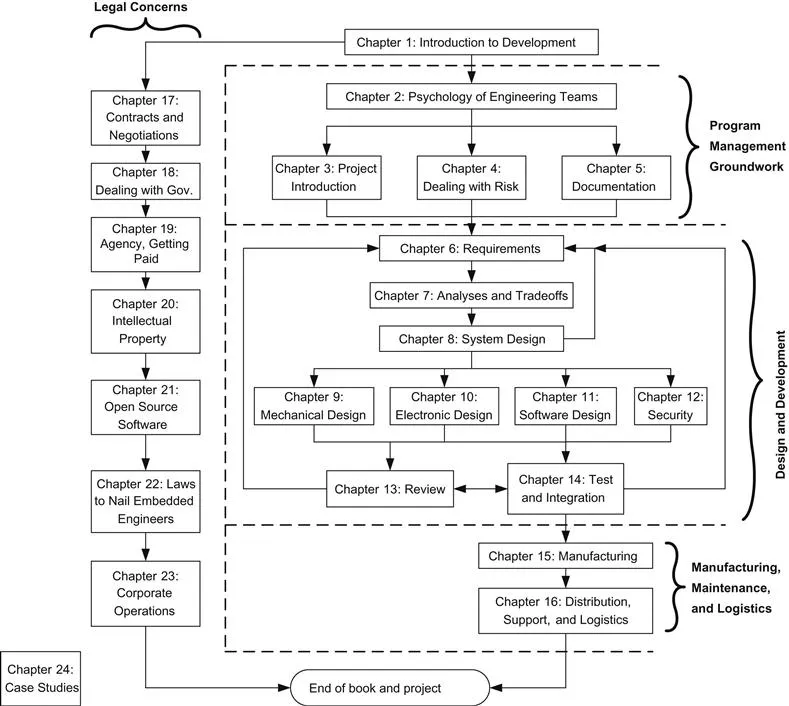
Though the chapters present in a sequential fashion within this book, development of an embedded system is anything but sequential. Figure 1.2 is a diagram of the chapters and when they might be most useful within a project. The multiple paths and connections should clue you into the parallel and concurrent nature of most design and development. Furthermore, much of the design activity is iterative. Feedback is necessary for refinement of requirements and the design, it is also integral to verification and validation.
What you can get from this book
This book concentrates on the framework that you should use to manage, develop, produce, and support embedded products. It delves into the interactions between disciplines and the potential effort that you might expect to expend....
Table of contents
- Cover image
- Title page
- Table of Contents
- Copyright
- List of Contributors
- About the Editor
- Co-Author Biography
- Author’s Biographies
- Developing and Managing Embedded Systems and Products: The Roadmap
- List of Acronyms
- Chapter 1. Introduction to Good Development
- Chapter 2. Drivers of Success in Engineering Teams
- Chapter 3. Project Introduction
- Chapter 4. Dealing with Risk
- Chapter 5. Documentation
- Chapter 6. System Requirements
- Chapter 7. Analyses and Tradeoffs
- Chapter 8. The Discipline of System Design
- Chapter 9. Mechanical Design
- Chapter 10. Electronic Design
- Chapter 11. Software Design and Development
- Chapter 12. Security
- Chapter 13. Review
- Chapter 14. Test and Integration
- Chapter 15. Manufacturing
- Chapter 16. Logistics, Distribution, and Support
- Chapter 17. Agreements, Contracts, and Negotiations
- Chapter 18. Dealing with the Government
- Chapter 19. Agency and Getting Paid
- Chapter 20. Intellectual Property, Licensing, and Patents
- Chapter 21. Open-Source Software
- Chapter 22. Laws That Can Nail Embedded Engineers
- Chapter 23. Corporate Operations
- Chapter 24. Case Studies
- Appendix A. Dependability Calculations
- Index
Trusted by 375,005 students
Access to over 1.5 million titles for a fair monthly price.
Study more efficiently using our study tools.
Frequently asked questions
Yes, you can cancel anytime from the Subscription tab in your account settings on the Perlego website. Your subscription will stay active until the end of your current billing period. Learn how to cancel your subscription
No, books cannot be downloaded as external files, such as PDFs, for use outside of Perlego. However, you can download books within the Perlego app for offline reading on mobile or tablet. Learn how to download books offline
Perlego offers two plans: Essential and Complete
- Essential is ideal for learners and professionals who enjoy exploring a wide range of subjects. Access the Essential Library with 800,000+ trusted titles and best-sellers across business, personal growth, and the humanities. Includes unlimited reading time and Standard Read Aloud voice.
- Complete: Perfect for advanced learners and researchers needing full, unrestricted access. Unlock 1.5M+ books across hundreds of subjects, including academic and specialized titles. The Complete Plan also includes advanced features like Premium Read Aloud and Research Assistant.
We are an online textbook subscription service, where you can get access to an entire online library for less than the price of a single book per month. With over 1.5 million books across 990+ topics, we’ve got you covered! Learn about our mission
Look out for the read-aloud symbol on your next book to see if you can listen to it. The read-aloud tool reads text aloud for you, highlighting the text as it is being read. You can pause it, speed it up and slow it down. Learn more about Read Aloud
Yes! You can use the Perlego app on both iOS and Android devices to read anytime, anywhere — even offline. Perfect for commutes or when you’re on the go.
Please note we cannot support devices running on iOS 13 and Android 7 or earlier. Learn more about using the app
Please note we cannot support devices running on iOS 13 and Android 7 or earlier. Learn more about using the app
Yes, you can access Developing and Managing Embedded Systems and Products by Kim Fowler in PDF and/or ePUB format, as well as other popular books in Design & Management. We have over 1.5 million books available in our catalogue for you to explore.