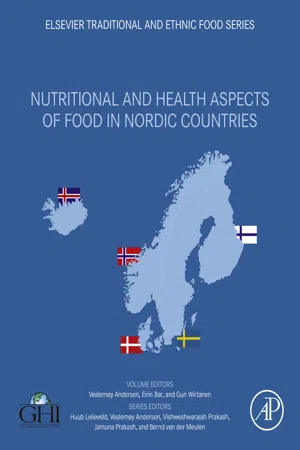
eBook - ePub
Nutritional and Health Aspects of Food in Nordic Countries
- 275 pages
- English
- ePUB (mobile friendly)
- Available on iOS & Android
eBook - ePub
Nutritional and Health Aspects of Food in Nordic Countries
About this book
Nutritional and Health Aspects of Food in Nordic Countries provides an analysis of traditional and ethnic foods from the Nordic countries, including Norway (and Svalbard), Sweden, Finland, Iceland, and Denmark (including Greenland and the Faroe Islands). The book addresses the history of use, origin, composition and preparation, ingredient origin, nutritional aspects, and the effects on health for various foods and food products in each of these countries. In addition, readers will find local and international regulations and suggestions on how to harmonize regulations to promote global availability of these foods.
- Provides insight into the varieties of food and food products available in the Nordic countries
- Presents nutritional and health claims that are either based on opinion and/or experience, on scientific evidence, or on both
- Contains a framework to determine whether these northern European foods meet local and international regulatory requirements
- Offers strategies to remedy those foods that do not meet local and international regulatory requirements
Information
Topic
MedicineSubtopic
Nutrition, Dietics & BariatricsChapter 1
Health and Nutritional Perspectives on Nordic Food Traditions—An Approach Through Food Culture and History
Virginie Amilien⁎; Henry Notaker† ⁎ Research Professor, Consumption Research Norway (SIFO), Oslo Metropolitan University, Oslo, Norway
† Food Historian, Independent Researcher, Author of Studies on Food History and Culture, Oslo, Norway
† Food Historian, Independent Researcher, Author of Studies on Food History and Culture, Oslo, Norway
Abstract
This chapter proposes a cultural historical analysis of the nutritional and health aspects of traditional and ethnic foods in Nordic countries. Using a food cultural perspective permits to emphasize the contextual frame and to better understand food uses and identities. After an introductory section about the various elements of Nordic food culture and traditions, we intend to delimit the study by explaining what “food culture and traditions” mean and by giving a general overview about Nordic dietetic and nutritional policy. A second part will focus on concrete chosen food products, such as dairy products, corn and cereals, fruits and vegetables, or meat and fish, thus systematically presenting a historical view. A third part will eventually consider the roles of situation and context in order to emphasize evolution and changes, while a fourth part concentrates on current Nordic food culture through the New Nordic Food movement and Nordic nutritional policy.
Keywords
Food culture; Nordic food; Food history; Food policy; Food traditions
Acknowledgment
We would like to thank our colleagues Atle Wehn Hegnes and Gun Roos for enriching discussions and providing advice.
1.1 Introduction
Considering food culture and traditional products as part of nutritional policy is not only extremely interesting and enriching, but is also pertinent in a period of global renaissance for Nordic food.
On the one hand, there is a lack of cultural perspective and reflections in “EU-initiatives carried out within the framework of health promotion and obesity prevention” (Hedegaard, 2016, p. 537). Hedegaard claims the necessity of studying food culture and especially the link between place, time, and identity and its impact on obesity rates. On the other hand, discussing food culture and traditions in Nordic countries has become fashionable. This recent interest is well illustrated by a nice book signed by Chef Nilsson promoting traditional products, ancient techniques and local know-how, and Nordic food culture (Nilsson, 2015).
In our cultural historical analysis, we will take a closer look at the nutritional and health aspects of traditional and ethnic foods in Nordic countries from a food cultural perspective; the aim is to better understand the link between food, culture, nutrition policy, health dimension, and identity in Nordic countries. After an introductory section about the various elements of Nordic food culture and traditions, we intend to delimit the study by explaining what food culture means and by giving a general overview about Nordic dietetic and nutritional policy. In the second part, we will then focus on concrete selected food products, such as dairy products, corn and cereals, fruits and vegetables, or meat and fish, thus systematically presenting a historical view to better understand today's cultural significance of these foods. A third part will eventually consider the roles of situation and context in order to emphasize evolution and changes. The final part will concentrate on current Nordic food culture through the New Nordic food movement and Nordic nutritional policy.
1.2 Overview and Definitions
1.2.1 Tradition and traditional food1
“Traditional food” is a quite recent term in Nordic countries, where food ethnologists mostly used concepts like “old” or “ancient” in discussing food habits from previous generations up to World War II. As written by Handler and Linnekin (Handler & Linnekin, 1984, p. 273), “In its common-sense meaning, tradition refers to an inherited body of custom and beliefs,” also described as a social construction of traditions. The concept of tradition is often used in a static way, although tradition is always changing. In other words the bottom line in the tradition is not the reference to the past but rather the expression of its link to the present. Traditional foods are then chosen and defined in relation to what is important for us today. As Pouillon stated, “A tradition is defined by looking from now to the future, and not the opposite,” (Pouillon, 1975, p. 160). In a previous study based on both a theoretical and an empirical approach of the concept of “traditional food” in reflexive modernity, we observed that the concept of traditional food, as it is used today in Nordic countries, was based on four main pillars: time, know-how, place, and meaning. The axes of time and know-how are interwoven in a “meaning” dimension, which links time and culture, as well as a “place” dimension, which links geographical boundaries and local identity (Amilien & Hegnes, 2013). In other words, “traditional food” is a term used for both preserving older values and renewing a sense of identity. The interest for traditional foods recently evolved towards localized food and terroir (Amilien, 2011, 2012) or cultural heritage, which basically cover the same understanding of food in the past and present with an even greater focus respectively on place, know-how and on identity.
“Traditional” and “traditional food” are currently concepts used in everyday life for political or scientific purposes. Traditional food is often defined either through a product approach, where foodstuff or conservation methods are at stake, or through a constructionist approach including sociocultural and political perspective of food culture. It has been an important part of the European agricultural policy since the beginning of our century as underlined in an overview article about traditional food (Guerrero et al., 2009), which provides a useful example of the complex mixture created by collective effort and product positioning. The challenge is to have an active relationship with tradition. According to the Italian historian Massimo Montanari, food culture takes place where tradition and innovation intersect. Tradition, as well as innovation, builds on know-how, techniques, and values, which are handed down through the generations. Hence tradition for Montanari is a very successful innovation, and culture is the interface between these two perspectives (Montanari, 2006, p. 6). Although this duality or embeddedness between tradition and innovation is a major pillar, it seems that the Nordic perspective of food culture gives a larger understanding of food that spans practices, structure, norms, consumption, and situations, all while taking into account the context in which this culture evolves and is transformed, including change, tradition, and innovation.
1.2.2 A food culture approach
Food culture is a significant concept in Nordic countries, where the first professorial chair in food culture was created in Finland in 2012.2 The concept of food culture is still not currently used in food studies,3 although it has been used in Nordic food studies since the mid-1980s.4
Basically, the notion builds on the words food and culture, where food not only refers to the tangible product people use (e.g., gathered, picked, collected, made, produced, transported, processed, given, exchanged, sold, cooked, eaten, spoiled, and thrown away) but also to the social context and situation. Culture mainly brings up the two c...
Table of contents
- Cover image
- Title page
- Table of Contents
- Copyright
- Contributors
- Introduction
- Chapter 1: Health and Nutritional Perspectives on Nordic Food Traditions—An Approach Through Food Culture and History
- Chapter 2: Food, Nutrition, and Health in Norway (Including Svalbard)
- Chapter 3: Aspects of Food, Nutrition, and Health in Sweden
- Chapter 4: Food, Nutrition, and Health in Denmark (Including Greenland and Faroe Islands)
- Chapter 5: Food, Nutrition, and Health in Finland
- Chapter 6: Food, Nutrition, and Health in Iceland
- Chapter 7: Food, Nutrition, and Health in Sápmi
- Chapter 8: Common Nutrition and Health Issues: Nordic Nutrition Recommendations
- Chapter 9: Environmental Sustainability Issues Regarding Nordic Food Production
- Chapter 10: Common Legal Issues for Traditional and Ethnic Food
- Chapter 11: Future Outlooks: Nordic Gastronomy in Food Marketing and Catering
- Index
Trusted by 375,005 students
Access to over 1.5 million titles for a fair monthly price.
Study more efficiently using our study tools.
Frequently asked questions
Yes, you can cancel anytime from the Subscription tab in your account settings on the Perlego website. Your subscription will stay active until the end of your current billing period. Learn how to cancel your subscription
No, books cannot be downloaded as external files, such as PDFs, for use outside of Perlego. However, you can download books within the Perlego app for offline reading on mobile or tablet. Learn how to download books offline
Perlego offers two plans: Essential and Complete
- Essential is ideal for learners and professionals who enjoy exploring a wide range of subjects. Access the Essential Library with 800,000+ trusted titles and best-sellers across business, personal growth, and the humanities. Includes unlimited reading time and Standard Read Aloud voice.
- Complete: Perfect for advanced learners and researchers needing full, unrestricted access. Unlock 1.5M+ books across hundreds of subjects, including academic and specialized titles. The Complete Plan also includes advanced features like Premium Read Aloud and Research Assistant.
We are an online textbook subscription service, where you can get access to an entire online library for less than the price of a single book per month. With over 1.5 million books across 990+ topics, we’ve got you covered! Learn about our mission
Look out for the read-aloud symbol on your next book to see if you can listen to it. The read-aloud tool reads text aloud for you, highlighting the text as it is being read. You can pause it, speed it up and slow it down. Learn more about Read Aloud
Yes! You can use the Perlego app on both iOS and Android devices to read anytime, anywhere — even offline. Perfect for commutes or when you’re on the go.
Please note we cannot support devices running on iOS 13 and Android 7 or earlier. Learn more about using the app
Please note we cannot support devices running on iOS 13 and Android 7 or earlier. Learn more about using the app
Yes, you can access Nutritional and Health Aspects of Food in Nordic Countries by Veslemøy Andersen, Eirin Bar, Gun Wirtanen, Veslemøy Andersen,Eirin Bar,Gun Wirtanen in PDF and/or ePUB format, as well as other popular books in Medicine & Nutrition, Dietics & Bariatrics. We have over 1.5 million books available in our catalogue for you to explore.