eBook - ePub
Securing Safe Water Supplies
Comparison of Applicable Technologies
- 92 pages
- English
- ePUB (mobile friendly)
- Available on iOS & Android
eBook - ePub
Securing Safe Water Supplies
Comparison of Applicable Technologies
About this book
Available water disinfection systems rely mainly on large-scale filtration and the combination of filtration (to remove solids), and subsequent application of chemical disinfectants. This has proven to produce water of acceptable quality. Important points for application in household systems are low complexity, few training requirements, and easy transportation and distribution as well as a sufficiently high acceptance by the user.
Written and endorsed by the European Federation of Food Science and Technology this book compares a variety of purification systems. There is a growing evidence base on targeting water quality improvements to maximize health benefits, and it is believed that 4% of the global disease burden could be prevented by improving water supply, sanitation, and hygiene. Better tools and procedures to improve and protect drinking-water quality at the community and urban level, for example, through Water Safety Plans include the availability of simple and inexpensive approaches to treat and safely store water at the household-level.
- Provides single-source comparison of advantages and disadvantages relevant to the various practices of multiple water treatments
- Acknowledges the limitations of governmental interventions that need to be supplemented by individual practices such as home implementation systems
- Provides practical implementation insights and perspectives via graphs, tablesand charts that make information readily accessible and comparable
Information
Chapter 1
Introduction
“No single measure would do more to reduce disease and save lives in the developing world than bringing safe water and adequate sanitation to all.”
—Kofi Annan, former UN Secretary General (1997–2006)
In the UN Millennium Development Goals, signed in 2000 by 189 countries, target “7c” states that by the year 2015, the proportion of people without sustainable access to safe drinking water and basic sanitation should be halved (from 65% to 32%).1 This goal includes improved access to sanitation, drinking water sources, better hygiene and improved water quality (by municipal or home water treatment), which will verifiably reduce the diarrhoeal morbidity as depicted in Figure 1.1.
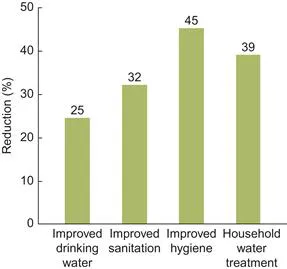
Fig. 1.1 Reduction in diarrhoeal diseases morbidity resulting from improvements in drinking water and sanitation services.2
1.1 Waterborne/Water-Related Diseases
In 2004, the World Health Organization published information, which depicted that every year more than 3.4 million people die as a result of water-related diseases, making it the leading cause of disease and death around the world. Most of the victims are young children, the vast majority of whom die of illnesses caused by organisms that thrive in water sources contaminated by raw sewage.3 Poor water quality continues to present a major threat to human health. Diarrhoeal disease alone amounts to an estimated 4.8% of the total DALY (disability-adjusted life years) global burden of disease (GDB) (8.6% for the African Region), and is responsible for the death of 1.8 million people every year.4 Nine out of the ten such deaths are children, and virtually all of these deaths occur in the developing countries.5 It was estimated that 88% of that burden is attributable to unsafe water supply, sanitation and hygiene, and it is mostly concentrated on children in the developing countries.4,6,7 In the developing countries, it is predominantly children under the age of five who suffer from diarrhoea: according to the latest figures from the World Health Organisation,8 around two million children die from this illness each year.9 In 2004, 16.8% of all deaths among children worldwide were caused by diarrhoea (see Figure 1.2).8 By comparison, according to the Ugandan Water and Sanitation Resource Centre, approximately 310,000 people died in Africa as a result of conflicts in 1998.9
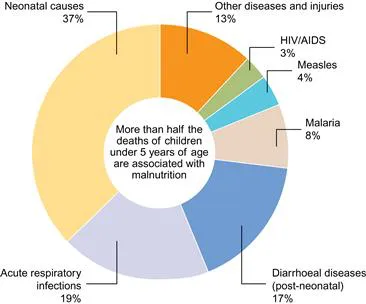
Fig. 1.2 Causes of death among children under 5 years old worldwide between 2000 and 2003.2
The need to provide sanitation both for drinking water and hygiene remains a huge challenge today in developing countries.10
1.2 Natural Disasters
Natural disasters and humanitarian emergencies occur on a recurring basis. In 2010 and January 2011, natural disasters and crises, including severe drinking water supply problems, took place in Sri Lanka, Pakistan, Colombia and Australia (flooding), Haiti (earthquake), DR Congo and Darfur/Chad (conflicts), Somalia (conflict, drought, flooding) and Zimbabwe (humanitarian crisis).11 In 2010 alone, there were 373 natural disasters with a total death toll of 296,800 people, 207 million affected persons and an estimated damage of 109 billion US Dollars (78.9 billion Euros). The top 10 natural disasters by number of deaths are shown in Table 1.1. The 10 worst disasters of the last century (1900–2000) are listed in Table 1.2 according to death toll. Table 1.3 gives an overview on large disaster events impacting on cities over the period 2000–2010. Tables 1.1 and 1.3 are overlapping at the Haiti earthquake disaster in January 2010.
Table 1.1 Top 10 Disasters in 2010 by Number of Deaths12
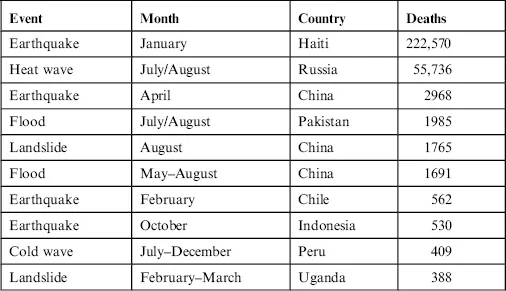
Table 1.2 Ten Worst Disasters of the Last Century (1900–2000) According to Death Toll13
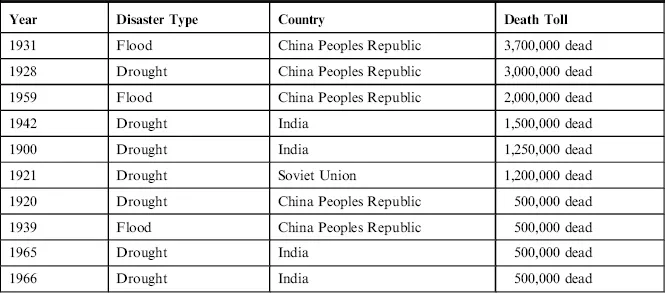
Table 1.3 Large Disaster Events Over the Period 2000–2010 Impacting on Cities14

Source: EM-DAT: The OFDA/CRED International Disaster Database (www.emdat.net), Université Catholique de Louvain – Brussels – Belgium.
Facts and figures on water quality and health and occurrence of natural disasters (as given by the World Health Organisation15).
Facts and figures on water quality and health and occurrence of natural disasters (as given by the World Health Organisation15).
The global health challenge: preventing water quality-related disease:
• No safe drinking-water: almost 1 billion people lack access to a safe water supply
• Diarrhoeal disease: 2 million annual deaths attributable to unsafe water, sanitation and hygiene
• Cholera: more than 50 countries still report cholera to the WHO
• Cancer and tooth/skeletal damage: millions exposed to unsafe levels of naturally occurring arsenic and fluoride
• Schistosomiasis: an estimated 260 million infected
• Emerging challenges: increasing use of wastewater in agriculture is important for livelihood opportunities, but also associated with serious public health risks
The health opportunities: implementing good practice:
• Four percent of the global disease burden could be prevented by improving water supply, sanitation, and hygiene
• A growing evidence base on how to target water ...
Table of contents
- Cover image
- Title page
- Table of Contents
- Copyright
- List of Abbreviations
- List of Figures
- List of Tables
- Chapter 1. Introduction
- Chapter 2. The Need of Water Decontamination in Disaster Areas and Areas with a Deficiency in Clean Drinking Water
- Chapter 3. Basic Principles of Water Decontamination in Disaster Areas
- Chapter 4. Key Facts About Implementing Home Water Treatment (HWT)23
- Chapter 5. Established Basic Methods for Water Decontamination
- Chapter 6. Comparison of Systems Available on the Market
- Chapter 7. Conditions and Requirements for a Successful PEF System Implementation and Resulting Advantages of This Method in Comparison to Established Methods
- Conclusion
- Acknowledgements
- Sources/Literature
Trusted by 375,005 students
Access to over 1.5 million titles for a fair monthly price.
Study more efficiently using our study tools.
Frequently asked questions
Yes, you can cancel anytime from the Subscription tab in your account settings on the Perlego website. Your subscription will stay active until the end of your current billing period. Learn how to cancel your subscription
No, books cannot be downloaded as external files, such as PDFs, for use outside of Perlego. However, you can download books within the Perlego app for offline reading on mobile or tablet. Learn how to download books offline
Perlego offers two plans: Essential and Complete
- Essential is ideal for learners and professionals who enjoy exploring a wide range of subjects. Access the Essential Library with 800,000+ trusted titles and best-sellers across business, personal growth, and the humanities. Includes unlimited reading time and Standard Read Aloud voice.
- Complete: Perfect for advanced learners and researchers needing full, unrestricted access. Unlock 1.5M+ books across hundreds of subjects, including academic and specialized titles. The Complete Plan also includes advanced features like Premium Read Aloud and Research Assistant.
We are an online textbook subscription service, where you can get access to an entire online library for less than the price of a single book per month. With over 1.5 million books across 990+ topics, we’ve got you covered! Learn about our mission
Look out for the read-aloud symbol on your next book to see if you can listen to it. The read-aloud tool reads text aloud for you, highlighting the text as it is being read. You can pause it, speed it up and slow it down. Learn more about Read Aloud
Yes! You can use the Perlego app on both iOS and Android devices to read anytime, anywhere — even offline. Perfect for commutes or when you’re on the go.
Please note we cannot support devices running on iOS 13 and Android 7 or earlier. Learn more about using the app
Please note we cannot support devices running on iOS 13 and Android 7 or earlier. Learn more about using the app
Yes, you can access Securing Safe Water Supplies by Erik Voigt,Henry Jaeger,Dietrich Knorr in PDF and/or ePUB format, as well as other popular books in Technology & Engineering & Environmental Management. We have over 1.5 million books available in our catalogue for you to explore.