- 214 pages
- English
- ePUB (mobile friendly)
- Available on iOS & Android
eBook - ePub
About this book
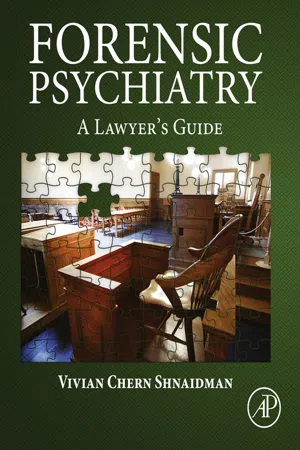
Lawyers frequently encounter clients and/or cases of bizarre behavior, mental illness, substance abuse, psychopathy, sexual offenses, learning disorders, birth defects, and other behavioral and emotional issues. Often they are ill-prepared to understand the nature of the psychiatric report, how the psychiatric assessment was structured, and how to best utilize and challenge these reports in court.Forensic Psychiatry: A Lawyer's Guide provides legal professionals the tools to identify mentally ill clients and help them navigate through the psychiatric information and language in reports and testimony. Topics include why a forensic psychiatrist is necessary, applications of psychiatry to law, various psychiatric disorders, and utilizing the expert witness.
- A user-friendly roadmap to psychiatry for the non-psychiatrist—covers why you need a forensic psychiatrist and the applications of psychiatry to law
- Provides coverage of the mental status examination, common psychiatric diagnoses, treatable disorders versus brain damage, medical problems masquerading as mental illness, and much more
- Includes a full glossary of psychiatric terms as an additional easy reference guide
Information
1
Psychiatry v. Everything Else
Abstract
To the best of our knowledge, mental illness has existed as long as humans have. The roots of the differences in behavior and responsibility between the sane and the insane have been documented since Biblical times. The goal of this book is to help those in the legal profession more easily recognize the mentally ill. This book has an international appeal and applicability because mental illness is the same the world over. Moreover, the diagnostic criteria and codes of the DSM are part of the ICD, which is an international publication. Therefore, this book is not limited to lawyers practicing in the United States—understanding psychiatry should be an international goal.
Keywords
Bio-bio-bio model; Diagnosis; DSM; Health Insurance; M’Naughten Rule; Mental illness; PsychiatryWhat Is Psychiatry?
Psychiatry is a branch of medicine specializing in emotions and behaviors. Or, to directly quote Wikipedia: “Psychiatry is the medical specialty devoted to the study, diagnosis, treatment, and prevention of mental disorders. These include various affective, behavioural (sic), cognitive and perceptual abnormalities.” In other words, psychiatrists deal with patients who are suffering from or exhibiting signs and symptoms of mental disorders.
The next question, clearly, is what is a mental disorder? This question is actually much more important than the first, because in order to have a doctor for something, we first have to define that “something.” And this something is hard to define. Mental illness has existed as long as humans have existed, as far as anyone can tell. The Bible contains references to insanity. Many are vague and use the word “madness,” although no one knows what the original meaning was. Clearly, as early in history as humans were capable of documenting their observations, they observed that some people behaved in ways outside the norm. King Saul was described as having had fits of euphoria alternating with black despair—certainly consistent with a modern view of bipolar disorder (more on this diagnosis later). The Talmud, the great body of literature expounding on the Jewish Law, the Torah, says that King David wondered why God would have created something as “purposeless” as insanity. Then David flees to the court of Achish the King of Gath, where he fakes insanity in order to save his own life. Implicit in this story is the concept that faking insanity bestows upon the faker social conditions and treatment different than that of a non-insane individual—the earliest known insanity defense. Thus, the Talmud decides that insanity can have a purpose after all. The Talmud also goes into great detail about legal decisions made while mad or insane. Interestingly, Maimonides, the philosopher and physician who wrote his own code of ethical behavior, finds that insanity covers so many different variations that it cannot be defined, but rather must be decided by a judge! We might say that Maimonides was the first forensic psychiatrist, even if he never did a fellowship, was not board-certified, and fell into the subspecialty via general family practice medicine.
Although forensic psychiatry was not officially practiced in Biblical times, we see that the roots of the differences in behavior and responsibility between the sane and the insane were documented as far back as those days. The word “forensic” itself means “in the forum,” and the Forum was the location of legal proceedings in ancient Rome. The Hammurabi Code, the ancient law of Mesopotamia, had a special section reserved just for dealing with insane criminal defendants. The legal system throughout the world apparently has recognized since the beginning of recorded history that mentally ill individuals lacked the same capacity for reason as their non-mentally ill brethren. Only today is the insanity defense fairly rare and the concept of mental illness extremely hard for people to grasp. My goal in this book is to make it a bit easier to recognize the mentally ill, so that whenever a person who is less than psychiatrically stable crosses your threshold, you will know what to do.
The first modern mention of the concept of forensic psychiatry in the English-speaking world was around 1843. In that year, Daniel M’Naughten fired a gun into the back of Edward Drummond, who died five days later. Drummond was the secretary of the British Prime Minister, Robert Peel. Without the benefit of technology and the 24-hour news cycle, the mentally ill Mr. M’Naughten had mistaken Peel’s secretary for Peel himself. M’Naughten’s actual motivation for wanting to kill Prime Minister Peel remains obscure, but clearly, the motive was something crazy, because out of this murder, the modern-day insanity defense of both the United Kingdom and the United States was born. The other English-speaking and English common-law-based jurisdictions, Australia, Canada, and New Zealand, all utilize some versions of this law as well.
While the English system utilized certain aspects of insanity defense prior to the introduction of the M’Naughten Rule (or M’Naughten Rules, as it is sometimes called, since the court had boiled down the determination of sanity to five questions), this case is the first landmark case of modern forensic psychiatry. In part, the rule states that:
to establish a defence on the ground of insanity, it must be clearly proved that, at the time of the committing of the act, the party accused was labouring under such a defect of reason, from disease of the mind, as not to know the nature and quality of the act he was doing; or, if he did know it, that he did not know he was doing what was wrong. (original British spelling unchanged)
In the United States, before anything could be done about using insanity in legal matters, an attempt was first made to determine how often such a thing might be required. The first official attempt to acquire information about the frequency of mental illness came with the 1840 census, which had a category for “idiocy/insanity.” By the 1880 census, seven options were available for mental illness: mania, melancholia, monomania, paresis, dementia, dipsomania, and epilepsy. Today, those categories have been subsumed into other more official sounding diagnoses, and most modern psychiatrists would be hard-pressed to determine the disorders described by those archaic-sounding diagnoses. However, please remember that just because the name of something changes, the actual condition, symptoms, and clinical presentation do not change. Dipsomania then might be called alcoholism today, but it still exists.
Since those early beginnings, statistical data have been utilized in the United States to form diagnostic categories of psychiatric illness. The American Medico-Psychological Association, later to become the American Psychiatric Association, joined with the National Commission on Mental Hygiene to formulate and enact a plan to gather uniform statistics from mental hospitals all across the country. A psychiatric nomenclature (or jargon) began to be developed. Later, following World War II, the United States Army and then the Veteran’s Administration developed an even broader language of psychiatry to better classify, identify, and treat the disorders of soldiers. More or less concurrently, the World Health Organization (WHO) published the ICD-6 (International Classification of Diseases, Sixth Revision), which was the first ICD to contain a section on mental disorders. The ICD remains the publication utilized throughout the world for medical diagnosis classification, especially for the all-important billing codes. Eventually, the statistical information gathered from hospitals and the census became part of a standardized way of classifying mental disorders, and in 1952, the first DSM (Diagnostic and Statistical Manual of Mental Disorders) was published.
One of the early reviewers of this book was concerned that it would have no international appeal because the DSM is an American publication and its diagnoses are limited to the United States. In reality, psychiatry is psychiatry the world over. Moreover, the diagnostic criteria and codes of the DSM are part of the ICD, which is an international publication. Schizophrenia in New Jersey and schizophrenia in Timbuktu have the exact same diagnostic criteria. Furthermore, (like that—two legal jargon words in a row?) schizophrenia itself is indistinguishable in New Jersey and in Timbuktu—insofar as schizophrenia is ever indistinguishable from itself. The most interesting feature of psychiatric disorders and the thing that makes them so difficult to identify and explain is that they are all so unique. The general features of psychiatric disorders are common to every disorder in a category. The specifics of the illness occur only in the individual who suffers from his own unique version. This concept can be so difficult to understand that I will only mention it here and try to address it elsewhere, but it may really need its own book one day. Another way to explain this concept is that the features of the disorder—the delusions, the hallucinations, the poverty of thought, the autism, all of the things that make schizophrenic people look schizophrenic—are common to all schizophrenics. The delusions of control happen to all schizophrenics. But the details—how they are being controlled, who is controlling them, why they are being controlled, all of the coloring in of the disorder—are as unique to each schizophrenic individual as their fingerprints. It is the uniqueness of each mentally ill person’s mental illness that makes the whole concept of mental illness so difficult to understand to people who are not psychiatrists. Even clinical social workers frequently have difficulty with diagnosis. I see this conundrum every day in my private practice. Therapists only know that patients are unhappy or dissatisfied, but somehow they are often unable to put the pieces together in a cohesive way. The therapists and the patients get lost in the details of the patients’ lives and cannot figure out what the diagnostic criteria are. The reverse, of course, is true as well. I know plenty of psychiatrists who put people into diagnostic categories and ignore the details of the patients’ lives that are so troubling to the patients. The best outcomes occur when the patient and therapist can communicate about the overall picture as well as the details, and when the doctor or non-MD therapist can figure out a diagnosis and a pharmacological approach, as well as understand the circumstances unique to the patient’s life and design a psychotherapeutic treatment that will work for the particular individual. While this type of a treatment plan seems intuitive and normal, you’d be surprised how infrequently it seems to actually happen. And this failure of providing individualized treatment is not necessarily the fault of the treatment providers. Insurance companies and even professional organizations increasingly demand “evidence-based” treatment protocols, based upon large research groups of subjects and not upon individuals.
To further look into this troubling paradigm, I interviewed a leader in this field, Dr. Eric Plakun. Dr. Plakun is the founder of the American Psychiatric Association’s Caucus on Psychotherapy and a proponent of maintaining the biopsychosocial model in the face of immense pressure to shift to something he jokingly refers to as the bio-bio-bio model, a term possibly initially coined by another icon in the field, Dr. John Read, together with his colleagues in an article in 2009. In that famous piece, Dr. Read opines that the modern trend of mental illness is toward a paradigm in which everything is thought to be only biological, and any other influences, such as dysfunctional families, abuse, neglect, domestic violence, drugs, alcohol, or any other factor known to be causally related to psychosis is pared down to the role of a trigger or a biological influence only. Another outspoken such critic was an ex-president of the American Psychiatric Association (APA), which publishes the DSM. The late Dr. Steven Sharfstein was publicly critical of this bio-bio-bio model and also may have coined the phrase. Certain things are so good that lots of people want to take credit for them.
Whoever made up the bio-bio-bio model, in a recent article in the Psychiatric Times, Dr. Plakun remarks upon this trend toward this model, and identifies three misconceptions which heavily influence both the field of psychiatry and the general public in this regard. These are the following:
• Genes equal disease
• Patients present with single disorders that respond to single evidence-based treatments
• The best treatments are pills
Dr. Plakun’s article explains why these assumptions are false, and a quick and dirty literature search reveals a whole world of information that shows exactly why and how he is right. In summary, no specific genes for specific diseases have been identified that are present in every case of every mental disorder; patients rarely have only one disorder, and when they do, many different treatment modalities (such as psychotherapy and exercise) are as effective, if not more effective, than medication, and medications do not always work, and if you read the fine print on any medication package insert you will find: “The exact mechanism of action is UNKNOWN.” This previous sentence is a very gross summary, of course. We can write volumes on how and why the bio-bio-bio model is false. Another problem too is that our brains and our bodies are biological organisms. So while we may not really know anything about the biology of mental illness, at the same time, we know quite a bit. We know that neurotransmitters do mediate communication between neurons in our brains. We know that every single thing that happens in our brains and our bodies is a biological event. We know that without brain activity we die. The expression “flat line” exists, and it does not refer only to cardiac activity. Brain death is a thing, and it is important in infinite variations in the legal system. We cannot separate mind and brain. But at the same time, we are not our neurotransmitters. And it is at this juncture that the faith-based people try to climb on board and derail the train, insisting that the soul is somehow in there with a life of its own. Who knows—maybe it is. But I am a scientist and until proven otherwise, while I do not deny the existence of a soul, I still believe there is a scientific explanation for personality, mental illness, and the interface of environment, genetics, stress, non-stress (i.e., good stuff), and everything else. There is some way in which the outside and inside world interact with each individual’s biology to create each individual. And there is plenty of scientific evidence to support my statement. We know that identical twins who live substantially different lives end up with slightly different DNA. These differences are not in the parts of the DNA that code for hair, eye color, or which version of liver enzymes they have. Instead, the differences are in the telomeres—the parts of their DNA that were once thought to be “junk” DNA, that are now thought by many experts to be related to aging, prevention of oxidation, prevention of cancer, and a whole bunch of things that are still very minimally understood. We (“we” being the real scientists that work in laboratories, but I like to consider myself at least an honorary cousin-type member of that group) now have actual physical evidence that the environment changes our biology. The future is now. With this bit of knowledge in my back pocket, so to speak, I decided to contact an expert.
I wanted to directly speak to Dr. Plakun to see how he thought I could best explain these false assumptions about psychiatry to an audience of attorneys. When even psychiatrists do not seem to understand how we are being manipulated by the health insurance industry into providing inferior care for our patients, how can we possibly expect a court to ever order a true fair outcome or standard or care? I find this lack of parity a huge problem, so I figured I’d better contact an expert right up front.
Dr. Plakun was kind enough to take my call. He told me quite a few interesting things. His opinion underscores my belief that there is a lost generation of psychiatrists who do not know anything about psychotherapy. For the past 20 years or so, psychotherapy training has been absent from psychiatry residency training programs. Gone are the intensive hours of supervision, the process notes, the one-way mirrors, and the T-groups (I don’t know if we ever really knew what that T stood for—possibly transference, possibly training, possibly something else). Gone are the hours of reading Freud in bad, flowery translation, the hours of watching videos of family therapy sessions, the processing of what happened in the community meetings on the “unit” (the long-term inpatient unit where the chronic schizophrenics lived, sometimes for years), and what happened in that meeting that triggered Anne-Marie’s or Walter’s need to get up and go to the bathroom at that exact moment. Those amazing hours spent thinking and talking about what we thought was going on in the minds of our patients, and what was going on in our own minds and those of our colleagues—all gone, as if none of it had ever really mattered. Now it’s all medication, and all keeping people out of the hospital in order to keep costs down. While the total amount of knowledge about the brain’s biology has grown immensely, the individual psychiatrist’s knowledge about the brain does not seem to have grown at all. The field of psychiatry has been so influenced by outside factors that the very things which drew so many of us into psychiatry—what makes people think, and what makes them think in crazy ways—has been abandoned for the much less interesting component of “how can we save the insurance companies money?”
Dr. Plakun pointed out a problem that we mentioned here right in the introduction—that so many people are diverted from the mental health system into the criminal justice system.
“I think it’s a national tragedy,” he told me. “The promise of the community mental health system in the sixties and seventies has fallen apart because of inadequate funding. People are diverted from an inadequately funded mental health system.” He went on to tell me that what the emerging science is teaching us is that “William Faulkner was right… ‘The past isn’t dead; it isn’t even past.’ All the evidence is that early adverse experiences shape later psychiatric and medical outcomes.” In other words, everything that happens to us as we develop from fetuses to babies to children into adults shapes our brains, bodies, and behaviors. Biology and psychology are inextricably linked; it is silly to pretend otherwise, and it is not therapeutic to treat patients as if th...
Table of contents
- Cover image
- Title page
- Table of Contents
- Copyright
- Dedication
- About the Author
- Don’t Skip This Foreword
- Introduction
- 1. Psychiatry v. Everything Else
- 2. Psychiatry v. Law
- 3. The Mental Status Examination v. Common Sense
- 4. Diagnosis v. Jargon: Some Common Psychiatric Diagnoses, and What Exactly Is Schizophrenia, Anyway?
- 5. Bad v. Mad: Doing It on Purpose versus Doing It Because You’re Crazy
- 6. Insight v. Lack Thereof
- 7. Treatable Disorders v. Permanent Brain Damage
- 8. Mad v. Sick: Medical Problems Masquerading as Mental Illness and Iatrogenic Psychiatric Symptoms
- 9. Drugs v. Your Brain
- 10. Mental Illness v. Hearing Voices—Malingering, Its Copycats, and Its Implications
- 11. Psychopathy v. You
- 12. Your Expert Witness v. the Other Guy
- References
- Glossary
- Index
Trusted by 375,005 students
Access to over 1.5 million titles for a fair monthly price.
Study more efficiently using our study tools.
Frequently asked questions
Yes, you can cancel anytime from the Subscription tab in your account settings on the Perlego website. Your subscription will stay active until the end of your current billing period. Learn how to cancel your subscription
No, books cannot be downloaded as external files, such as PDFs, for use outside of Perlego. However, you can download books within the Perlego app for offline reading on mobile or tablet. Learn how to download books offline
Perlego offers two plans: Essential and Complete
- Essential is ideal for learners and professionals who enjoy exploring a wide range of subjects. Access the Essential Library with 800,000+ trusted titles and best-sellers across business, personal growth, and the humanities. Includes unlimited reading time and Standard Read Aloud voice.
- Complete: Perfect for advanced learners and researchers needing full, unrestricted access. Unlock 1.5M+ books across hundreds of subjects, including academic and specialized titles. The Complete Plan also includes advanced features like Premium Read Aloud and Research Assistant.
We are an online textbook subscription service, where you can get access to an entire online library for less than the price of a single book per month. With over 1.5 million books across 990+ topics, we’ve got you covered! Learn about our mission
Look out for the read-aloud symbol on your next book to see if you can listen to it. The read-aloud tool reads text aloud for you, highlighting the text as it is being read. You can pause it, speed it up and slow it down. Learn more about Read Aloud
Yes! You can use the Perlego app on both iOS and Android devices to read anytime, anywhere — even offline. Perfect for commutes or when you’re on the go.
Please note we cannot support devices running on iOS 13 and Android 7 or earlier. Learn more about using the app
Please note we cannot support devices running on iOS 13 and Android 7 or earlier. Learn more about using the app
Yes, you can access Forensic Psychiatry by Vivian Shnaidman in PDF and/or ePUB format, as well as other popular books in Social Sciences & Forensic Science. We have over 1.5 million books available in our catalogue for you to explore.