eBook - ePub
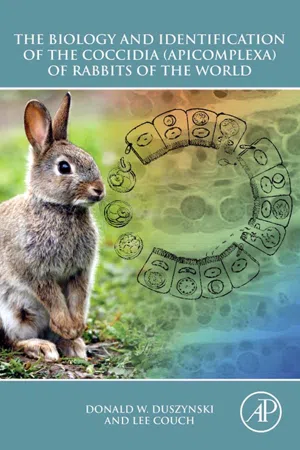
The Biology and Identification of the Coccidia (Apicomplexa) of Rabbits of the World
- 352 pages
- English
- ePUB (mobile friendly)
- Available on iOS & Android
eBook - ePub
The Biology and Identification of the Coccidia (Apicomplexa) of Rabbits of the World
About this book
The Biology and Identification of the Coccidia (Apicomplexa) of Rabbits of the World is a taxonomic summation of a damaging intestinal parasite found in rabbits and transmissible to other species, including humans. This book conceptually and historically summarizes the world's literature on the parasite and also provides a quick guide to isolation procedures, identification, strategies for management, and available chemotherapy. It is a vital source of knowledge about coccidia's real and potential transmission to humans, which can lead to dangerous health problems, like severe dehydration, vomiting, lethargy and even death.
Coccidiosis is an intestinal disease that affects several different animal species, including canines and humans, and is one of the most prevalent protozoal infections in North America. The causative agent is a protozoan that has the ability to multiply rapidly and cause major damage in the intestinal wall, rupturing the cells of the intestinal lining. The final stage, the oocyst, is extremely resistant to environmental stress and is difficult to completely remove from the environment. Oocysts are frequent contaminants of feed and water and when the sporulated oocysts are ingested by other animals, they start the life cycle over in the new host. With the demand for rabbits in scientific research and for rabbit meat for human consumption increasingly globally each year, rabbits are of epidemiologic significance for laboratory workers, university researchers, veterinarians, pet owners, and breeders.
- Evaluates the scientific and scholarly merit of each of the publications written about coccidian from every rabbit species, providing a complete historical rendition
- A treatise for the identification of coccidia and their treatment as needed
- Written in a style that can be understood by most educated lay persons and laboratory workers
- Written by the first ranked author team among the world-class parasitologists who study coccidia
- Combined in one single source, this book follows the gold standards in coccidian biology and identification
- Brings all that information together in one volume and solves the problems faced by researchers, veterinarians, students and others in trying to find and navigate through this scattered literature
Information
Topic
MedicineChapter 1
Introduction
Outline
Rabbits are Food, Pets, Lab Animals, and Pests
Rabbits and the History of Discovery of the Coccidia
High Prevalence and Multiple Species
An Emerging Disease Problem
Coccidiosis: Disease, Symptoms, Perpetrators
Epidemiology of Disease in Rabbits and its Limitations
The Species Concept
Taxonomy and Systematics Crises Affect Biodiversity
Taxonomy
Systematics
Biodiversity
Modern DNA Taxonomy
Taxonomy vs. Barcoding
Parasites, Shrinking Ecosystems, and Disease
Like its predecessor, The Coccidia of Snakes of the World (Duszynski and Upton, 2009), this book is intended to be the most comprehensive treatise, to date, describing the structural and biological knowledge of all species in the most pervasive group of protist (formerly protozoa) parasites that infect rabbits, a group called the Coccidia. These protists (Phylum Apicomplexa) are common in rabbits and are represented by about 87 species that fit taxonomically into six genera in three families that include Cryptosoporidiidae Léger, 1911 (Cryptosporidium), Eimeriidae Minchin, 1903 (Eimeria, Isospora), and Sarcocystidae Poche, 1913 (Besnoitia, Sarcocystis, Toxoplasma). An overview of the general biology, taxonomy, life cycles, and numbers of species of eimeriid and cryptosporid coccidia from wild mammals was published a decade ago (Duszynski and Upton, 2001), and monographic works on the coccidia of certain selected vertebrate groups also are available; these include Amphibia (Duszynski et al., 2007); Chiroptera (Duszynski, 2002); Insectivora (Duszynski and Upton, 2000); Marmotine squirrels in the Rodentia (Wilber et al., 1998); Primates and Scandentia (Duszynski et al., 1999); and the Serpentes of the Reptilia (Duszynski and Upton, 2009). No such review exists for the coccidia of rabbits. Here we strive to resolve that void for rabbits (Lagomorpha), because “bunnies” have a long and important history shared with humans, perhaps more so than any other domesticated animals.
Rabbits are Food, Pets, Lab Animals, and Pests
Rabbits are unique animals that are revered as an important source of protein, both commercially and as objects for hunting; treated as trusted and loved pets; docile and easily adapted to laboratory conditions as important experimental animals in biological research; and horrific pests at times, all qualities deeply imbedded within the human culture. The wild, Old World European rabbit (Oryctolagus cuniculus) has been transported and introduced globally, often with serious consequences on local biodiversity (vegetation and wildlife), especially when local, natural predators are missing. In the most classic example, 24 O. cuniculus were introduced into Victoria, Australia, in 1859. Because of the lack of any natural predators, the presence of a farming habitat that was nearly ideal for their reproducing, and a climate that allowed year-round breeding, their population expanded exponentially. By the turn of the century, the Australian government built an immense “rabbit-proof fence” in a futile attempt to halt the westward expansion of the ever-increasing rabbit population, but because the rabbits could both jump high and burrow, the fence was useless, and while their population continued to expand, they pushed some native herbivores to near-extinction. During the 1950s, introduction of the myxoma virus (a prototype of Leporipoxvirus), which causes the disease myxomatosis in rabbits, provided some relief in Australia, but not in New Zealand, where the insect vectors necessary for spread of the disease were not present. Today, wild rabbits in Australia are largely immune to myxomatosis.
Besides their very important and necessary use as laboratory animals, rabbits are raised for a variety of commercial purposes that include wool, meat, and fur (Bhat et al., 1996). They are efficient converters of vegetable protein into high-quality animal protein. In India, rabbit farming for wool and meat has developed into an important industry, and it has brought handsome returns to rabbit breeders, but those returns are affected by outbreaks of coccidiosis and major losses in the rabbit industry caused by multiple Eimeria species (Leysen et al., 1989; Bhat et al., 1996). Thus, coccidia present an emerging disease problem of increasing importance in commercial rabbitries (Licois et al., 1990).
Rabbits and the History of Discovery of the Coccidia
Norman D. Levine (1973a, 1974) was the first to attempt a scholarly study of the historical aspects of research on the coccidia. At first, he believed this task would be easy because early research on coccidia was done by some of the most prominent biologists of their times, but when he searched the literature, he found that very little had been written about even the most important and well-known scholars. Two examples will serve to illustrate his frustration. First, he (1974) found nothing about the life of Alphonse Labbé, “who did a great deal of taxonomic work on the coccidia and who assembled all the known information about them around the turn of the century.” Second, all he (Levine, 1974) found about Aimé Schneider, “who established the genus Eimeria, was a death notice in Nature in which his last name was misspelled.” What he did find is that “the history of the coccidia is badly tangled,” but his (always) positive nature let him conclude “that biographical research is a legitimate type of research for scientists—it puts flesh on the bones of knowledge.” Here we try to briefly untangle some of the history.
Coccidia were among the first single-celled animals seen by Antonie van Leeuwenhoek in 1674, when he saw “bodies” in the bile of a domestic rabbit (see Wenyon, 1926; Levine, 1973a, 1974), which Dobell (1922) believed were oocysts of Eimeria stiedai. Since then, the literature that records and documents the development of our knowledge about coccidian parasites of vertebrates in general, and of rabbits in particular, has become widely dispersed in hundreds of journals and dozens of languages. The “active” study of rabbit coccidia began in earnest after the work of Hake (1839), who first described pathology in the liver and duodenum of the domestic rabbit (Wenyon, 1926), although he believed the oocysts he saw were “pus globules” associated with a carcinoma of the liver.
Following Hake’s (1839) work, much of our early knowledge on the biology of the coccidia was done using domestic rabbits. Unfortunately, early investigators never thought to differentiate the species infecting the liver from the form(s) infecting the intestine, assuming they were all the same species, and this led to many misinterpretations. A second reason for confusion was that it took a long time for early workers to understand that the endogenous (sexual and asexual) and exogenous (oocyst) stages were part of the same life cycle. And a third reason, which entangled the terminology in the early development of our knowledge, is that several different generic names were given to the coccidia when they were confused with myxosporans and gregarines; these included Psorospermium, Coccidium, and Monocystis (for an overview, see Levine, 1973a, 1974).
In 1845, Remak was the first to find oocysts in the intestinal mucosa of rabbits, and Kauffmann (1847) observed that oocysts segmented into four separate sporocysts when kept in water. Two decades later, Stieda (1865) verified Kauffmann’s observation and also noted that two elongated structures (i.e., sporozoites) developed within each sporocyst; Lindemann (1865) recognized the parasitic nature of the liver stages and named the organism Monocystis stiedae, thinking it was a gregarine. A decade after this, Schneider (1875) named the genus Eimeria for a mouse coccidium and a few years later, apparently unaware of Schneider’s paper, Rivolta (1878) named a rabbit coccidium Psorospermium cuniculi and Leuckart (1879) proposed the name Coccidium oviforme for the same form he found in the rabbit intestine; we now know both are junior synonyms of Eimeria perforans. Two decades after Stieda’s report, Balbiani (1884) confirmed that sporocysts each produced two sporozoites along with a small residual body. According to Wenyon (1926), L. Pfeiffer (1890, 1891) and R. Pfeiffer (1892) were the first to report that an endogenous multiplication occurred in the rabbit’s intestine resulting in the development and production of oocysts. In 1897, Simond was the first to illustrate Koch’s postulates by feeding oocysts to young rabbits reared from birth and to find both the intermediate stages of merogony, and later, newly formed oocysts that resembled the original ones fed to the rabbits. In spite of all this important early work, the coccidia were considered of no practical importance until the beginning of the twentieth century.
The early days of the development of our knowledge about how many eimerians infected rabbits and how to separate them were confusing, at best. Perard (1924a) and Waworuntu (1924) described some developmental stages of E. perforans and E. stiedai, and Perard (1924a) also reported a new intestinal eimerian that he named E. magna (1925b). Prior to their work, all other workers with rabbit coccidia had considered this to be a larger form of E. perforans or had confused it with E. stiedai. Waworuntu (1924), unfortunately, didn’t (or couldn’t) distinguish between these species and said that he produced intestinal coccidiosis with what he thought was E. stiedai, when he was really using E. magna (1924, see his Fig. 9, Plate II). He was not the only person to make this mistake. Both Krijgsman (1926) and Wenyon (1926) also confused oocysts of E. magna and E. stiedai. Finally, Waworuntu (1924) reported a third kind of oocyst that he said was intermediate in size between E. magna and E. stiedai, which Kessel and Jankiewicz (1931) later named E. media. They (Kessel and Jankiewicz, 1931) also named another rabbit intestinal species, E. irresidua, the sporulated oocysts of which can easily be distinguished from those of E. stiedai. Our book tries to help sort out the details of the discovery and our total current knowledge of each species known to infect all rabbit species, both domesticated and wild.
High Prevalence and Multiple Species
Mention must be made that almost all rabbits sampled, regardless of genus or species, and from both wild populations and domestic rabbitries, seem to be infected with coccidia, and these infections usually are composed of multiple coccidian species. Nieschultz (1923), working on hares in Holland, found that over 90% were infected with coccidia. Cooper (1927), reporting on the incidence of coccidiosis in rabbits at Mukteswar, India (probably hares, Lepus nigricollis), found an infection rate > 83%. Boughton (1932), who surveyed the snowshoe rabbit (Lepus americanus) in western Canada, found 336 of 420 (80%) infected with eimerians of various species. Gill and Ray (1960) said that, “out of 855 consecutive post-mortem examinations performed during a year or so, 99.4%” of the hares they examined in India were infected with coccidia. Duszynski and Marquardt (1969) found all of 100 cottontail rabbits (Sylvilagus audubonii) collected near Fort Collins, Colorado, USA, to be infected with from four to six species of Eimeria. Catchpole and Norton (1979) examined 596 fecal samples from Oryctolagus cuniculus from three commercial rabbitries in southeast England. In those rabbits managed conventionally in wire cages over dropping pits, 96% contained oocysts, and mixed infections were most common, with 67% of the rabbits carrying two to four different eimerians. Moreno-Montañez et al. (1979) found 27 of 42 (64%) L. capensis from different localities in Spain to be multiply infected with three eimerian species. Taşan and Özer (1989), in Turkey, found 32 of 40 (80%) L. europaeus hunted between 1985 and 1987 in the rural districts of two Provinces to be infected with from one to four Eimeria species. Pakandl (1990) reported a study done from 1983 to 1985, in which he surveyed 33 digestive tracts and 317 fecal samples of the European hare (L. europaeus) from various localities in the Czech Republic, and found 337 of 350 (96%) hares surveyed were positive for coccidia infections representing various combinations of nine different species of Eimeria. Polozowski (1993) examined feces from 246 rabbits in six farm rabbitries in the Wroclaw District of Poland and found 234 (95%) to be infected with from one to nine species of Eimeria; their individual prevalences ranged from 21% to 85% in the infected hosts. Rabbits 1 to 3 months old always had five to nine species of coccidia concurrently, while rabbits > 24 months old were infected by only one to three species concu...
Table of contents
- Cover image
- Title page
- Table of Contents
- Copyright
- Dedication
- Preface and Acknowledgments
- Chapter 1. Introduction
- Chapter 2. Lagomorpha Origins and Diversification
- Chapter 3. Coccidia (Eimeriidae) of the Family Ochotonidae: Genus Ochotona
- Chapter 4. Coccidia (Eimeriidae) from the Family Leporidae: Genus Brachylagus
- Chapter 5. Coccidia (Eimeriidae) from the Family Leporidae: Genus Lepus
- Chapter 6. Coccidia (Eimeriidae) of the Family Leporidae: Genus Oryctolagus
- Chapter 7. Coccidia (Eimeriidae) of the Family Leporidae: Genus Sylvilagus
- Chapter 8. Sarcocystidae Poche, 1913, the Predator-Prey Coccidia in Rabbits: Besnoitia, Sarcocystis, Toxoplasma
- Chapter 9. Cryptosporidium and Cryptosporidiosis in Rabbits
- Chapter 10. Strategies for Management, Control, and Chemotherapy
- Chapter 11. Summary and Conclusions
- Glossary and List of Abbreviations
- Literature Cited (∗) and Related References
- Index
Trusted by 375,005 students
Access to over 1.5 million titles for a fair monthly price.
Study more efficiently using our study tools.
Frequently asked questions
Yes, you can cancel anytime from the Subscription tab in your account settings on the Perlego website. Your subscription will stay active until the end of your current billing period. Learn how to cancel your subscription
No, books cannot be downloaded as external files, such as PDFs, for use outside of Perlego. However, you can download books within the Perlego app for offline reading on mobile or tablet. Learn how to download books offline
We are an online textbook subscription service, where you can get access to an entire online library for less than the price of a single book per month. With over 1.5 million books across 990+ topics, we’ve got you covered! Learn about our mission
Look out for the read-aloud symbol on your next book to see if you can listen to it. The read-aloud tool reads text aloud for you, highlighting the text as it is being read. You can pause it, speed it up and slow it down. Learn more about Read Aloud
Yes! You can use the Perlego app on both iOS and Android devices to read anytime, anywhere — even offline. Perfect for commutes or when you’re on the go.
Please note we cannot support devices running on iOS 13 and Android 7 or earlier. Learn more about using the app
Please note we cannot support devices running on iOS 13 and Android 7 or earlier. Learn more about using the app
Yes, you can access The Biology and Identification of the Coccidia (Apicomplexa) of Rabbits of the World by Donald W. Duszynski,Lee Couch in PDF and/or ePUB format, as well as other popular books in Medicine & Medical Microbiology & Parasitology. We have over 1.5 million books available in our catalogue for you to explore.