eBook - ePub
The Performance of Photovoltaic (PV) Systems
Modelling, Measurement and Assessment
- 366 pages
- English
- ePUB (mobile friendly)
- Available on iOS & Android
eBook - ePub
About this book
The Performance of Photovoltaic (PV) Systems: Modelling, Measurement and Assessment explores the system lifetime of a PV system and the energy output of the system over that lifetime. The book concentrates on the prediction, measurement, and assessment of the performance of PV systems, allowing the reader to obtain a thorough understanding of the performance issues and progress that has been made in optimizing system performance.
- Provides unique insights into the performance of photovoltaic systems
- Includes comprehensive and systematic coverage of a fascinating area in energy
- Written by an expert team of authors and a respected editor
Information
1
Introduction to photovoltaic system performance
N.M. Pearsall Northumbria University, Newcastle upon Tyne, United Kingdom
Abstract
Photovoltaic systems are used in a wide range of applications and can be designed in a range of configurations, including grid-connected or stand-alone, fixed or tracking, flat plate or concentrator operation. This chapter discusses the basic components and designs of the photovoltaic system and describes the performance parameters used to express the system output. It provides an introduction to the principles of photovoltaic system performance for those new to the technology, a reminder for the more experienced readers and a basis for the more in-depth discussions in the later chapters of the book.
Keywords
Grid-connected PV systems; Stand-alone PV systems; PV system efficiency; Performance ratio; PV module technology; Inverter; PV design principles
1.1 Introduction
Photovoltaic (PV) systems, which convert solar irradiation directly to electricity, can be used for a wide range of applications, from small systems powering loads such as sensors or domestic lighting through to large systems feeding electrical power directly into the electricity grid. Despite this variety of uses, the basic system configuration is rather simple. The heart of the system is the PV array itself, a collection of PV modules totalling the required power capacity of the system. The balance of system (BOS) components then include equipment for power conditioning and energy storage, mounting and support of the array, measurement of system performance and safety assurance.
The performance of the system, which mainly concerns the energy output, both in quantity and in timing, depends on the operating conditions and the detailed configuration of the system. In turn, the operating conditions depend on the location of the system, which governs the solar irradiation received, the ambient temperature and other climate-related aspects that influence the system performance. How the system performs determines its technical and economic feasibility and whether it is the best solution in terms of a source of electricity for any given application.
This chapter provides an introduction to the configuration of PV systems, what influences their performance and how that performance is expressed. It is intended for readers who are unfamiliar with PV systems, but can also be used as a summary chapter for those who want to refresh their knowledge about the systems. It provides a foundation for the later chapters in this book, which consider various aspects of system performance in greater detail.
1.2 The PV system
1.2.1 System categories
PV systems can be classified into two main categories, depending on whether or not they are connected to the local electricity network (or grid). Grid-connected systems are generally designed to produce their maximum energy output at all times and to contribute to meeting electrical loads, either close to the system (generally termed local loads) or via the electricity network. Stand-alone PV systems operate independently from the grid supply and are often located where there is no electricity grid or the grid is difficult to access. In this case, the system is designed to supply the required amount of electricity for the specified load, but does not always necessarily provide the maximum output from the system. This is discussed further in Section 1.3, in terms of expressing these differences in performance mode.
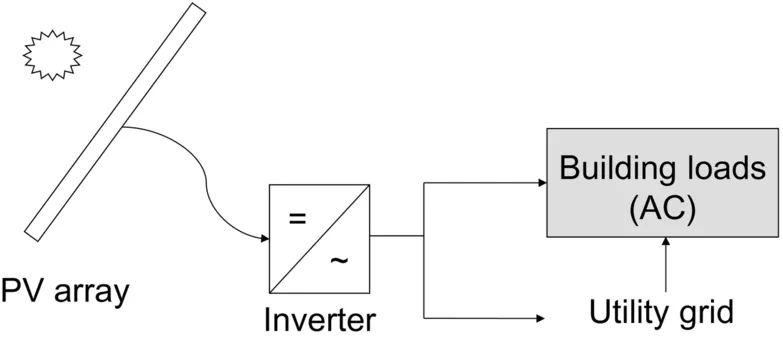
Grid-connected PV systems accounted for around 99% of the cumulative capacity installed worldwide at the end of 2014, according to the International Energy Agency Photovoltaic Power Systems Programme (IEA PVPS) [1], and the market in 2015 is expected to have been similarly dominated by this system category. The concept of the grid-connected PV system is simple and is shown schematically in Fig. 1.1. The PV array is connected to an inverter, which converts the DC output of the array into AC output matching the voltage and frequency of the local grid supply. The system can be connected in parallel with the grid and used to meet local loads. In this case, the output from the PV system will be fed to the load and any shortfall will be supplied from the grid. If there is an excess of generation from the PV system, this excess will be exported to the grid. Alternatively, if there are no significant local loads to be met, the entire output of the PV system may be fed into the grid. It should be noted that the system shown in the figure does not include any facility for the storage of electricity and this is the usual configuration of most current grid-connected systems. However, as the penetration of PV systems on the grid increases and, in some cases, for economic reasons related to the value of local use of electricity, there is a growing interest in storage, either local or central, for grid-connected systems and it can be expected that this will become more common in the future.
The grid-connected system is often classified into distributed and centralized systems, but there are different definitions in regard to how this classification is made. The definition can be made in regard to size (eg, small systems less than, say, 100 kW in capacity would be classed as distributed, whilst larger systems would be considered as centralized), configuration (eg, those meeting local loads are distributed, those only feeding into the grid are centralized) or grid connection point (eg, systems connected to the low voltage distribution feeder are classed as distributed, those connected at a higher voltage are centralized). The IEA PVPS defines distributed (or decentralized) systems in terms of their function being to meet the needs of a specified customer or group of customers, whereas centralized systems feed into the general grid supply. Their data show that distributed systems represented around 56% of the cumulative installed capacity at the end of 2014 [1]. Building-related systems, where the PV array is integrated into or attached to the roof or façade of a building to meet loads within that building, are typical examples of a distributed system.
The stand-alone system operates independently from the grid and provides the only power source to meet a particular specified load, for example, telecommunications mast, water pumping, medical refrigeration and many more. The most common configuration of the system comprises the PV array, battery storage, a charge controller (to control the charging and discharging of the batteries and to provide maximum power point (MPP) tracking) and the specified load. This is shown schematically in Fig. 1.2. The load must form part of the design of the system, so as to ensure the PV array and battery storage are sized to meet the load under all relevant weather conditions. In some cases, particularly when there is a large variation of the load profile and/or a large seasonal variation in sunlight levels, a hybrid system is used, where this includes one or more additional electricity generation technologies (eg, wind turbine, diesel generato...
Table of contents
- Cover image
- Title page
- Table of Contents
- Copyright
- Contributors
- Preface
- Woodhead Publishing Series in Energy
- 1: Introduction to photovoltaic system performance
- Part One: Photovoltaic module performance
- Part Two: Photovoltaic system performance
- Part Three: Maximising photovoltaic (PV) system performance
- Index
Trusted by 375,005 students
Access to over 1.5 million titles for a fair monthly price.
Study more efficiently using our study tools.
Frequently asked questions
Yes, you can cancel anytime from the Subscription tab in your account settings on the Perlego website. Your subscription will stay active until the end of your current billing period. Learn how to cancel your subscription
No, books cannot be downloaded as external files, such as PDFs, for use outside of Perlego. However, you can download books within the Perlego app for offline reading on mobile or tablet. Learn how to download books offline
Perlego offers two plans: Essential and Complete
- Essential is ideal for learners and professionals who enjoy exploring a wide range of subjects. Access the Essential Library with 800,000+ trusted titles and best-sellers across business, personal growth, and the humanities. Includes unlimited reading time and Standard Read Aloud voice.
- Complete: Perfect for advanced learners and researchers needing full, unrestricted access. Unlock 1.5M+ books across hundreds of subjects, including academic and specialized titles. The Complete Plan also includes advanced features like Premium Read Aloud and Research Assistant.
We are an online textbook subscription service, where you can get access to an entire online library for less than the price of a single book per month. With over 1.5 million books across 990+ topics, we’ve got you covered! Learn about our mission
Look out for the read-aloud symbol on your next book to see if you can listen to it. The read-aloud tool reads text aloud for you, highlighting the text as it is being read. You can pause it, speed it up and slow it down. Learn more about Read Aloud
Yes! You can use the Perlego app on both iOS and Android devices to read anytime, anywhere — even offline. Perfect for commutes or when you’re on the go.
Please note we cannot support devices running on iOS 13 and Android 7 or earlier. Learn more about using the app
Please note we cannot support devices running on iOS 13 and Android 7 or earlier. Learn more about using the app
Yes, you can access The Performance of Photovoltaic (PV) Systems by Nicola Pearsall in PDF and/or ePUB format, as well as other popular books in Technology & Engineering & Electrical Engineering & Telecommunications. We have over 1.5 million books available in our catalogue for you to explore.