- 270 pages
- English
- ePUB (mobile friendly)
- Available on iOS & Android
eBook - ePub
Network Function Virtualization
About this book
Network Function Virtualization provides an architectural, vendor-neutral level overview of the issues surrounding the large levels of data storage and transmission requirements needed for today's companies, also enumerating the benefits of NFV for the enterprise.
Drawing upon years of practical experience, and using numerous examples and an easy-to-understand framework, authors Tom Nadeau and Ken Gary discuss the relevancy of NFV and how it can be effectively used to create and deploy new services. Readers will learn how to determine if network function virtualization is right for their enterprise network, be able to use hands-on, step-by-step guides to design, deploy, and manage NFV in an enterprise, and learn how to evaluate all relevant NFV standards, including ETSI, IETF, Openstack, and Open Daylight.
- Provides a comprehensive overview of Network Function Virtualization (NFV)
- Discusses how to determine if network function virtualization is right for an enterprise network
- Presents an ideal reference for those interested in NFV Network Service Chaining, NSC network address translation (NAT), firewalling, intrusion detection, domain name service (DNS), caching, and software defined networks
- Includes hands-on, step-by-step guides for designing, deploying, and managing NFV in the enterprise
- Explains, and contrasts, all relevant NFV standards, including ETSI, IETF, Openstack, and Open Daylight
Information
Chapter 1
Network Function Virtualization
Abstract
In this chapter, we define what Network Function Virtualization is in our view. We also take the time to discuss what its key components are and more importantly, are not.
Keywords
Network function virtualization; NFV; COTS; service function chaining; SFC
Introduction
Arguably, Network Function Virtualization (NFV) builds on some of the basic and now salient concepts of SDN. These include control/data plane separation, logical centralization, controllers, network virtualization (logical overlays), application awareness, application intent control, and the trend of running all of these on commodity (Commercial Off-The-Shelf (COTS)) hardware platforms. NFV expands these concepts with new methods in support of service element interconnectivity such as Service Function Chaining (SFC) and new management techniques that must be employed to cope with its dynamic, elastic capabilities.
NFV is a complex technical and business topic. This book is structured to cover the key topics in both of these areas that continue to fuel the discussions around both proof-of-concept, and ultimate deployments of NFV.
In this chapter, we will first review the evolution of NFV from its origins in physical proprietary hardware, to its first stage of evolution with the onset of virtualization, and then SDN concepts to what exists at present. We will also demonstrate how these most recent requirements for SDN and specifically NFV requirements have evolved into a consistent set of requirements that are not appearing on any network operator RFP/RFQs over the short course of two years.
By the end of the chapter, we will define what NFV is fundamentally about (and support that definition through the material in the remaining chapters).
As was the case with SDN, our definition may not include the hyperbolic properties you hear espoused by invested vendors or endorse the architectures proposed by ardent devotees of newly evolved interest groups attempting to “standardize” NFV. Rather, we will offer a pragmatic assessment of the value proposition of NFV.
Background
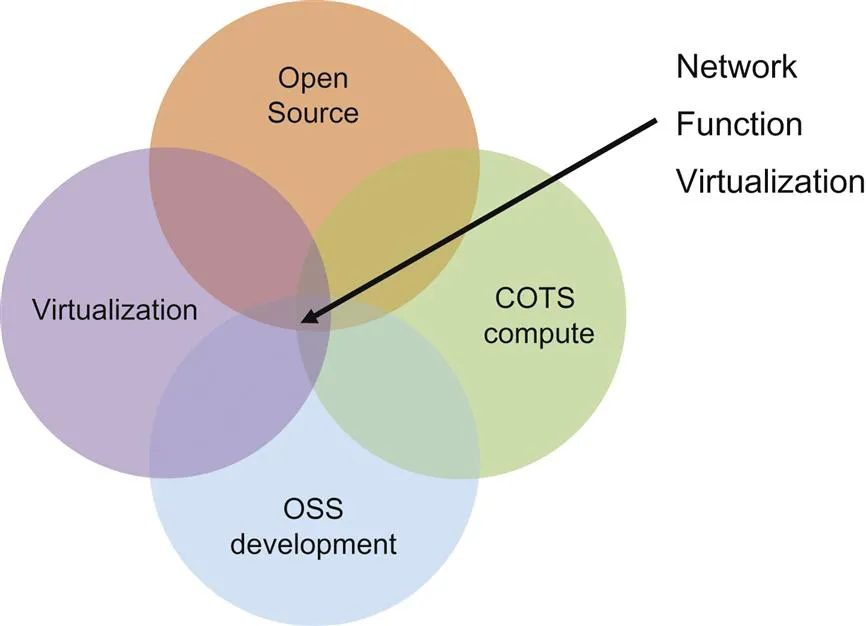
In 2013, in our first book covering SDN1 we described NFV as an application that would manage the splicing together of virtual machines that were deployed as virtualized services (eg, vFirewall) in collaboration with an SDN controller. While the NFV concept continues to have Enterprise application relevance, the evolution of the idea was triggered by a broader set of political/economic realities in the Service Provider industry and technical innovations in areas adjacent and critical to NFV (shown in Fig. 1.1).
The acceleration of pressure that network operators began to see when we wrote about SDN in 2013 grew into real challenges to their businesses.
• What began as an Over The Top (OTT) video and social media incursion into their broadband customer base expanded into OTT service offerings to their business customers. The outsourcing of Enterprise IT to cloud providers positioned these new competitors as potentially more relevant IT partners. Many were now seeing competition in traditional services like virtual private networking (VPN).
• Wireline operators in particular faced large and long-delayed transitions in copper-based services.
• Wireless operators were also facing a potentially expensive architecture change in the move to LTE to accommodate the growing demand for data services. Complicating this was the growing presence of WiFi while competition put pressure on pricing.
These circumstances led to pressure from investors on traditional service providers to increase operational agility, particularly around service agility (reducing costs through automation, just in time provisioning, resource pooling, etc.) and innovation (create new, sticky, and potentially individualized services). The intended result would be twofold—to compete (or at least find a stable position) with the OTT threat and avoid relegation as mere transport providers and to provide new revenue sources.
Many operators had both wireline and wireless operations that they were seeking to consolidate to cut costs and increase efficiency. Here the impacts are seen largely in reducing operational and capital expense (OPEX and CAPEX).
Meanwhile, virtualization concepts evolved from more Enterprise-centric virtual machine operations (eg, VM-motion) to more compose-able and scalable constructs like containers (in public and private clouds) and open source alternatives in orchestration matured.
Optimized performance for virtualization infrastructure started to receive a huge push through efforts like Intel’s Dataplane Development Kit (DPDK)-enabled version of Open vSwitch (OVS)—making the potential throughput of virtualized network functions more attractive.
During this time, cloud computing continued to attract enterprise customers. This not only continued the reduction in COTS costs, but also created an environment in which potentially more service outsourcing may be palatable.
Some highly computer-centric network applications were already beginning to appear as ready-to-run on COTS hardware (eg, IMS, PCRF and other elements of mobile networks), either from incumbents or startups that sensed an easy entry opportunity. Network operators, particularly Tier 1 telcos, were encouraged by the technological gains in virtualization and orchestration over this period and chastened by these business challenges. They responded by working toward establishing what they called next generation network evolutions. Some declared these publicly (eg, AT&T Domain 2.0 or Verizon's SDN/NFV Reference Architecture (https://www.sdxcentral.com/articles/news/verizon-publishes-sdnnfv-reference-architecture/2016/04/)) while others held their cards closer to their vests. In either case, these approaches were all predicated on the promises of SDN and NFV.
Redrawing NFV and Missing Pieces
In our previous book, the functionality spawning the interest in NFV was depicted as the intersection of technological revolutions (Fig. 1.2).
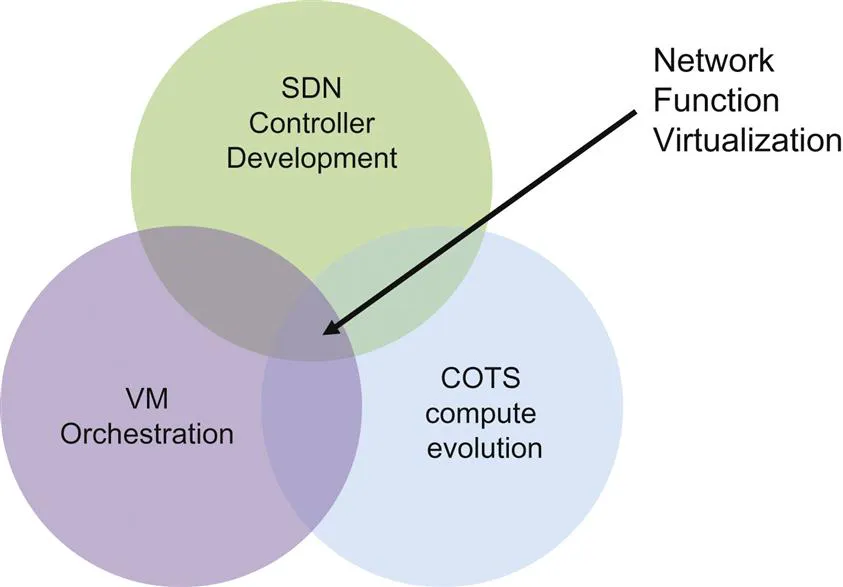
The difference between the view projected in 2013 (Fig. 1.2) and today (Fig. 1.1) is explained by the growth of open source software for infrastructure and some oversights in the original NFV discussion.
Since 2013, there has been an expansion of interest in highly collaborative, multivendor open source environments. Open source software emerged as a very real and viable ingredient of networking and compute environments. This was the case both in the development of orchestration components and SDN controllers based on the Linux operating system, which was already a big part of cloud compute. Open source environments are changing the landscape of how compute and network solutions are standardized, packaged, and introduced to the marketplace. So much so, that this interest is often co-opted in what we refer to as “open-washing” of products targeted at NFV infrastructure. To put a point on this, many of these first phase products or efforts were merely proprietary offerings covered by a thin veil of “open” with a vendor-only or single vendor dominant community that used the term “open” as a marketing strategy.
This growing “open mandate” is explored more fully in Chapter 5, The NFV Infrastructure Management (OpenDaylight and OpenStack), Chapter 6, MANO: Management, Orchestration, OSS, and Service Assurance (MANO), and Chapter 7, The Virtualization Layer—Performance, Packaging, and NFV (virtualization) and has replaced the SDN component of the original drawing (as a super-set).
Other chapters will deal with some missing pieces from the original concept of NFV:
• While the virtualization aspects of those early NFV definitions included the concepts of orchestrated overlays (virtual networking), they did not have a firm plan for service chaining. It was the addition of the SFC concept that finally offered a true service overlay (this is covered in Chapter 4: IETF Related Standards: NETMOD, NETCONF, SFC and SPRING).
• Another critical area that was not included in the original calculus of NFV proponents was the Operations Support Systems (OSS) used to operate and manage the networks where NFV will be used. While a very old concept dating back to networks in the 1960s and 1970s, the OSS is undergoing a potential rebirth as an SDN-driven and highly programmable system (this is covered in Chapter 6: MANO: Management, Orchestration, OSS, and Service Assurance).
Without these critical components, NFV is merely virtualized physical devices (or emulations thereof) dropped down on COTS hardware. Ultimately it is the intersection and combination of the advancement of the OSS, plus advances in COTS computing to support virtualization and high speed network forwarding at severely lower cost points coupled with the latest trend in open source network software components, and virtualization that together form the complete NFV (and later SFC) story.
Defining NFV
Before we explore each of these areas to see how they combine together as the basis for NFV, we should start by defining NFV.
NFV describes and defines how network services are d...
Table of contents
- Cover image
- Title page
- Table of Contents
- Copyright
- Foreword by Dave Ward
- Foreword by Chris Wright
- Preface
- Acknowledgments
- Introduction
- Chapter 1. Network Function Virtualization
- Chapter 2. Service Creation and Service Function Chaining
- Chapter 3. ETSI NFV ISG
- Chapter 4. IETF Related Standards: NETMOD, NETCONF, SFC and SPRING
- Chapter 5. The NFV Infrastructure Management
- Chapter 6. MANO: Management, Orchestration, OSS, and Service Assurance
- Chapter 7. The Virtualization Layer—Performance, Packaging, and NFV
- Chapter 8. NFV Infrastructure—Hardware Evolution and Testing
- Chapter 9. An NFV Future
- Index
Trusted by 375,005 students
Access to over 1.5 million titles for a fair monthly price.
Study more efficiently using our study tools.
Frequently asked questions
Yes, you can cancel anytime from the Subscription tab in your account settings on the Perlego website. Your subscription will stay active until the end of your current billing period. Learn how to cancel your subscription
No, books cannot be downloaded as external files, such as PDFs, for use outside of Perlego. However, you can download books within the Perlego app for offline reading on mobile or tablet. Learn how to download books offline
Perlego offers two plans: Essential and Complete
- Essential is ideal for learners and professionals who enjoy exploring a wide range of subjects. Access the Essential Library with 800,000+ trusted titles and best-sellers across business, personal growth, and the humanities. Includes unlimited reading time and Standard Read Aloud voice.
- Complete: Perfect for advanced learners and researchers needing full, unrestricted access. Unlock 1.5M+ books across hundreds of subjects, including academic and specialized titles. The Complete Plan also includes advanced features like Premium Read Aloud and Research Assistant.
We are an online textbook subscription service, where you can get access to an entire online library for less than the price of a single book per month. With over 1.5 million books across 990+ topics, we’ve got you covered! Learn about our mission
Look out for the read-aloud symbol on your next book to see if you can listen to it. The read-aloud tool reads text aloud for you, highlighting the text as it is being read. You can pause it, speed it up and slow it down. Learn more about Read Aloud
Yes! You can use the Perlego app on both iOS and Android devices to read anytime, anywhere — even offline. Perfect for commutes or when you’re on the go.
Please note we cannot support devices running on iOS 13 and Android 7 or earlier. Learn more about using the app
Please note we cannot support devices running on iOS 13 and Android 7 or earlier. Learn more about using the app
Yes, you can access Network Function Virtualization by Ken Gray,Thomas D. Nadeau in PDF and/or ePUB format, as well as other popular books in Computer Science & Computer Networking. We have over 1.5 million books available in our catalogue for you to explore.