
- 696 pages
- English
- ePUB (mobile friendly)
- Available on iOS & Android
eBook - ePub
About this book
Piezoelectric materials produce electric charges on their surfaces as a consequence of applying mechanical stress. They are used in the fabrication of a growing range of devices such as transducers (used, for example, in ultrasound scanning), actuators (deployed in such areas as vibration suppression in optical and microelectronic engineering), pressure sensor devices (such as gyroscopes) and increasingly as a way of producing energy. Their versatility has led to a wealth of research to broaden the range of piezoelectric materials and their potential uses. Advanced piezoelectric materials: science and technology provides a comprehensive review of these new materials, their properties, methods of manufacture and applications.After an introductory overview of the development of piezoelectric materials, Part one reviews the various types of piezoelectric material, ranging from lead zirconate titanate (PZT) piezo-ceramics, relaxor ferroelectric ceramics, lead-free piezo-ceramics, quartz-based piezoelectric materials, the use of lithium niobate and lithium in piezoelectrics, single crystal piezoelectric materials, electroactive polymers (EAP) and piezoelectric composite materials. Part two discusses how to design and fabricate piezo-materials with chapters on piezo-ceramics, single crystal preparation techniques, thin film technologies, aerosol techniques and manufacturing technologies for piezoelectric transducers. The final part of the book looks at applications such as high-power piezoelectric materials and actuators as well as the performance of piezoelectric materials under stress.With its distinguished editor and international team of expert contributors Advanced piezoelectric materials: science and technology is a standard reference for all those researching piezoelectric materials and using them to develop new devices in such areas as microelectronics, optical, sound, structural and biomedical engineering.
- Provides a comprehensive review of the new materials, their properties and methods of manufacture and application
- Explores the development of piezoelectric materials from the historical background to the present status
- Features an overview of manufacturing methods for piezoelectric ceramic materials including design considerations
Information
1
The development of piezoelectric materials and the new perspective
K. Uchino, The Pennsylvania State University, USA
Abstract:
Certain materials produce electric charges on their surfaces as a consequence of applying mechanical stress. The induced charges are proportional to the mechanical stress. This is called the direct piezoelectric effect and was discovered in quartz by Pierre and Jacques Curie in 1880. Materials showing have a geometric strain proportional to an applied electric field. This is the converse piezoelectric effect, discovered by Gabriel Lippmann in 1881. This article first reviews the historical episodes of piezoelectric materials in the sequence of quartz, Rochelle salt, barium titanate, PZT, lithium niobate/tantalate, relaxor ferroelectrics, PVDF, Pb-free piezoelectrics, and composites. Then, the detailed performances are described in the following section, which serves as the introduction to each chapter in this book. Third, since piezoelectricity is utilized extensively in the fabrication of various devices such as transducers, sensors, actuators, surface acoustic wave devices, frequency control, etc., applications of piezoelectric materials are introduced briefly in conjunction with materials. The author hopes that the reader can ‘learn the history aiming at creating a new perspective for the future of piezoelectric materials’.
Key words:
piezoelectric material
quartz
Rochelle salt
barium titanate
lead zirconate titanate
relaxor ferroelectrics
Pb-free piezoelectrics
electromechanical coupling factor
1.1 The history of piezoelectrics
Any material or product has a lifecycle, which is determined by various ‘external’ environmental forces, which can be summarized under the acronym STEP (Social/cultural, Technological, Economic, and Political).1 We will observe first how these forces encouraged/discouraged the development of piezoelectric materials.
1.1.1 The dawn of piezoelectrics
The Curie brothers (Pierre and Jacques Curie) discovered the direct piezoelectric effect in single crystal quartz in 1880. Under pressure, quartz generated an electrical charge/voltage from quartz and other materials. The root of the word ‘piezo’ means ‘pressure’ in Greek; hence the original meaning of the word piezoelectricity implied ‘pressure electricity’. Materials showing this phenomenon also conversely have a geometric strain proportional to an applied electric field. This is the converse piezoelectric effect, discovered by Gabriel Lippmann in 1881. Recognizing the connection between the two phenomena helped Pierre Curie to develop pioneering ideas about the fundamental role of symmetry in the laws of physics. Meanwhile, the Curie brothers put their discovery to practical use by devising the piezoelectric quartz electrometer, which could measure faint electric currents, and helped Pierre’s wife, Marie Curie, 20 years later in her early research.
It was at 11.45 pm on 10 April 1912 that the tragedy of the sinking of the Titanic happened (see Fig. 1.1). As the reader knows well, this was caused by an iceberg hidden in the sea. If the ultrasonic sonar system had been developed, it would not have happened. Owing to this tragic incident (social force), ultrasonic technology development was motivated, using piezoelectricity.

1.1 The sinking of the Titanic was caused by an iceberg in the sea.
1.1.2 World War I: underwater acoustic devices with quartz and Rochelle salt
The outbreak of World War I in 1914 led to real investment to accelerate the development of ultrasonic technology in order to search for German U-Boats under the sea. The strongest forces both in these developments were social and political. Dr Paul Langevin, a professor at the Industrial College of Physics and Chemistry in Paris, who had a wide circle of friends including Drs Albert Einstein, Pierre Curie, Ernest Rutherford, among others, started experiments on ultrasonic signal transmission into the sea, in collaboration with the French Navy. Langevin succeeded in transmitting an ultrasonic pulse into the sea off the coast of southern France in 1917. We can learn most of the practical development approaches from this original transducer design (Fig. 1.2). First, 40 kHz was chosen for the sound wave frequency. Increasing the frequency (shorter wavelength) leads to the better monitoring resolution of the objective; however, it also leads to a rapid decrease in the reachable distance. Notice that quartz and Rochelle salt single crystals were the only available piezoelectric materials in the early twentieth century. Since the sound velocity in quartz is about 5 km/s, 40 kHz corresponds to the wavelength of 12.5 cm in quartz. If we use a mechanical resonance in the piezoelectric material, a 12.5/2 = 6.25 cm thick quartz single crystal piece is required. However, in that period, it was not possible to produce such large high-quality single crystals.2
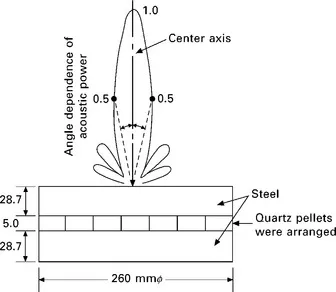
1.2 Original design of the Langevin underwater transducer and its acoustic power directivity.
In order to overcome this dilemma, Langevin invented a new transducer construction; small quartz crystals arranged in a mosaic were sandwiched by two steel plates. Since the sound velocity in steel is in a similar range to quartz, taking 6.25 cm in total thickness, he succeeded to set the thickness resonance frequency around 40 kHz. This sandwich structure is called ̒Langevin type’ and remains popular even today. Notice that quartz...
Table of contents
- Cover image
- Title page
- Table of Contents
- Copyright
- Contributor contact details
- Preface
- Chapter 1: The development of piezoelectric materials and the new perspective
- Part I: Piezoelectric materials
- Part II: Preparation methods and applications
- Part III: Application oriented materials development
- Index
Trusted by 375,005 students
Access to over 1.5 million titles for a fair monthly price.
Study more efficiently using our study tools.
Frequently asked questions
Yes, you can cancel anytime from the Subscription tab in your account settings on the Perlego website. Your subscription will stay active until the end of your current billing period. Learn how to cancel your subscription
No, books cannot be downloaded as external files, such as PDFs, for use outside of Perlego. However, you can download books within the Perlego app for offline reading on mobile or tablet. Learn how to download books offline
Perlego offers two plans: Essential and Complete
- Essential is ideal for learners and professionals who enjoy exploring a wide range of subjects. Access the Essential Library with 800,000+ trusted titles and best-sellers across business, personal growth, and the humanities. Includes unlimited reading time and Standard Read Aloud voice.
- Complete: Perfect for advanced learners and researchers needing full, unrestricted access. Unlock 1.5M+ books across hundreds of subjects, including academic and specialized titles. The Complete Plan also includes advanced features like Premium Read Aloud and Research Assistant.
We are an online textbook subscription service, where you can get access to an entire online library for less than the price of a single book per month. With over 1.5 million books across 990+ topics, we’ve got you covered! Learn about our mission
Look out for the read-aloud symbol on your next book to see if you can listen to it. The read-aloud tool reads text aloud for you, highlighting the text as it is being read. You can pause it, speed it up and slow it down. Learn more about Read Aloud
Yes! You can use the Perlego app on both iOS and Android devices to read anytime, anywhere — even offline. Perfect for commutes or when you’re on the go.
Please note we cannot support devices running on iOS 13 and Android 7 or earlier. Learn more about using the app
Please note we cannot support devices running on iOS 13 and Android 7 or earlier. Learn more about using the app
Yes, you can access Advanced Piezoelectric Materials by Kenji Uchino in PDF and/or ePUB format, as well as other popular books in Technology & Engineering & Electrical Engineering & Telecommunications. We have over 1.5 million books available in our catalogue for you to explore.