Polymer nanocomposites are polymer matrices reinforced with nano-scale fillers. This new class of composite materials has shown enhanced optical, electrical and dielectric properties. This important book begins by examining the characteristics of the main types of polymer nanocomposites and then reviews their diverse applications.Part one focuses on polymer/nanoparticle composites, their synthesis, optical properties and electrical conductivity. Part two describes the electrical, dielectric and thermal behaviour of polymer/nanoplatelet composites, whilst polymer/nanotube composites are the subject of Part three. The processing and industrial applications of these nanocomposite materials are discussed in Part four, including uses in fuel cells, bioimaging and sensors as well as the manufacture and applications of electrospun polymer nanocomposite fibers, nanostructured transition metal oxides, clay nanofiller/epoxy nanocomposites, hybrid epoxy-silica-rubber nanocomposites and other rubber-based nanocomposites.Polymer nanocomposites: physical properties and applications is a valuable reference tool for both the research community and industry professionals wanting to learn about these materials and their applications in such areas as fuel cell, sensor and biomedical technology.
- Gives a comprehensive review of polymer nanocomposites and their properties
- A standard reference on this area
- Written by distinguished editors and a international team of authors
M. Kato; A. Usuki Toyota Central R&D Labs Inc., Japan
1.1 Introduction
A typical polymer composite is a combination of a polymer and a filler. Because compounding is a technique that can ameliorate the drawbacks of conventional polymers, it has been studied over a long period and its practical applications are well known. Reinforcing materials such as ‘short-fiber’ are often used for compounding with thermoplastic polymers in order to improve their mechanical or thermal properties. Polyamide (nylon) is a thermoplastic polymer, and glass fiber and carbon fiber are used mainly as reinforcing materials. A filler, typically micron-sized, is incorporated into composite materials to improve their properties. The polymer matrix and the fillers are bonded to each other by weak intermolecular forces, and chemical bonding is rarely involved. If the reinforcing material in the composite could be dispersed on a molecular scale (nanometer level) and interacted with the matrix by chemical bonding, then significant improvements in the mechanical properties of the material or unexpected new properties might be realized. These are the general goals of polymer nanocomposite studies. In order to achieve this purpose, clay minerals (montmorillonite, saponite, hectorite, etc.) have been discussed as candidates for the filler material. A layer of silicate clay mineral is about 1 nm in thickness and consists of platelets of around 100 nm in width, so it represents a filler with a significantly large aspect ratio. For comparison, a glass fiber 13 μm in diameter with a length of 0.3 mm is 4 × 10⁹ times the size of a typical silicate layer. In other words, if the same volumes of glass fiber and silicate were evenly dispersed, there would be a roughly 109-fold excess of silicate layers, with an exponentially higher specific surface area available.
A nylon 6-clay hybrid (nanocomposite, NCH: Nylon 6-Clay Hybrid) was originally developed by Usuki and his colleagues and was the first polymer nanocomposite to be used practically. Since 1990 when it was first used, various studies and analyses have been reported. In this chapter, details of the NCH and other nylon-clay nanocomposites will be described.
1.2 Nylon 6-clay hybrid (NCH)
Nylon 6-clay hybrid (NCH) is synthesized by the ‘monomer intercalation’ method, in which clay is first ion-exchanged using an organic compound in order for the monomer to intercalate into the layers of the clay. The monomers that form the intercalated layer become a polymerized interlayer. The basic concept of the technique is as follows. Nylon 6 is produced by the ring-opening polymerization of
-caprolactam. This can occur in the presence of clay, after
-caprolactam intercalates into a clay gallery so that the silicate layers are dispersed uniformly in the nylon 6 matrix. Usuki and his colleagues found that organophilic clay that had been ion-exchanged with 12-aminododecanoic acid could be swollen by molten
-caprolactam (the basal spacing expanded from 1.7 nm to 3.5 nm) (Usuki, 1993a).
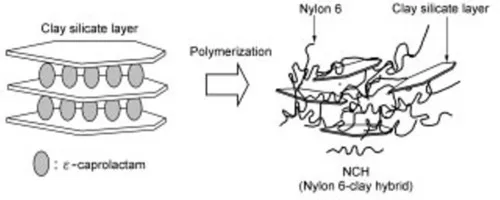
-caprolactam was then polymerized in the clay gallery and the silicate layers were dispersed in nylon 6 to yield a nylon 6-clay hybrid (NCH) (Usuki, 1993b). This is the first example of an industrial clay-based polymer nanocomposite. Figure 1.1 shows a schematic representation of the polymerization.
1.1 Schematic diagram of polymerization to NCH.
The modulus of NCH increased to 1.5 times that of nylon 6, the heat distortion temperature increased to 140°C from 65°C, and the gas barrier effect was doubled at a low loading (2 wt.%) of clay (Kojima, 1993a).
1.3 Synthesis of nylon 6-clay hybrid (NCH)
1.3.1 Clay organization and monomer swelling (Usuki, 1993a)
If montmorillonite containing sodium ions between its layers is dispersed in water, its silicate layers swell uniformly. If an alkylammonium salt is added to this aqueous mixture, the alkylammonium ions are exchanged with the sodium ions. As a result of this exchange reaction, an organophilic clay forms, in which the alkylammonium ions are intercalated between the layers. Because the silicate layers in the clay are negatively charged, they form ionic bonds with the intercalated alkylammonium ions. By changing the length and type of alkyl chain, the hydrophilic/hydrophobic and other characteristics of this organophilic clay can be adjusted such that surface modification of the clay becomes possible.
A novel compounding technique was developed to synthesize nylon 6 in a clay gallery by modifying the clay surface and intercalating monomers into the gallery. The organophilic material used in this technique must satisfy the following three requirements:
1.It must have an ammonium ion at one end of the chain so that it can interact with clay through ionic bonding.
2.It must have a carboxylic acid group (–COOH) at the other end to react with
-caprolactam, a nylon 6 monomer, for ring opening and polymerization.
3.It must possess intermediate polarity to enable
-caprolactam to intercalate among silicate layers.
It was found that 12-aminododecanoic acid (H2N(CH2)11COOH) met all of these requirements.
A representative method for making organophilic clay by using 12-aminododecanoic acid and the method of swelling organophilic clay by
-caprolactam will now be described.
Using a homomixer, 300 g of montmorillonite were uniformly dispersed in 9 liters of deionized water at 80°C. 154 g of 12-aminododecanoic acid and 72 g of concentrated hydrochloric acid were dissolved in 2 liters of deionized water at 80°C. This solution was mixed with the montmorillonite dispersion and stirred for five minutes. The mixture was filtered to obtain aggregates, which were washed twice with water at 80°C and freeze-dried. In this way, organophilic clay was obtained in the form of a fine white powder, called ‘12-Mt’.
12-Mt and
-caprolactam in a weight ratio of 1:4 were mixed thoroughly in a mortar, and then dried and dehydrated for 12 hours in a vacuum desiccator containing phosphorous pentoxide. These specimens were left in a temperature-controlled bath at 100°C for one hour to be swollen by
-caprolactam. They were then subjected to X-ray diffraction measurements at 25°C and 100°C. It was found that two distinct spacings ...
Table of contents
Cover image
Title page
Table of Contents
Copyright page
Contributor contact details
Preface
Part I: Layered silicates
Part II: Nanotubes, nanoparticles and inorganic-organic hybrid systems
Index
Trusted by 375,005 students
Access to over 1.5 million titles for a fair monthly price.
Study more efficiently using our study tools.
Frequently asked questions
Yes, you can cancel anytime from the Subscription tab in your account settings on the Perlego website. Your subscription will stay active until the end of your current billing period. Learn how to cancel your subscription
No, books cannot be downloaded as external files, such as PDFs, for use outside of Perlego. However, you can download books within the Perlego app for offline reading on mobile or tablet. Learn how to download books offline
We are an online textbook subscription service, where you can get access to an entire online library for less than the price of a single book per month. With over 1.5 million books across 990+ topics, we’ve got you covered! Learn about our mission
Look out for the read-aloud symbol on your next book to see if you can listen to it. The read-aloud tool reads text aloud for you, highlighting the text as it is being read. You can pause it, speed it up and slow it down. Learn more about Read Aloud
Yes! You can use the Perlego app on both iOS and Android devices to read anytime, anywhere — even offline. Perfect for commutes or when you’re on the go. Please note we cannot support devices running on iOS 13 and Android 7 or earlier. Learn more about using the app
Yes, you can access Polymer Nanocomposites by Yiu-Wing Mai,Zhong-Zhen Yu in PDF and/or ePUB format, as well as other popular books in Technology & Engineering & Materials Science. We have over 1.5 million books available in our catalogue for you to explore.