- 570 pages
- English
- ePUB (mobile friendly)
- Available on iOS & Android
eBook - ePub
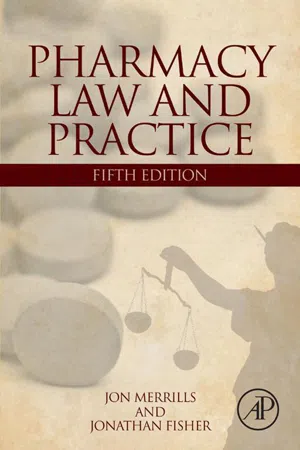
Pharmacy Law and Practice
About this book
Pharmacy Law and Practice, Fifth Edition provides a straightforward and useable guide for students, practitioners, academics and others interested in pharmacy law and practice in the United Kingdom. This multi-dimensional book includes discussions of socio-political influences on legal developments to provide greater insight to the reader. It clearly sets out the background to regulatory issues together with simple and practical statements of what a pharmacist has to do to obey the law. As in previous editions, this book discusses topics thematically rather than by statute. It is a unique and reader-friendly guide that boils down the complex or difficult language of the law, describes the reasons behind it, and illustrates the application to pharmacy practice.
- Thoroughly updated to reflect regulatory and legal developments in areas including employment law, online transactions and internet pharmacies, non-medical prescribing and more
- Takes an intuitive, problem-solving approach and discusses topics thematically rather than by statute to show how all of the larger pieces fit together
- The electronic version of this book contains valuable links to provide readers with the most current information in a rapidly changing subject area
Information
Topic
MedicineSubtopic
International LawChapter 1
The National Health Service
History of the National Health Service from Conception to Latest Changes
Introduction
The National Health Service (NHS) has been described as the most magnificent feature of the UK’s post-Second World War landscape. The National Health Service Act 1946, which created the NHS as we know it, was extensive in scope. It covered the funding of the service and created a national network of hospitals operating in a tiered management structure. Benefits were extended to the whole of the population, which were provided free of charge with medicines and the services of hospitals, doctors, dentists and opticians.
The National Insurance Act 1911
Before 1911 the provision of medical care was haphazard. There were some voluntary health insurance schemes, often based on a particular industry. By 1900 about 7 million people in the country were covered. In return for flat-rate payments they had the services of a doctor and were provided with free medicines.
In 1911 the then Prime Minister, Lloyd George, introduced a compulsory health insurance scheme. It was based on a German scheme which had been introduced in 1883 by Bismarck.
The National Health Insurance Act 1911 covered all employees below a certain income level. The worker paid into a scheme run by a trade union, a friendly society or a commercial insurance company. In return, when the employee was ill he or she received cash, the free services of a doctor and the necessary medicines. However, only about 43% of the population was included. The majority, mainly women and children, were not covered.
A National Health Service Begins
There remained a number of problems with the provision of health services. The hospitals varied in quality of buildings and quality of care. Many were run by charities. Only those persons who actually paid the insurance were covered for treatment. There was no provision for dependants. The problems, especially those of the hospitals, were highlighted during the Second World War.
The 1944 White Paper, ‘A National Health Service’, set out two guiding principles:

The new Socialist government of 1946 immediately implemented the National Health Service Act 1946, which brought the NHS into being on 5 July 1948.
The National Health Service Act 1946
The words are quoted purely for historical purposes – this Act has been superseded.
Section 1 - (1) It shall be the duty of the Minister of Health to promote the establishment in England and Wales of a comprehensive health service designed to secure improvement in the physical and mental health of the people of England and Wales and the prevention, diagnosis and treatment of illness, and for that purpose to provide or secure the effective provision of services in accordance with the following provisions of this Act
(2) The services so provided shall be free of charge, except where any provision of this Act expressly provides for the making and recovery of charges
The Minister was to provide hospital and other medical and nursing services throughout England and Wales,
to such extent as he considers necessary to meet all reasonable requirements (Section 3)
The Act vested in the Minister a range of facilities and services which had previously been owned or provided by local health authorities, voluntary hospital authorities and other voluntary organisations, by the Government under the 1911 scheme and by doctors practising privately.
The Act covered England and Wales, with separate legislation produced for Scotland and Northern Ireland.
The Act recognised the right of doctors to continue to practise privately, either full time or in combination with certain types of NHS contract. They could admit patients to private beds in NHS hospitals.
The 1946 Act set up a tripartite structure to administer the new arrangements. Different authorities controlled the hospitals, the primary care service and the mental hospitals.
Hospitals
The NHS took over control of 2688 hospitals from local authorities, charities and commercial bodies. The new structure consisted of 14 regional boards. Below them were 388 hospital management committees. The special position of teaching hospitals was recognised by the creation of 36 teaching hospital groups. Within each hospital, the management was in the hands of an administrator, a matron and the senior doctor.
Local health authorities administered ambulance services, midwifery, home nursing and provision of care for the mentally ill.
Primary Care
The primary health care services were run by 134 executive councils. The health professionals – general practitioner (GP), dentist, optician and pharmacist – were (and remain) independent contractors. By contrast staff in the hospital services were (and remain) employees.
The Act embodied the principle of the 1911 Act that medicines were normally to be dispensed at pharmacies, and that normally doctors were not to dispense for their patients. Regulations could lay down the conditions for departing from this.
In the first full year of its operation, the Government spent £11.4 billion (in today’s money) on health.
Dispensing by Pharmacists
The 1911 Act gave statutory recognition to the principle, long advocated by pharmacists, that the dispensing of prescriptions should be carried out under normal conditions only by or under the supervision of pharmacists. It applied this principle to the large class of the community which received their medicines under the provisions of the Act. This principle was carried on into the 1946 Act.
T...
Table of contents
- Cover image
- Title page
- Table of Contents
- Copyright
- Preface
- Chapter 1. The National Health Service: History of the National Health Service from Conception to Latest Changes
- Chapter 2. Administration of the NHS: The New Administrative Structure of the NHS
- Chapter 3. NHS Pharmaceutical Services in the Community
- Chapter 4. The Drug Tariff: Reimbursement and Remuneration Structure for Community Pharmacy
- Chapter 5. Applications to Dispense NHS Scripts
- Chapter 6. Rural Dispensing
- Chapter 7. Prescription Charges
- Chapter 8. The Interests of the Public
- Chapter 9. Complaints and Breaches of the Terms of Service
- Chapter 10. Retail Pharmacy
- Chapter 11. The Manufacture and Licensing of Medicinal Products
- Chapter 12. Control on Sales of Medicines
- Chapter 13. Emergency Supplies, Deliveries and Faxed Prescriptions
- Chapter 14. Unlicensed Products
- Chapter 15. Traditional and Alternative Medicines
- Chapter 16. Controlled Drugs
- Chapter 17. Labelling, Leaflets, Packaging and Advertising
- Chapter 18. Poisons and Dangerous Substances
- Chapter 19. Patient Group Directions
- Chapter 20. Non-Medical Prescribing
- Chapter 21. Rights of Access
- Chapter 22. Confidentiality
- Chapter 23. Consent
- Chapter 24. The European Union
- Chapter 25. The Pharmacy Profession
- Chapter 26. Liability in Negligence
- Chapter 27. Business Premises
- Chapter 28. Business Associations
- Chapter 29. The Sale of Goods
- Chapter 30. Employment Law
- Chapter 31. Human Rights
- Index
Trusted by 375,005 students
Access to over 1.5 million titles for a fair monthly price.
Study more efficiently using our study tools.
Frequently asked questions
Yes, you can cancel anytime from the Subscription tab in your account settings on the Perlego website. Your subscription will stay active until the end of your current billing period. Learn how to cancel your subscription
No, books cannot be downloaded as external files, such as PDFs, for use outside of Perlego. However, you can download books within the Perlego app for offline reading on mobile or tablet. Learn how to download books offline
Perlego offers two plans: Essential and Complete
- Essential is ideal for learners and professionals who enjoy exploring a wide range of subjects. Access the Essential Library with 800,000+ trusted titles and best-sellers across business, personal growth, and the humanities. Includes unlimited reading time and Standard Read Aloud voice.
- Complete: Perfect for advanced learners and researchers needing full, unrestricted access. Unlock 1.5M+ books across hundreds of subjects, including academic and specialized titles. The Complete Plan also includes advanced features like Premium Read Aloud and Research Assistant.
We are an online textbook subscription service, where you can get access to an entire online library for less than the price of a single book per month. With over 1.5 million books across 990+ topics, we’ve got you covered! Learn about our mission
Look out for the read-aloud symbol on your next book to see if you can listen to it. The read-aloud tool reads text aloud for you, highlighting the text as it is being read. You can pause it, speed it up and slow it down. Learn more about Read Aloud
Yes! You can use the Perlego app on both iOS and Android devices to read anytime, anywhere — even offline. Perfect for commutes or when you’re on the go.
Please note we cannot support devices running on iOS 13 and Android 7 or earlier. Learn more about using the app
Please note we cannot support devices running on iOS 13 and Android 7 or earlier. Learn more about using the app
Yes, you can access Pharmacy Law and Practice by Jon Merrills,Jonathan Fisher in PDF and/or ePUB format, as well as other popular books in Medicine & International Law. We have over 1.5 million books available in our catalogue for you to explore.