
- 718 pages
- English
- ePUB (mobile friendly)
- Available on iOS & Android
eBook - ePub
Advances in Polyurethane Biomaterials
About this book
Advances in Polyurethane Biomaterials brings together a thorough review of advances in the properties and applications of polyurethanes for biomedical applications. The first set of chapters in the book provides an important overview of the fundamentals of this material with chapters on properties and processing methods for polyurethane. Further sections cover significant uses such as their tissue engineering and vascular and drug delivery applications
Written by an international team of leading authors, the book is a comprehensive and essential reference on this important biomaterial.
- Brings together in-depth coverage of an important material, essential for many advanced biomedical applications
- Connects the fundamentals of polyurethanes with state-of-the-art analysis of significant new applications, including tissue engineering and drug delivery
- Written by a team of highly knowledgeable authors with a range of professional and academic experience, overseen by an editor who is a leading expert in the field
Information
Topic
MedicineSubtopic
Medical Technology & SuppliesPart One
Chemistry, processing and applicationsof polyurethane biomaterials
1
Hierarchal structure–property relationships of segmented polyurethanes
T.J. Touchet, and E.M. Cosgriff-Hernandez∗ Texas A&M University, TX, USA
∗ Corresponding author: [email protected]
∗ Corresponding author: [email protected]
Abstract
The highly tunable mechanical and physicochemical properties of biodegradable polyurethanes make them promising candidates in the rapidly growing market of resorbable devices. Incorporation of hydrolytically or enzymatically cleavable moieties into the polyurethane structure confers biodegradability; however, these modifications can also affect other physical properties. The impact of these modifications on the resulting properties is determined by a number of structural and morphological factors. Successful design of biodegradable polyurethane devices depends on balancing the mechanical property requirements and the desired degradation rate. To this end, key structure–property relationships of biodegradable polyurethanes are discussed. An overview of the effects of structural components, such as soft segment chemistry, hard segment chemistry, and hard segment content, on mechanical properties and degradation rate is provided.
Keywords
Biodegradable; Polyurethane; Structure–property relationships; Tissue engineering1.1. Introduction
The use of polyurethanes in medical devices has been well documented since 1965 [1–7]. More recently, efforts have focused on the design of biodegradable formulations for use in tissue-engineered scaffolds and other resorbable implants. Biodegradable polyurethanes have a unique set of design requirements that include the use of biocompatible components, tissue-like mechanical properties, bioactivity, and an appropriate degradation rate. To accommodate these design criteria, the traditional polyurethane structure is often modified to incorporate degradable linkages or cell-responsive moieties. The impact of these modifications on the resulting properties is affected by a number of factors including phase mixing, soft segment chemistry, hard segment chemistry, hard segment content, and molecular weight [8–12]. To enable rational design for these applications, an in-depth understanding of the effects that structure has on the properties is necessary. Characterization of polyurethane structure–property relationships has historically been focused on biostable formulations [4,9,13–17]. This chapter will provide an overview of the effect of polyurethane structure on physical properties with an emphasis on biodegradable polyurethane elastomers.
1.2. Structure of segmented polyurethanes
1.2.1. Polyurethane reactions
Polyurethane reactions fall into the category of step growth or condensation polymerization. In this process, bifunctional monomers react in a stepwise manner to produce long chains of the reacting monomers [18]. Step growth and polycondensation polymerizations typically expel a small molecule such as water or CO2; however, there is no by-product in the segmented polyurethane synthesis. Segmented polyurethanes comprise a low Tg soft segment that is commonly a low molecular weight macrodiol ranging from 400 to 6000 kg/mol and a glassy or semicrystalline hard segment of diisocyanate and chain extender. In a typical segmented polyurethane synthesis, the macrodiol is reacted with an excess of isocyanate to form a prepolymer. The prepolymer is then reacted with a chain extender to build molecular weight and form a linear block copolymer with alternating blocks of hard segment and soft segment. In contrast to the one-shot method in which the isocyanate, polyol, and chain extender are all reacted at once, the prepolymer method yields more ordered structure and control of properties [18]. Figure 1.1 provides a schematic comparing the polyurethane reaction using the one shot-method and the prepolymer method.
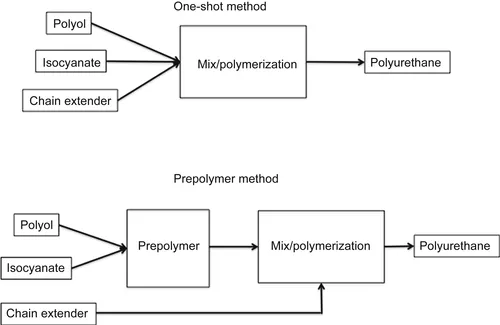
Figure 1.1 Polyurethane polymerization based on the one-shot method and prepolymer method.
The central reactions of polyurethane synthesis are the formation of the carbamate or urethane linkage that occurs when an isocyanate reacts with an alcohol and the urea linkage that occurs when an isocyanate reacts with an amine. Isocyanates are a unique functional group that has several resonant structures and allows for the reaction with both nucleophiles and electrophiles [6,7,18]. Isocyanates react readily with primary alcohol functional groups but will also react with both secondary and tertiary alcohols at slower rates. The reaction kinetics can be influenced by factors such as steric hindrance that can slow down the reaction or proximity of electron-withdrawing groups that increase the rate of reaction [6,7]. The nitrogen of the urethane can also undergo a secondary reaction with excess isocyanate to form allophanates. Urea linkages can undergo similar reactions with excess isocyanate to form biurets [6,7,18]. These reactions provide thermally labile crosslinks and provide additional structural diversity in polyurethane design (Figure 1.2).
1.2.2. Segmented polyurethane elastomers
Elastomers are a class of polymers that can be repeatedly strained and then return to the approximate original length on release of the load. Traditional elastomers such as rubber are able to achieve this elastic behavior by having a low glass transition temperature and a small number of chemical crosslinks that form a permanent network for high recovery. Similar to rubber, thermoplastic polyurethane elastomers have soft segments with low glass transition temperatures but are reinforced...
Table of contents
- Cover image
- Title page
- Table of Contents
- Related titles
- Copyright
- List of contributors
- Woodhead Publishing Series in Biomaterials
- Preface
- Part One. Chemistry, processing and applicationsof polyurethane biomaterials
- Part Two. Polyurethanes for vascular applications
- Part Three. Polyurethane scaffolds for tissue engineering
- Index
- Sync with Jellybooks
Trusted by 375,005 students
Access to over 1.5 million titles for a fair monthly price.
Study more efficiently using our study tools.
Frequently asked questions
Yes, you can cancel anytime from the Subscription tab in your account settings on the Perlego website. Your subscription will stay active until the end of your current billing period. Learn how to cancel your subscription
No, books cannot be downloaded as external files, such as PDFs, for use outside of Perlego. However, you can download books within the Perlego app for offline reading on mobile or tablet. Learn how to download books offline
Perlego offers two plans: Essential and Complete
- Essential is ideal for learners and professionals who enjoy exploring a wide range of subjects. Access the Essential Library with 800,000+ trusted titles and best-sellers across business, personal growth, and the humanities. Includes unlimited reading time and Standard Read Aloud voice.
- Complete: Perfect for advanced learners and researchers needing full, unrestricted access. Unlock 1.5M+ books across hundreds of subjects, including academic and specialized titles. The Complete Plan also includes advanced features like Premium Read Aloud and Research Assistant.
We are an online textbook subscription service, where you can get access to an entire online library for less than the price of a single book per month. With over 1.5 million books across 990+ topics, we’ve got you covered! Learn about our mission
Look out for the read-aloud symbol on your next book to see if you can listen to it. The read-aloud tool reads text aloud for you, highlighting the text as it is being read. You can pause it, speed it up and slow it down. Learn more about Read Aloud
Yes! You can use the Perlego app on both iOS and Android devices to read anytime, anywhere — even offline. Perfect for commutes or when you’re on the go.
Please note we cannot support devices running on iOS 13 and Android 7 or earlier. Learn more about using the app
Please note we cannot support devices running on iOS 13 and Android 7 or earlier. Learn more about using the app
Yes, you can access Advances in Polyurethane Biomaterials by Stuart L. Cooper,Jianjun Guan in PDF and/or ePUB format, as well as other popular books in Medicine & Medical Technology & Supplies. We have over 1.5 million books available in our catalogue for you to explore.