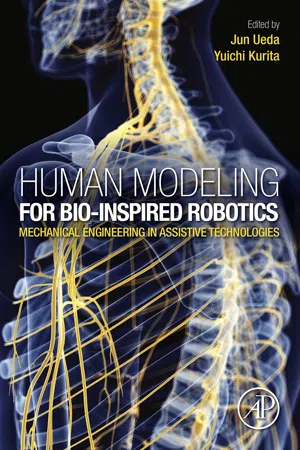
eBook - ePub
Human Modeling for Bio-Inspired Robotics
Mechanical Engineering in Assistive Technologies
- 358 pages
- English
- ePUB (mobile friendly)
- Available on iOS & Android
eBook - ePub
Human Modeling for Bio-Inspired Robotics
Mechanical Engineering in Assistive Technologies
About this book
Human Modelling for Bio-inspired Robotics: Mechanical Engineering in Assistive Technologies presents the most cutting-edge research outcomes in the area of mechanical and control aspects of human functions for macro-scale (human size) applications. Intended to provide researchers both in academia and industry with key content on which to base their developments, this book is organized and written by senior experts in their fields.
Human Modeling for Bio-Inspired Robotics: Mechanical Engineering in Assistive Technologies offers a system-level investigation into human mechanisms that inspire the development of assistive technologies and humanoid robotics, including topics in modelling of anatomical, musculoskeletal, neural and cognitive systems, as well as motor skills, adaptation and integration. Each chapter is written by a subject expert and discusses its background, research challenges, key outcomes, application, and future trends.
This book will be especially useful for academic and industry researchers in this exciting field, as well as graduate-level students to bring them up to speed with the latest technology in mechanical design and control aspects of the area. Previous knowledge of the fundamentals of kinematics, dynamics, control, and signal processing is assumed.
- Presents the most recent research outcomes in the area of mechanical and control aspects of human functions for macro-scale (human size) applications
- Covers background information and fundamental concepts of human modelling
- Includes modelling of anatomical, musculoskeletal, neural and cognitive systems, as well as motor skills, adaptation, integration, and safety issues
- Assumes previous knowledge of the fundamentals of kinematics, dynamics, control, and signal processing
Information
Part I
Modeling of Human Musculoskeletal System/Computational Analysis of Human Movements and Their Applications
Chapter One
Implementation of Human-Like Joint Stiffness in Robotics Hands for Improved Manipulation
A. Deshpande; T. Niehues; P. Rao University of Texas, Austin, TX, United States
Abstract
Humans exploit the inherent biomechanical compliance in their fingers to achieve stability and dexterity during many manipulation tasks. The compliance is a result of muscles, tendons (series compliance), and flexible joints (parallel compliance). While the effects of series compliance have been studied in many robotic systems, research on the effects of joint compliance arranged in parallel with the actuators is limited.
In this chapter we first present an approach for modeling the passive stiffness at the human metacarpophalangeal joint, and the individual contributions from the elasticity of muscle-tendon units (MTUs) and capsule ligament complex (CLC). Toward this goal, we conducted experiments with 10 human subjects and collected joint angle and finger tip force data. The total passive moment and joint angle data were fitted with a double exponential model, and the passive moments due to the MTUs were determined by developing subject-specific models of the passive force length relationships. Our results show that for all the subjects, the work done by the passive moments from the MTUs is less than 50% of total work done, and the CLC provides dominant contributions to the joint stiffness throughout the flexion-extension range of motion.
We then demonstrate, through mathematical modeling, that introducing parallel compliance improves stability and robustness in the presence of time delay in a generic robotic joint. We also provide guidelines to balance the benefits of added stability with increased actuator load when implementing parallel compliance in robotic joints. We designed two 2-DOF tendon-driven fingers with parallel compliance, and developed an impedance control law for object manipulation with the fingers. Experimental results demonstrate the advantages of introducing parallel compliance in robotic hands during dexterous manipulation tasks, specifically in achieving smoother trajectory tracking, improved stability, and robustness to impacts.
Keywords
Human hand; Joint stiffness; Manipulation; Joint compliance; Robotic joint; Series, Parallel compliance
1 Introduction
In the past two decades, a number of robotic hands have been designed with compliance with the goal of improving interaction stability, robustness, and manipulation abilities. In the human hand, the intrinsic, passive joint stiffness of the fingers critically affects the hand functions and joint stability [1–3]. Because of its prominent role in many hand functions, a number of studies have focused on investigating the joint stiffness of the index finger metacarpophalangeal (MCP) joint [2, 4–7]. The muscle-tendon units (MTUs) contribute to the passive MCP joint stiffness by generating resistive forces when stretched [2, 3]. In addition to the MTUs, the capsule-ligament complex (CLC) at the joint provides resistance, especially to prevent joint instability. We carry out a quantitative analysis to determine the relative contributions of MTUs and CLC to the passive joint stiffness, in various finger configurations. It has been established through a number of previous studies that the resistive moment generated at the MCP joint due to the joint stiffness has a double exponential dependency on the joint angle [4, 5]. A number of previous studies assume, either explicitly or implicitly, that this joint stiffness is strictly due to the passive forces from the stretching of muscles and tendons, and that the effect of CLC can be ignored [7, 8].
Inspired by the dominant role of joint compliance in the human hands, we explore the role of mechanical springs added in parallel to the joint actuators (parallel compliance) in robotic hands. While the series compliance, introduced through series elastic actuators (SEA), has been studied extensively [9] an...
Table of contents
- Cover image
- Title page
- Table of Contents
- Copyright
- Contributors
- Motivation
- About This Book
- Part I: Modeling of Human Musculoskeletal System/Computational Analysis of Human Movements and Their Applications
- Part II: Modeling of Human Cognitive/Muscular Skills and Their Applications
- Index
Trusted by 375,005 students
Access to over 1.5 million titles for a fair monthly price.
Study more efficiently using our study tools.
Frequently asked questions
Yes, you can cancel anytime from the Subscription tab in your account settings on the Perlego website. Your subscription will stay active until the end of your current billing period. Learn how to cancel your subscription
No, books cannot be downloaded as external files, such as PDFs, for use outside of Perlego. However, you can download books within the Perlego app for offline reading on mobile or tablet. Learn how to download books offline
Perlego offers two plans: Essential and Complete
- Essential is ideal for learners and professionals who enjoy exploring a wide range of subjects. Access the Essential Library with 800,000+ trusted titles and best-sellers across business, personal growth, and the humanities. Includes unlimited reading time and Standard Read Aloud voice.
- Complete: Perfect for advanced learners and researchers needing full, unrestricted access. Unlock 1.5M+ books across hundreds of subjects, including academic and specialized titles. The Complete Plan also includes advanced features like Premium Read Aloud and Research Assistant.
We are an online textbook subscription service, where you can get access to an entire online library for less than the price of a single book per month. With over 1.5 million books across 990+ topics, we’ve got you covered! Learn about our mission
Look out for the read-aloud symbol on your next book to see if you can listen to it. The read-aloud tool reads text aloud for you, highlighting the text as it is being read. You can pause it, speed it up and slow it down. Learn more about Read Aloud
Yes! You can use the Perlego app on both iOS and Android devices to read anytime, anywhere — even offline. Perfect for commutes or when you’re on the go.
Please note we cannot support devices running on iOS 13 and Android 7 or earlier. Learn more about using the app
Please note we cannot support devices running on iOS 13 and Android 7 or earlier. Learn more about using the app
Yes, you can access Human Modeling for Bio-Inspired Robotics by Jun Ueda,Yuichi Kurita in PDF and/or ePUB format, as well as other popular books in Technology & Engineering & Artificial Intelligence (AI) & Semantics. We have over 1.5 million books available in our catalogue for you to explore.