- 772 pages
- English
- ePUB (mobile friendly)
- Available on iOS & Android
eBook - ePub
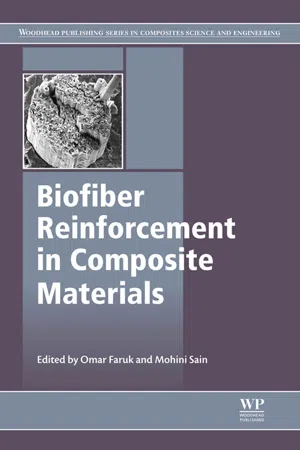
Biofiber Reinforcements in Composite Materials
About this book
Natural fiber-reinforced composites have the potential to replace synthetic composites, leading to less expensive, stronger and more environmentally-friendly materials. This book provides a detailed review on how a broad range of biofibers can be used as reinforcements in composites and assesses their overall performance.
The book is divided into five major parts according to the origins of the different biofibers. Part I contains chapters on bast fibers, Part II; leaf fibers, Part III; seed fibers, Part IV; grass, reed and cane fibers, and finally Part V covers wood, cellulosic and other fibers including cellulosic nanofibers. Each chapter reviews a specific type of biofiber providing detailed information on the sources of each fiber, their cultivation, how to process and prepare them, and how to integrate them into composite materials. The chapters outline current and potential applications for each fiber and discuss their main strengths and weaknesses.
- The book is divided into five major parts according to the origins of the different biofibers - bast, leaf, seed; grass, reed and cane fibers, and finally wood, cellulosic and other fibers including cellulosic nanofibers.
- This book provides a detailed review on how a broad range of biofibers can be used as reinforcements in composites and assesses their overall performance
- The chapters outline current and potential applications for each fiber and discuss their main strengths and weaknesses
Information
Part I
Bast fibres
1
The use of jute fibers as reinforcements in composites
J.A. Khan National University of Bangladesh, Bangladesh
M.A. Khan Bangladesh Atomic Energy Commission, Bangladesh
Abstract
This chapter discusses the physico-mechanical properties of jute-reinforced polymer composites and the applications of jute composites in different areas. The chapter describes the various types of surface modifications such as grafting, mercerization, oxidation, ultraviolet and gamma radiation, etc., which are commonly used to improve the interfacial adhesion between jute fibers and polymer matrices. Jute hybrid composites, interfacial bonding characteristics of grafted jute fibers and fabrication of jute composites are also included.
Key words
jute-reinforced polymer composites
physico-mechanical properties of jute composites
applications of jute composites
surface modifications of jute fibers
jute hybrid composites
interfacial adhesion
fabrication of jute composites
1.1 Introduction
Jute is extracted from the stem of the jute plant which belongs to the genus Corchorus, family Tiliaceae. Only two species of Corchorus, C. capsularis L. and C. olitorius L., are grown commercially. Corchorus capsularis is known as white jute whilst Corchorus olitorius is known as tossa jute. Olitorius and capsularis jute have very similar chemical compositions [1–3]. Jute plants grow to about 2.5 to 3.5 meters in height. The fiber runs along the length of the stem in the form of a lacework sheath. The fiber is removed from the stem by a process of biological retting.
Jute is grown in South Asia. The major jute-producing countries are Bangladesh, India, China and Thailand. Bangladesh provides over 90% of the world’s raw jute and allied fiber exports. Jute is the second most important vegetable fiber after cotton, in terms of usage, global consumption, production and availability. It is one of the cheapest and the strongest of all natural fibers [2, 4]. Jute fiber has traditionally been used for the manufacture of sacks, hessian cloth, carpet and twines, ropes and cords. Jute fiber is used as a reinforcing material in the automotive, construction and packaging industries [5–8].
Jute fiber is biodegradable and eco-friendly. Jute products compare well with other fibers in terms of energy use, greenhouse gas emissions, eutrophication and acidification. It has been reported that one hectare of jute plants absorbs 15 tons of CO2 from the atmosphere and adds 11 tons of O2 during their lifespan of 120 days. Moreover, the decomposed leaves and roots of jute plants increase the fertility of the soil, reducing fertilizer costs. It was reported that the manufacture of 1 kg of fabric of jute shopping bags saves 80 MJ of energy in comparison to 1 kg of polyhydroxyalkanoid (PHA) [9]. Jute hessian cloth consumes lesser amounts of energy and emits negligible amounts of greenhouse gas (GHG) in comparison to thermoplastic polypropylene resin [10] (Table 1.1). Jute fiber is renewable and cheap.
Table 1.1
Energy inputs and greenhouse gas (GHG) outputs for PP plastic resin and jute hessian [10]
| Material | Energy (GJ/1000 kg) | GHG (tonnes CO2 eq.) |
| Polypropylene (PP) | 63 | 1340 |
| Jute hessian | 2 | 0.15 |
1.2 Composition and properties of jute fibers
The chemical composition of jute fiber is as follows [11]:
• Cellulose (61–71%)
• Hemicelluloses (13.6–20.4%)
• Lignin (12–13%)
• Ash (0.5–2%)
• Pectin (~0.2%)
• Wax (~0.5%)
• Moisture (~12.6%).
The different structural components of a fiber play an important role in the properties of the fiber. High cellulose content and low microfibril angle are the desirable properties of a fiber to be used as reinforcement in a polymer matrix. It is notable that jute fiber has high cellulose content and low microfibril angle (~8.0°) [11]. The crystalline portion of cellulose is resistant to strong alkali (17.5 wt%) but is easily hydrolyzed by acid. Cellulose is relatively resistant to oxidizing agents. The cellulose fibrils provide rigidity and high tensile and flexural strength. The fibrils are composed of microfibrils which form a microfibrillar angle with respect to the fiber axis. The microfibrillar angle determines the stiffness of the fibers which in turn governs the mechanical properties of the composite. Low microfibril angle makes the fiber more rigid, inflexible and mechanically more strong. The value of the microfibrillar angle varies from one fiber to another [11–13].
The large number of hydroxyl groups in cellulose gives a hydrophilic character to jute fiber which is responsible for its poor compatibility with hydrophobic polymer matrices and also for its dimensional instability. However, these hydroxyl groups make the fibers more reactive toward the different surface modifiers. The reinforcing efficiency of jute fiber is related to the nature of cellulose and its crystallinity.
The hemicellulose fraction of plant fibers consists of several different sugar units. The principal constituent of jute hemicellulose is composed of the backbone of β-D-xylopyranose units with every seventh unit carrying a terminal α-D-4-o-methylglucuronic acid residue (Fig. 1.1). Hemicellulose is very hydrophilic, soluble in alkali and easily hydrol...
Table of contents
- Cover image
- Title page
- Table of Contents
- Copyright page
- Contributor contact details
- Editor biographies
- Woodhead Publishing Series in Composites Science and Engineering
- Preface
- Part I: Bast fibres
- Part II: Leaf fibres
- Part III: Seed fibres
- Part IV: Grass, reed and cane fibres
- Part V: Wood, cellulosic and other fibres
- Index
Trusted by 375,005 students
Access to over 1.5 million titles for a fair monthly price.
Study more efficiently using our study tools.
Frequently asked questions
Yes, you can cancel anytime from the Subscription tab in your account settings on the Perlego website. Your subscription will stay active until the end of your current billing period. Learn how to cancel your subscription
No, books cannot be downloaded as external files, such as PDFs, for use outside of Perlego. However, you can download books within the Perlego app for offline reading on mobile or tablet. Learn how to download books offline
Perlego offers two plans: Essential and Complete
- Essential is ideal for learners and professionals who enjoy exploring a wide range of subjects. Access the Essential Library with 800,000+ trusted titles and best-sellers across business, personal growth, and the humanities. Includes unlimited reading time and Standard Read Aloud voice.
- Complete: Perfect for advanced learners and researchers needing full, unrestricted access. Unlock 1.5M+ books across hundreds of subjects, including academic and specialized titles. The Complete Plan also includes advanced features like Premium Read Aloud and Research Assistant.
We are an online textbook subscription service, where you can get access to an entire online library for less than the price of a single book per month. With over 1.5 million books across 990+ topics, we’ve got you covered! Learn about our mission
Look out for the read-aloud symbol on your next book to see if you can listen to it. The read-aloud tool reads text aloud for you, highlighting the text as it is being read. You can pause it, speed it up and slow it down. Learn more about Read Aloud
Yes! You can use the Perlego app on both iOS and Android devices to read anytime, anywhere — even offline. Perfect for commutes or when you’re on the go.
Please note we cannot support devices running on iOS 13 and Android 7 or earlier. Learn more about using the app
Please note we cannot support devices running on iOS 13 and Android 7 or earlier. Learn more about using the app
Yes, you can access Biofiber Reinforcements in Composite Materials by Omar Faruk,Mohini Sain in PDF and/or ePUB format, as well as other popular books in Technology & Engineering & Materials Science. We have over 1.5 million books available in our catalogue for you to explore.