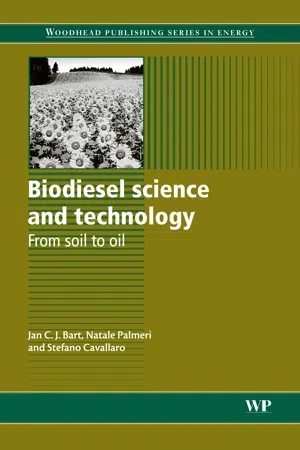
eBook - ePub
Biodiesel Science and Technology
From Soil to Oil
- 864 pages
- English
- ePUB (mobile friendly)
- Available on iOS & Android
eBook - ePub
About this book
Biodiesel production is a rapidly advancing field worldwide, with biodiesel fuel increasingly being used in compression ignition (diesel) engines. Biodiesel has been extensively studied and utilised in developed countries, and it is increasingly being introduced in developing countries, especially in regions with high potential for sustainable biodiesel production.Initial sections systematically review feedstock resources and vegetable oil formulations, including the economics of vegetable oil conversion to diesel fuel, with additional coverage of emerging energy crops for biodiesel production. Further sections review the transesterification process, including chemical (catalysis) and biochemical (biocatalysis) processes, with extended coverage of industrial process technology and control methods, and standards for biodiesel fuel quality assurance. Final chapters cover the sustainability, performance and environmental issues of biodiesel production, as well as routes to improve glycerol by-product usage and the development of next-generation products.Biodiesel science and technology: From soil to oil provides a comprehensive reference to fuel engineers, researchers and academics on the technological developments involved in improving biodiesel quality and production capacity that are crucial to the future of the industry.
- Evaluates biodiesel as a renewable energy source and documents global biodiesel development
- The outlook for biodiesel science and technology is presented exploring the challenges faced by the global diesel industry
- Reviews feedstock resources and vegetable oil formation including emerging crops and the agronomic potential of underexploited oil crops
Information
1
Biodiesel as a renewable energy source
Abstract:
Renewable fuels are bound to gradually replace fossil fuels. Development of biorefineries will mark the historic transition into a sustainable society in which biological feedstocks, processes and products constitute the main pillars of the economy. Energy policy facilitating the introduction of biofuels, including biodiesel, avails itself of taxation, subsidies and mandates, which are not always unquestioned. Transformation of vegetable oils to liquid fuels is achieved industrially by catalytic transesterification. Biodiesel manufacturing, as yet based mainly on rapeseed oil (Europe), soybean oil (US, Argentina, Brazil) and palm oil (SouthEast Asia), requires further feedstock development. Important actors in the biodiesel value chain are vegetable oil milling facilities and the crude oil industry.
Key words
Renewable fuels
energy policy
transformation of biomass
global biodiesel development
biodiesel value chain
1.1 Introduction
Our industrial civilisation greatly depends upon abundant, low-cost energy, which could be produced without political intervention and suppression. Despite recent new oil discoveries in areas such as the Gulf of Mexico, the Tupi and Guará fields off South-East Brazil, Sudan, the Caspian Sea, Sakhalin, and in the Arctic, fossil resources are limited and nowadays no longer constitute cheap and reliable raw materials. Moreover, many convenient industrial products and processes based on these resources seriously damage the environment. The Petrochemical Age has resulted in massive pollution of air, water and soil as well as in emissions of anthropogenic greenhouse gases (GHGs) thought to be at least partly responsible for the recent climate change [1]. Warming of the climate system is unequivocal and there is a high probability that it has taken place during the last five decades or so as a result of human actions. In order to tackle climate change it is deemed necessary to stabilise the atmospheric level of CO2 at about 450 ppm by the end of the century. This means an emission level of 2 t CO2/yr per person, corresponding to the present Indian average (the current European level is at 11–12 t). Meeting the target requires a variety of actions, including government regulation, energy efficiency in industry (in particular in chemical, cement and steel manufacturing) and elsewhere, production of biofuels in a zero-carbon cycle, development of GM crops, nuclear power and photovoltaics, and capturing and storage of CO2. It is uncertain, however, that global warming can be limited by implementing low-carbon energy technologies. This would anyhow require considerable R&D efforts (not foreseen by the Kyoto Protocol). There is also no unanimous short-term solution for reversing climate change. Moreover, the harmful climatic effects (‘human-caused global warming’) due to increased hydrocarbon use and CO2 emissions have also been questioned [2, 3]. About 40% of the heat trapped by GHGs is due to gases other than CO2, primarily methane [4]. In any case, water, oxygen and CO2 enable life. In a higher CO2 environment crop growth rates may be expected to increase to the benefit of agriculture.
The search for alternatives to fossil fuels dates back to the petrol crisis of the early 1970s, but just more recently the looming dangers of a global climate change are driving renewed interest in biofuels. The world is awakening to the renewable fuels movement and the public clamours for alternatives to foreign petroleum. The last 25 years have witnessed a gradual but growing shift towards greater use of plant matter as a feedstock for both energy and chemical products. The combination of steeply increasing oil prices (in particular in the past few years), environmental awareness, relatively low cost of plant material (until recently), and the development of biorefineries prepare mankind for a historic transition into a sustainable society in which biological feedstocks, processes and products become the main pillars of the economy. This calls for further developing the necessary science and technology that enable this transition, while at the same time investing in infrastructure and defining economic and policy issues. The various biomass-based resources used so far for fuel generation have mostly been (expensive) food crops, but biomass also consists of (cheap) agricultural and forest residues (e.g. crop residues, rice husk, cotton stalk, pine sawdust, sugarcane, bagasse, etc.), urban and industrial residues. Renewable and sustainable resources, which can be used as an extender or a complete substitute of diesel fuel may play a significant role in agriculture, industrial and transport sectors in the energy crisis situation. Agricultural and transport sectors are highly diesel dependent. Various alternative fuel options for diesel are mainly biogas, producer gas, ethanol, methanol and vegetable oils.
Development of new energy sources replacing fossil sources is the greatest challenge of the 21st century. Renewable resources are more evenly distributed than fossil resources and energy flows from renewable resources are more than three orders of magnitude higher than current global energy use.
1.2 Energy Policy
The world economy depends on only two significant energy carriers, namely hydrocarbons (natural gas, gasoline and diesel fuel or heating oil) and electrical current. Whereas the primary energy supply differs greatly from nation to nation, hydrocarbons are our main means of storing energy. At present, the consumption of primary energy is globally highly dependent on fossil fuels, as shown in Table 1.1. US energy figures for 2006 are as follows: hydrocarbons, 84.9%; nuclear, 8.2%; hydropower, 2.9%; wood, 2.1%; biofuels, 0.8%; waste, 0.4%; geothermal, 0.3%; wind and solar, 0.3% (43% being used for electricity production). With France being the nuclear energy champion, Germany is a solar power leader (total PV capacity of 3063 MWp in 2006); by the end of 2007, the installed photovoltaic capacity in the EU amounted to 4700 MWp (globally: 9200 MWp). USA and Spain are actively developing large-scale concentrating solar power (CSP) plants. Large-scale hydropower provides virtually all of Norway’s electricity. Wind power accounts for at most 5% of primary energy generation in Europe, but up to 21% in Denmark. Important onshore wind farms are located also in USA, Portugal and Egypt; focus is nowadays on large offshore power stations (e.g. in Sweden, UK, Belgium and the Netherlands).
Table 1.1
Fuel shares of world total primary energy supply (%)
| Energy source | Developed countries | Developing countries |
| Biomass | 3 | 35 |
| Natural gas | 24 | 7 |
| Solid fuels | 26 | 28 |
| Crude oila | 35 | 23 |
| Hydropower | 6 | 6 |
| Nuclear | 6 | 1 |
aGasoline, diesel, aviaton fuel, marine bunker, middle distillates.
In global energy supply fossil fuels amount to over 80%. Petroleum provides a significant fraction (~ 35%) of the world’s energy [5]. Currently, global production and world consumption are approximately 85 Mbd of conventional oil and 11 Mbd of natural gas (totalling 5600 Mt/yr); the predicted output of oil would stall at about 100 Mbd. Even the world’s largest oil fields (Ghawar, 80 billion barrels; offshore Safaniya, 25 billion barrels, and Cantavell, 20 billion barrels) are at the limits of their capacity and oil extraction is slowing down. Actually, it is even not so much the quantity of total reserves (which are still immense), which causes an impending oil shortage in the short term [6], but the flow and quality of the oil recovered. There exists insufficient refining capacity for heavy oils with higher molecular mass hydrocarbon composition and higher sulphur content. The era of cheap oil for our oiloholic society has definitely finished.
According to some (Energy Watch Group), maximum petroleum production already occurred in 2006. More optimistic views foresee an irreversible decline in oil production by 2015–20 in the 20 oil-producing countries (rather concentrated areas of the globe). On the other hand, global demand for energy (and food) is predicted to double by 2050 [7, 8]. The International Energy Agency (IEA) estimates an increase in energy consumption of 55% between 2005 and 2030 at an annual increase of 1.8%. Safe g...
Table of contents
- Cover image
- Title page
- Table of Contents
- Copyright
- About the authors
- Woodhead Publishing Series in Energy
- Preface
- Chapter 1: Biodiesel as a renewable energy source
- Chapter 2: Development of non-food agricultural industries for biofuel applications
- Chapter 3: Oleochemical sources: basic science, processing and applications of oils
- Chapter 4: Vegetable oil formulations for utilisation as biofuels
- Chapter 5: Feedstocks for biodiesel production
- Chapter 6: Emerging new energy crops for biodiesel production
- Chapter 7: Transesterification processes for biodiesel production from oils and fats
- Chapter 8: Biodiesel catalysis
- Chapter 9: Processes for biodiesel production from unrefined oils and fats
- Chapter 10: Biocatalytic production of biodiesel
- Chapter 11: Industrial process technology for biodiesel production
- Chapter 12: Analytical methods and standards for quality assurance in biodiesel production
- Chapter 13: Valorisation of the glycerol by-product from biodiesel production
- Chapter 14: Sustainability and use of biodiesel
- Chapter 15: Evolution of biodiesel and alternative diesel fuels
- Chapter 16: Epilogue: outlook for biodiesel science and technology
- Appendix I: Acronyms/abbreviations of techniques
- Appendix II: (Bio)chemical nomenclature
- Appendix III: Physical and mathematical symbols
- Appendix IV: General abbreviations
- Appendix V: Main websites
- Index
Trusted by 375,005 students
Access to over 1.5 million titles for a fair monthly price.
Study more efficiently using our study tools.
Frequently asked questions
Yes, you can cancel anytime from the Subscription tab in your account settings on the Perlego website. Your subscription will stay active until the end of your current billing period. Learn how to cancel your subscription
No, books cannot be downloaded as external files, such as PDFs, for use outside of Perlego. However, you can download books within the Perlego app for offline reading on mobile or tablet. Learn how to download books offline
Perlego offers two plans: Essential and Complete
- Essential is ideal for learners and professionals who enjoy exploring a wide range of subjects. Access the Essential Library with 800,000+ trusted titles and best-sellers across business, personal growth, and the humanities. Includes unlimited reading time and Standard Read Aloud voice.
- Complete: Perfect for advanced learners and researchers needing full, unrestricted access. Unlock 1.5M+ books across hundreds of subjects, including academic and specialized titles. The Complete Plan also includes advanced features like Premium Read Aloud and Research Assistant.
We are an online textbook subscription service, where you can get access to an entire online library for less than the price of a single book per month. With over 1.5 million books across 990+ topics, we’ve got you covered! Learn about our mission
Look out for the read-aloud symbol on your next book to see if you can listen to it. The read-aloud tool reads text aloud for you, highlighting the text as it is being read. You can pause it, speed it up and slow it down. Learn more about Read Aloud
Yes! You can use the Perlego app on both iOS and Android devices to read anytime, anywhere — even offline. Perfect for commutes or when you’re on the go.
Please note we cannot support devices running on iOS 13 and Android 7 or earlier. Learn more about using the app
Please note we cannot support devices running on iOS 13 and Android 7 or earlier. Learn more about using the app
Yes, you can access Biodiesel Science and Technology by Jan C.J. Bart,N Palmeri,Stefano Cavallaro in PDF and/or ePUB format, as well as other popular books in Technology & Engineering & Renewable Power Resources. We have over 1.5 million books available in our catalogue for you to explore.