- 200 pages
- English
- ePUB (mobile friendly)
- Available on iOS & Android
eBook - ePub
About this book
Silk is a natural, environmentally-friendly fibre with a remarkable range of properties, making it ideal for use in apparel and many other applications. Silk: Processing, properties and applications provides an authoritative reference on sericulture, silk fabric processing, silk properties and its applications.The book begins by looking at key aspects of sericulture, including the range of mulberry and non-mulberry species of silk worm, early and late stage rearing and harvesting of cocoons. Further chapters discuss reeling, weaving and spinning techniques as well as dyeing. The book also discusses the physical and chemical structure of silk as well as its mechanical and thermal properties. Concluding chapters discuss developments in applications and the properties of spider silk.Silk: Processing, properties and applications is useful for textile technologists, fibre scientists and all those with an interest in the characteristics of silk, its production and the varied uses of this important fibre.
- Provides an in-depth summary of silk production, properties and structure-property relationships
- Examines the future of silk, including its application in the textile, biomedical, pharmaceutical and cosmetic industries
- Provides an authoritative reference on sericulture, silk fabric processing, silk properties and its applications
Information
Subtopic
Scienza dei materiali1
Introduction to silk and sericulture
Abstract:
This chapter reviews the different types of mulberry and non-mulberry species of silk moth. It discusses the cultivation of different varieties of mulberry (moriculture), the life cycle and rearing of silkworms as well as the harvesting of cocoons (sericulture). It also covers diseases of silkworms and physical characteristics of cocoons.
Key words
silkworm
mulberry and non-mulberry species
moriculture
sericulture
1.1 Introduction
Silk is one of the oldest fibres known to man. It is an animal fibre produced by certain insects to build their cocoons and webs. Although many insects produce silk, only the filament produced by the mulberry silk moth Bombyx mori and a few others in the same genus is used by the commercial silk industry (Jolly et al., 1979). The silk produced by other insects, mainly spiders, is used in a small number of other commercial applications, for example weapon and telescope cross-hairs and other optical instruments (Spring and Hudson, 2002).
Over the centuries, silk has been regarded as a highly valued textile fibre. Its qualities of strength, elasticity, softness, absorbency, affinity for dyes and adaptability to various forms of twisting continue to meet various applications. Because of its high (tensile) strength, lustre, durability and ability to bind chemical dyes, silk is still considered a leading textile material (Zarkoob et al., 2000). Despite facing keen competition from man-made fibres, silk has maintained its supremacy in the production of luxury apparel and other high-quality goods (Robson, 1998). Silk fibres display unusual mechanical properties: they are strong, extensible and mechanically compressible (Matsumoto et al., 2006). Silk is rightly called the ‘queen of textiles’ for its lustre and feel (Manohar Reddy, 2009). Silk’s natural beauty and properties of comfort in warm weather and warmth during colder months have also made it ideal for high-fashion clothing. As a result there is significant research into the artificial production of silk fibres (Chen et al., 2003).
Sericulture is an art of rearing silkworm for the production of cocoons which are the raw material for the production of silk. The major activities of sericulture comprises food-plant cultivation to feed the silkworms which spin silk cocoons and reeling the cocoons for unwinding the silk filament for value added benefits such as processing and weaving (Kumar et al., 2001). Sericulture is ideally suited for improving the rural economy as it is practised as a subsidiary industry to agriculture. Recent research has also shown that sericulture can be developed as a highly rewarding agro-industry. Sericulture involves the cultivation of mulberry and production of cocoons to produce silk filaments. The best raw silk is obtained from the species of moth B. mori. Breeding of silkworm normally occurs once in a year but, under industrial conditions, eggs may be hatched three times a year. The female moth lays around 350–400 eggs, after which the moths die. As they are subject to hereditary infection, any eggs from infected moths are destroyed. Larvae of about 3 mm are hatched from the eggs. For about 20–30 days, they are carefully nurtured and are fed five times a day on chopped mulberry leaves. In the meantime, the larvae change their skin four times and are formed into caterpillars about 9 cm long. At this point they are ready to spin a cocoon, for which racks, clusters of twigs or straw are provided.
The caterpillars have small openings under their jaws called spinnerets, through which they secrete a protein-like substance. This substance solidifies when it comes in contact with air and the resulting filament is spun around the silkworm in a shape resembling the digit 8. The cocoon, which is about the size of a peanut shell, is completed. The filament is held together by sericin or silk gum. The life of the worm is ended by the process of ‘stoving’ or ‘stifling’ in which the cocoons are heated. Some of the cocoons are preserved so that the pupae or chrysalises inside them develops into moths for further breeding.
There are five major types of silk of commercial importance, obtained from different species of silkworms which in turn feed on a number of food plants. The main type is mulberry. Other varieties of silks are generally termed non-mulberry silks. India has the unique distinction of producing all these commercial varieties of silk.
1.2 Mulberry silk species
The bulk of the commercial silk produced in the world comes from this variety. Mulberry silk (Fig. 1.1) comes from the silkworm B. mori L., which feeds solely on the leaves of the mulberry plant. These silkworms are completely domesticated and reared indoors. In India, the major mulberry-silk-producing states are Karnataka, Andhra Pradesh, West Bengal, Tamil Nadu and Jammu and Kashmir, which together account for 92% of country’s total mulberry raw silk production.
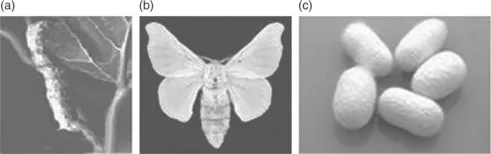
1.1 Mulberry silk: (a) worm, (b) moth and (c) cocoons.
B. mori, the domesticated silkworm, has been reared for over 2000 years. During this long history many mutations have occurred. The process of mutation has resulted in a combination of various genes producing a large number of silkworm races. Silkworm races are classified on the basis of:
1. place of origin;
2. voltinism (the number of broods or generations produced in a year); and
3. moulting (the number of times the caterpillar sheds its skin before starting to spin silk).
1.2.1 Classification by place of origin
There are various races defined by place of origin:
• Indian;
• Japanese;
• Chinese and
• European.
Indian races
These races are indigenous to India and South East Asia. The larval stage is longer and they are resistant to high temperature and humidity. The size of the cocoon and larvae is small. In many cases, the cocoon is spindle shaped and the cocoon colour is green, yellow or white. The cocoon shell is thin. They are mainly multivoltines. The quality of the silk filament is good.
Thai silk is only one of the mulberry silkworm (B. mori) silks but it differs somewhat in appearance, and is yellower in colour. The filament is coarser and has more silk gum (e.g., up to 37%) than normal mulberry silk (e.g. 20–25%) (Dhavalikar, 1962; Zhou et al., 2000). These characteristics cause Thai silk to have its own style after weaving. Thai silk products are mainly produced by domestic industries in the northern and north east part of Thailand.
Japanese races
These races are indigenous to Japan. The larvae are robust. The cocoon is peanut-shaped. The cocoon colour is usually white but some are also green or yellow. The ratio of double cocoons is higher. The quality of the silk filaments is inferior, being thick and short. They are univoltine or bivoltine.
Chinese races
These races are indigenous to China. The larvae are resistant to high temperature but not to high humidity. The larvae grow quickly. The cocoon shape is, in many cases, elliptical but sometimes spindle shaped. The cocoon colour is white, golden yellow, green, red or beige. The cocoon filament is fine and reelability is good. They are univoltine, bivoltine and multivoltine.
European races
These races are indigenous to Europe and Central Asia. Larvae are vulnerable to ...
Table of contents
- Cover image
- Title page
- Table of Contents
- Copyright
- Woodhead Publishing Series in Textiles
- Chapter 1: Introduction to silk and sericulture
- Chapter 2: Silk reeling and silk fabric manufacture
- Chapter 3: Structural aspects of silk
- Chapter 4: Mechanical and thermal properties of silk
- Chapter 5: The dyeing of silk
- Chapter 6: Developments in the processing and applications of silk
- Chapter 7: Spider silks and their applications
- Index
Trusted by 375,005 students
Access to over 1.5 million titles for a fair monthly price.
Study more efficiently using our study tools.
Frequently asked questions
Yes, you can cancel anytime from the Subscription tab in your account settings on the Perlego website. Your subscription will stay active until the end of your current billing period. Learn how to cancel your subscription
No, books cannot be downloaded as external files, such as PDFs, for use outside of Perlego. However, you can download books within the Perlego app for offline reading on mobile or tablet. Learn how to download books offline
Perlego offers two plans: Essential and Complete
- Essential is ideal for learners and professionals who enjoy exploring a wide range of subjects. Access the Essential Library with 800,000+ trusted titles and best-sellers across business, personal growth, and the humanities. Includes unlimited reading time and Standard Read Aloud voice.
- Complete: Perfect for advanced learners and researchers needing full, unrestricted access. Unlock 1.5M+ books across hundreds of subjects, including academic and specialized titles. The Complete Plan also includes advanced features like Premium Read Aloud and Research Assistant.
We are an online textbook subscription service, where you can get access to an entire online library for less than the price of a single book per month. With over 1.5 million books across 990+ topics, we’ve got you covered! Learn about our mission
Look out for the read-aloud symbol on your next book to see if you can listen to it. The read-aloud tool reads text aloud for you, highlighting the text as it is being read. You can pause it, speed it up and slow it down. Learn more about Read Aloud
Yes! You can use the Perlego app on both iOS and Android devices to read anytime, anywhere — even offline. Perfect for commutes or when you’re on the go.
Please note we cannot support devices running on iOS 13 and Android 7 or earlier. Learn more about using the app
Please note we cannot support devices running on iOS 13 and Android 7 or earlier. Learn more about using the app
Yes, you can access Silk by K. Murugesh Babu in PDF and/or ePUB format, as well as other popular books in Tecnologia e ingegneria & Scienza dei materiali. We have over 1.5 million books available in our catalogue for you to explore.