- 436 pages
- English
- ePUB (mobile friendly)
- Available on iOS & Android
eBook - ePub
About this book
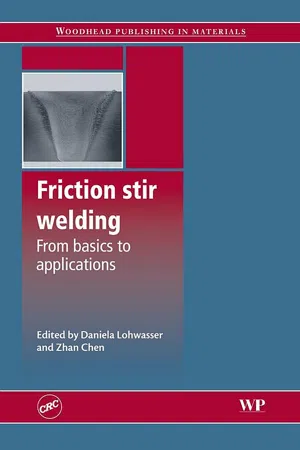
Friction stir welding (FSW) is a highly important and recently developed joining technology that produces a solid phase bond. It uses a rotating tool to generate frictional heat that causes material of the components to be welded to soften without reaching the melting point and allows the tool to move along the weld line. Plasticized material is transferred from the leading edge to trailing edge of the tool probe, leaving a solid phase bond between the two parts. Friction stir welding: from basics to applications reviews the fundamentals of the process and how it is used in industrial applications.Part one discusses general issues with chapters on topics such as basic process overview, material deformation and joint formation in friction stir welding, inspection and quality control and friction stir welding equipment requirements and machinery descriptions as well as industrial applications of friction stir welding. A chapter giving an outlook on the future of friction stir welding is included in Part one. Part two reviews the variables in friction stir welding including residual stresses in friction stir welding, effects and defects of friction stir welds, modelling thermal properties in friction stir welding and metallurgy and weld performance.With its distinguished editors and international team of contributors, Friction stir welding: from basics to applications is a standard reference for mechanical, welding and materials engineers in the aerospace, automotive, railway, shipbuilding, nuclear and other metal fabrication industries, particularly those that use aluminium alloys.
- Provides essential information on topics such as basic process overview, materials deformation and joint formation in friction stir welding
- Inspection and quality control and friction stir welding equipment requirements are discussed as well as industrial applications of friction stir welding
- Reviews the variables involved in friction stir welding including residual stresses, effects and defects of friction stir welds, modelling thermal properties, metallurgy and weld performance
Information
1
Introduction
D. Lohwasser Airbus, Germany
Z. Chen AUT University, New Zealand
Abstract
This introduction gives a brief overview about the content of this book. The history from the first welding using gas and arc welding followed by resistance and later fusion welding processes (plasma, laser) is briefly described together with the need to develop friction and friction stir welding (FSW) processes. The rapid introduction of FSW is underlined by showing the numbers of publications and patents as well as the evolving standards on this process for ship, train and aerospace applications.
Key words
friction stir welding
book introduction
quick history of welding and FSW invention
publications and patents
FSW standards
1.1 Pre-word
The first time people hear about friction stir welding (FSW) they usually state: “How does it work?”. After a brief introduction describing the process their next reaction is always disbelief: “And that works?”. Without seeing the very unspectacular process themselves – looking, touching, feeling – they cannot believe the extraordinarily good properties described to them. A very impressive way to demonstrate these properties is to give them a bending sample not yet bent and let them perform the 180° bending test themselves. This is a very effective way of getting rid of any remaining doubts. Watching the process is always impressive, although as said earlier, it is quite unspectacular. All one sees is a rotating tool pushing through material. Usually there are no fumes, spattering, red glowing material and the noise is also quite low, making it difficult to believe that such a simple process can produce such good joints (it is similar to inspecting a vacuum cleaner which is not loud enough when it is used – people will not believe that its suction performance is sufficient). So for FSW there is a great need to demonstrate and show the process to the world in order to have a widespread introduction into many industry sectors.
This book aims to describe the main process principles followed by a deep analysis of the material flow helping to understand why this process works so well. After that, a description of the equipment requirements followed by equipment examples is given. With today’s knowledge on FSW, numerous applications have evolved which are summarized in an extensive way, followed by a chapter giving an outlook on the research and development work to come in the near future. In the second part of this book, the complex topic of residual stress in FS welded structures is first discussed. This is followed by a detailed discussion on the effects of defects, which is a topic of high practical importance. To minimize the testing needs, a detailed description of the modelling achievements is given, especially on thermal modelling, which is for both better process understanding and for selecting FSW parameters. In the final chapter, an in-depth discussion on the metallurgy and the evolving mechanical and corrosion properties of FS welded joints are described.
1.2 History of friction stir welding (FSW)
Although joining pieces together can be traced back more than 2000 years, welding emerged as a viable manufacturing process only in the late 1800s (Messler Jr, 2004). This emergence followed a number of important discoveries and inventions: acetylene and oxyacetylene blowpipe leading to gas welding, arc between two carbon electrodes leading to arc welding, and joule heating leading to resistance welding. While gas welding was practised more widely in the early part of 1990s, arc welding has since gradually become a popular and major welding method as many advances have been made in various aspects of arc welding processes. Gas and arc welding processes are fusion-welding, meaning that locally the locations the pieces to be welded first melt together and subsequently solidify.
For arc fusion welding, the density of the heat energy is usually low. Low energy density fusion welding processes result in a wide weld (molten) metal zone and wide heat-affected zones, resulting in a high level of solidification-related defects, strength reduction and distortion. To address this, in the late 1950s, a more constricted arc (plasma arc) technique was developed and plasma arc welding reduces the adverse effects of low energy density heat sources. Also in the late 1950s, with the invention of laser, which enables a high concentration of heat source and thus deep penetration, laser beam welding was soon developed. Nowadays laser beam welding is used industrially and is capable of making a thick weld with very narrow molten weld zone and heat-affected zones. Thus, quality and properties of laser welds are generally high.
Before the invention of FSW, there had been some important technological developments of non-fusion welding processes, which have found some limited industrial uses. A significant process of these is friction welding developed at the time just before laser was invented. During friction welding, the pieces to be welded are compressed together and are made to move relative to each other. Thus frictional heat is generated to soften the material in the joining region. The final step is made by applying increased pressure to the softened material to yield a metallurgical joint without melting the joining material. However, the relative movement during the stage of heat generation and material softening can practically only be rotational or linear. Although friction welding operation is simple, the welding geometry is quite restricted and thus its use is also limited.
As has been described, the demand for increasing energy density of fusion welding is a major driving force for a number of important innovations and developments in fusion welding. For solid state welding, the thermomechanical principle of friction welding had actually laid an important base for the later invention of FSW. The Welding Institute (TWI) in the UK had for years engaged in various R&D and industrial activities on friction welding and surfacing. Wayne Thomas and his colleagues in TWI had long worked on and developed a number of variants of friction welding. In particular, they developed friction extrusion, friction hydropillar processing and third-body friction joining processes. Over the long period of working on and developing these materials processes, the group in TWI observed and studied a number of important phenomena and accumulated an in-depth working knowledge of those processes. These include the highly plasticized third-body effect and the transportation phenomena of the plasticized material, the adiabatic heating during deformation, and the relationship between the torque and rotation speed when a sufficient amount of the plasticized material is present during processing.
With the in-depth understanding and working knowledge of the various friction-based material processes, a welding technique with an effective transportation mechanism for the plasticized material suited for a wide range of geometries of structures to be welded was never far from the minds of Wayne Thomas and his colleagues. One day in 1991, in a flash of inspiration, Wayne Thomas realized that with the use of a...
Table of contents
- Cover image
- Title page
- Table of Contents
- Copyright page
- Contributor contact details
- 1: Introduction
- Part I: General issues
- Part II: Variables in friction stir welding
- Index
Trusted by 375,005 students
Access to over 1.5 million titles for a fair monthly price.
Study more efficiently using our study tools.
Frequently asked questions
Yes, you can cancel anytime from the Subscription tab in your account settings on the Perlego website. Your subscription will stay active until the end of your current billing period. Learn how to cancel your subscription
No, books cannot be downloaded as external files, such as PDFs, for use outside of Perlego. However, you can download books within the Perlego app for offline reading on mobile or tablet. Learn how to download books offline
Perlego offers two plans: Essential and Complete
- Essential is ideal for learners and professionals who enjoy exploring a wide range of subjects. Access the Essential Library with 800,000+ trusted titles and best-sellers across business, personal growth, and the humanities. Includes unlimited reading time and Standard Read Aloud voice.
- Complete: Perfect for advanced learners and researchers needing full, unrestricted access. Unlock 1.5M+ books across hundreds of subjects, including academic and specialized titles. The Complete Plan also includes advanced features like Premium Read Aloud and Research Assistant.
We are an online textbook subscription service, where you can get access to an entire online library for less than the price of a single book per month. With over 1.5 million books across 990+ topics, we’ve got you covered! Learn about our mission
Look out for the read-aloud symbol on your next book to see if you can listen to it. The read-aloud tool reads text aloud for you, highlighting the text as it is being read. You can pause it, speed it up and slow it down. Learn more about Read Aloud
Yes! You can use the Perlego app on both iOS and Android devices to read anytime, anywhere — even offline. Perfect for commutes or when you’re on the go.
Please note we cannot support devices running on iOS 13 and Android 7 or earlier. Learn more about using the app
Please note we cannot support devices running on iOS 13 and Android 7 or earlier. Learn more about using the app
Yes, you can access Friction Stir Welding by Daniela Lohwasser,Zhan Chen in PDF and/or ePUB format, as well as other popular books in Technology & Engineering & Industrial Engineering. We have over 1.5 million books available in our catalogue for you to explore.