- 276 pages
- English
- ePUB (mobile friendly)
- Available on iOS & Android
eBook - ePub
Biomarkers in Alzheimer's Disease
About this book
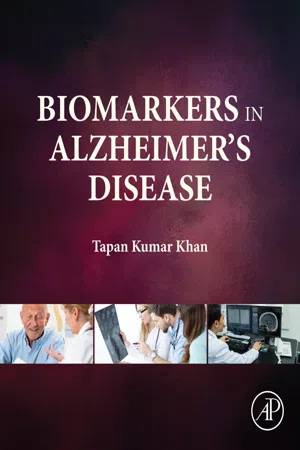
Biomarkers in Alzheimer's Disease provides a comprehensive overview of all modalities of Alzheimer's disease biomarkers, including neuroimaging, cerebrospinal fluid, genomic, and peripheral systems. Each chapter integrates molecular/cellular abnormality due to Alzheimer's disease and technological advancement of biomarkers techniques.The book is ideal for clinical neuroscience and molecular/cellular neuroscience researchers, psychiatrists, and allied healthcare practitioners involved in the diagnosis and management of patients with cognitive impairment and Alzheimer's disease, and for differential diagnosis of Alzheimer's disease with other non-Alzheimer's dementia.
- Presents a comprehensive overview detailing all modalities of Alzheimer's disease biomarkers
- Written for neuroscience researchers and clinicians studying or treating patients with Alzheimer's Disease
- Integrates, in each chapter, the molecular/cellular abnormality due to Alzheimer's disease and the technological advancement of biomarkers techniques
Information
Chapter 1
Introduction to Alzheimer’s Disease Biomarkers
Summary
A discussion of the biomarkers of Alzheimer’s disease (AD) first requires a brief historical perspective and an introduction to the disease. This chapter provides a brief outline of AD epidemiology, the definition of an AD biomarker, the classification and features of AD, and AD risk factors, followed by a description of the structure and content of each of the following chapters and their focus on specific types of AD biomarkers. The greatest challenge in AD biomarker research is the ability to diagnose AD and assess prognosis while patients are in the preclinical stages of the disease, before clinical symptoms develop, in order to identify those who would benefit from therapeutic intervention. The importance of diagnosing preclinical stages of AD is presented as a major focus of ongoing research in the field of AD biomarker discovery, development, and validation. A discussion of the societal impact of AD and its associated economic burden to the healthcare system is included at the end of the chapter. This book is intended to provide a comprehensive summary of AD, the rationale for identifying AD biomarkers, and their potential applications in AD diagnosis, prognosis, longitudinal disease tracking, evaluating drug efficacy, and guiding therapeutic intervention.
Keywords
biomarker
Alzheimer’s disease (AD) biomarkers
preclinical AD
risk factors of AD
genetics of AD
economic impact of AD
cerebrospinal fluid biomarkers
neuroimaging biomarkers
genetic biomarkers
peripheral biomarkers
1.1. Historical Background
Alzheimer disease (AD) was discovered in 1906 by Dr. Alois Alzheimer based on his observations and treatment of a 51-year-old patient, Miss Augusta “D” (Maurer et al., 1997; Strassnig and Ganguli, 2005), at the Frankfurt Psychiatric Hospital starting in Nov 1901. At the time, Dr. Alzheimer was a senior assistant at the institution. When Miss Augusta “D” died on Apr. 8, 1906, Dr. Alzheimer conducted the autopsy of her brain and described the morphological and histological changes in the brain that continue to stand as hallmarks of modern day AD neuropathology (Hippius and Neundörfer, 2003). Dr. Alzheimer presented his first report of Alzheimer’s disease at a congress in Tübingen, Germany, in 1906. He described two neuropathological phenomena: amyloid plaques, which he referred to as “miliary bodies,” and neurofibrillary tangles, which he described as “dense bundles of fibrils.” In 1910, Dr. Emil Kraepelin (Dr. Alzheimer’s supervisor) introduced the term “Alzheimer’s disease” to recognize Dr. Alzheimer’s contribution to the discovery of this disorder. Dr. Alzheimer died in 1915 without knowing the outstanding contribution he made to the history of medica...
Table of contents
- Cover
- Title page
- Table of Contents
- Dedication
- Copyright
- Foreword
- Preface
- Acknowledgments
- Chapter 1: Introduction to Alzheimer’s Disease Biomarkers
- Chapter 2: Clinical Diagnosis of Alzheimer’s Disease
- Chapter 3: Neuroimaging Biomarkers in Alzheimer’s Disease
- Chapter 4: Genetic Biomarkers in Alzheimer’s Disease
- Chapter 5: Alzheimer’s Disease Cerebrospinal Fluid (CSF) Biomarkers
- Chapter 6: Peripheral Fluid-Based Biomarkers of Alzheimer’s Disease
- Chapter 7: Cell-Based Alzheimer’s Disease Biomarkers
- Index
Trusted by 375,005 students
Access to over 1.5 million titles for a fair monthly price.
Study more efficiently using our study tools.
Frequently asked questions
Yes, you can cancel anytime from the Subscription tab in your account settings on the Perlego website. Your subscription will stay active until the end of your current billing period. Learn how to cancel your subscription
No, books cannot be downloaded as external files, such as PDFs, for use outside of Perlego. However, you can download books within the Perlego app for offline reading on mobile or tablet. Learn how to download books offline
Perlego offers two plans: Essential and Complete
- Essential is ideal for learners and professionals who enjoy exploring a wide range of subjects. Access the Essential Library with 800,000+ trusted titles and best-sellers across business, personal growth, and the humanities. Includes unlimited reading time and Standard Read Aloud voice.
- Complete: Perfect for advanced learners and researchers needing full, unrestricted access. Unlock 1.5M+ books across hundreds of subjects, including academic and specialized titles. The Complete Plan also includes advanced features like Premium Read Aloud and Research Assistant.
We are an online textbook subscription service, where you can get access to an entire online library for less than the price of a single book per month. With over 1.5 million books across 990+ topics, we’ve got you covered! Learn about our mission
Look out for the read-aloud symbol on your next book to see if you can listen to it. The read-aloud tool reads text aloud for you, highlighting the text as it is being read. You can pause it, speed it up and slow it down. Learn more about Read Aloud
Yes! You can use the Perlego app on both iOS and Android devices to read anytime, anywhere — even offline. Perfect for commutes or when you’re on the go.
Please note we cannot support devices running on iOS 13 and Android 7 or earlier. Learn more about using the app
Please note we cannot support devices running on iOS 13 and Android 7 or earlier. Learn more about using the app
Yes, you can access Biomarkers in Alzheimer's Disease by Tapan Khan in PDF and/or ePUB format, as well as other popular books in Psychology & Pathology. We have over 1.5 million books available in our catalogue for you to explore.