eBook - ePub
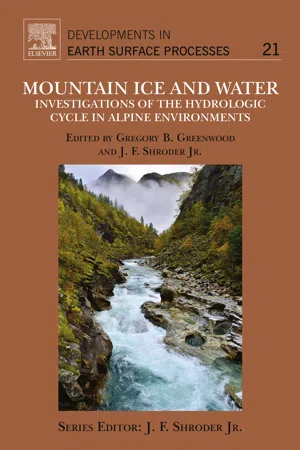
Mountain Ice and Water
Investigations of the Hydrologic Cycle in Alpine Environments
- 402 pages
- English
- ePUB (mobile friendly)
- Available on iOS & Android
eBook - ePub
Mountain Ice and Water
Investigations of the Hydrologic Cycle in Alpine Environments
About this book
Mountain Ice and Water: Investigations of the Hydrologic Cycle in Alpine Environments is a new volume of papers reviewed and edited by John Shroder, Emeritus Professor of Geography and Geology at the University of Nebraska at Omaha, USA, and Greg Greenwood, Director of the Mountain Research Initiative from Bern, Switzerland.
Chapters in this book were derived from research papers that were delivered at the Perth III Conference on Mountains of our Future Earth in Scotland in October 2015. The conference was established to help develop the knowledge necessary to respond effectively to the risks and opportunities of global environmental change and to support transformations toward global sustainability in the coming decades.
To this end, the conference and book have investigated the future situation in mountains from three points of view. (1) Dynamic Planet: Observing, explaining, understanding, and projecting Earth, environmental, and societal system trends, drivers, and processes and their interactions to anticipate global thresholds and risks, (2) Global Sustainable Development: Increasing knowledge for sustainable, secure, and fair stewardship of biodiversity, food, water, health, energy, materials, and other ecosystem services, and (3) Transformations towards Sustainability: Understanding transformation processes and options, assessing how these relate to human values, emerging technologies and social and economic development pathways, and evaluating strategies for governing and managing the global environment across sectors and scales.
- Derived from research papers delivered at the Perth III Conference on Mountains of our Future Earth in Scotland in October 2015
- Helps develop the knowledge necessary for responding effectively in coming decades to the risks and opportunities of global environmental change and tactics for global sustainability
- Provides the research community working on global change in mountains with a broader framework established by the Future Earth initiative
Information
Topic
Physical SciencesSubtopic
Environmental ScienceChapter 1
The Drakensberg Escarpment as the Great Supplier of Water to South Africa
S.J. Taylor∗,1, J.W.H. Ferguson∗, F.A. Engelbrecht§, V.R. Clark¶, S. Van Rensburg|| and N. Barker∗∗ ∗Centre for Environmental Studies, University of Pretoria, South Africa §Climate Studies, Modelling and Environmental Health, Natural Resources and the Environment, Council for Scientific and Industrial Research (CSIR), South Africa ¶Botany Department, Rhodes University, South Africa ||South African Environmental Observation Network, Pretoria, South Africa **School of Plant Sciences, University of Pretoria, South Africa
1 Corresponding author: E-mail: [email protected]
1 Corresponding author: E-mail: [email protected]
Abstract
The South African Drakensberg escarpment is a major source of water for South Africa with considerable economic value. Long-term climate change has not yet significantly affected rainfall or runoff from the Drakensberg, and human population growth is expected to be the largest medium-term constraint on water availability. Most of the rivers from the Drakensberg are currently overutilized and it is foreseen that this situation will worsen dramatically by 2025, particularly in the spatial aspects of demand and supply. Human land management has a major influence on water discharge and siltation at all altitudes. Water and water infrastructure are acknowledged as major constraints to future economic expansion in South Africa. Systematic long-term data on rainfall and other climatic variables are lacking above 2000 m asl and impedes a thorough understanding of the risk factors affecting water from this important mountain range. Significant temperature increases are projected across the mountain range under low mitigation climate change futures, with potential impacts on evaporation rates and land use, but the rainfall futures of the region are uncertain. Because of the strategic value of this water, and as a risk reduction measure, a holistic data-based mountain governance approach is now needed which manages the Drakensberg in its totality, rather than as a fragmented collection of catchments, protected areas, and vast unprotected landscapes.
Keywords
Climate; Climate change; Drakensberg; Escarpment; Mountain ecosystem services; Observatory; Rainfall; Water governance; Water needs; Water provision; Water runoff; Water yield
Introduction
The world's freshwater supplies are increasingly constrained by population growth, urbanization, pollution, eutrophication, changing rainfall patterns, and shrinking cryospheric storage, a situation that could cause conflicts (Jury and Vaux, 2007; Rijsberman, 2006; Ohlsson, 2000). Water security, along with food and energy security, has become a global issue (Ludwig and Roson, 2015). Mountains are vital sources of freshwater for rural and commercial agriculture as well as cities, for national and local economies, and for ecosystems and ecosystem services, often with a trans-boundary dimension. Mountains induce precipitation and are able to store large amounts of water either as snow or ice, or in soil, wetlands, or peat areas, for slow release throughout the year. The Intergovernmental Panel on Climate Change (IPCC) warned in 2007 that mountain regions around the world will be particularly affected by climate change and that hydrological changes can already be observed (Christensen et al., 2007).
South Africa is a water-deficient country with mean annual precipitation (MAP) ranging from around 1250 mm in the east to 50 mm in the west with a mean value of around 500 mm (Tyson, 1991). Half of the country has an annual precipitation less than 400 mm. In addition, potential evaporation increases strongly from around 1200 mm annually in the east to 2750 mm in the west (de Villiers, 1996). For this reason, water scarcity in South Africa is considered a potentially significant constraint for economic development, and it is predicted the demand will outstrip supply in the near future (Blignaut and van Heerden, 2009). In addition to this, the impacts of climate change on regional water resources are uncertain. While there is high confidence in the projections of drastic increases in temperature over southern Africa under low mitigation (Engelbrecht et al., 2015), and while the region is likely to become generally drier (Niang et al., 2014), the rainfall features of eastern South Africa are uncertain. Some models project drier scenarios while others suggested wetter futures (DEA, 2013, p. 3–10; Niang et al., 2014). Even in wetter scenarios, the increase in temperature may still result in reduced water availability (DEA, 2013, pp. 3–10; Engelbrecht et al., 2015).
In 2000, surface water resources were already over-allocated in 5 of 19 Water Management Areas (WMAs) (DEA, 2013, p. 77). The Department of Environmental Affairs (DEA) estimates that South Africa faces shortages of between 2% and 13% of total water requirements by 2025, but if climate change projections and other uncertainties are included, these shortages could be as high as 19–33% by 2025 (DEA, 2013, p. 21).
While not in the group of the world’s 30 most water-stressed countries (Maddocks et al., 2015), South Africa’s water resources are considered stressed, bordering on water scarce, with a current water availability of 1100 m3 per person per annum (StatsSA, 2010, p. 7). The United Nations considers a water availability of less than 1700 m3 per person per annum as “water stress,” with values below 1000 m3 per person per annum considered as “water scarcity” (StatsSA, 2010, p. 7). The Intergovernmental Panel on Climate Change (IPCC) projected that water availability in South Africa could decline in time to below the 1000 m3 per capita per annum threshold deemed to be a global standard for human “well-being” because of climate change impacts (Bates et al., 2008). As elsewhere i...
Table of contents
- Cover image
- Title page
- Table of Contents
- Developments in Earth Surface Processes, 21
- Copyright
- List of Contributors
- Editorial Foreword
- Chapter 1. The Drakensberg Escarpment as the Great Supplier of Water to South Africa
- Chapter 2. Mountain Area Glaciers of Russia in the 20th and the Beginning of the 21st Centuries
- Chapter 3. Inorganic Chemistry in the Mountain Critical Zone: Are the Mountain Water Towers of Contemporary Society Under Threat by Trace Contaminants?
- Chapter 4. Water and Sustainability in the Lake Mývatn Region of Iceland: Historical Perspectives and Current Concerns
- Chapter 5. Precipitation and Conifer Response in Semiarid Mountains: A Case From the 2012–15 Drought in the Great Basin, USA
- Chapter 6. Impact of Hydropower on Mountain Communities in Teesta Basin of Eastern Himalaya, India
- Chapter 7. Climate Vulnerability, Water Vulnerability: Challenges to Adaptation in Eastern Himalayan Springsheds
- Chapter 8. Neotropical Mountains Beyond Water Supply: Environmental Services as a Trifecta of Sustainable Mountain Development
- Chapter 9. What Future for Mountain Glaciers? Insights and Implications From Long-Term Monitoring in the Austrian Alps
- Index
Trusted by 375,005 students
Access to over 1.5 million titles for a fair monthly price.
Study more efficiently using our study tools.
Frequently asked questions
Yes, you can cancel anytime from the Subscription tab in your account settings on the Perlego website. Your subscription will stay active until the end of your current billing period. Learn how to cancel your subscription
No, books cannot be downloaded as external files, such as PDFs, for use outside of Perlego. However, you can download books within the Perlego app for offline reading on mobile or tablet. Learn how to download books offline
Perlego offers two plans: Essential and Complete
- Essential is ideal for learners and professionals who enjoy exploring a wide range of subjects. Access the Essential Library with 800,000+ trusted titles and best-sellers across business, personal growth, and the humanities. Includes unlimited reading time and Standard Read Aloud voice.
- Complete: Perfect for advanced learners and researchers needing full, unrestricted access. Unlock 1.5M+ books across hundreds of subjects, including academic and specialized titles. The Complete Plan also includes advanced features like Premium Read Aloud and Research Assistant.
We are an online textbook subscription service, where you can get access to an entire online library for less than the price of a single book per month. With over 1.5 million books across 990+ topics, we’ve got you covered! Learn about our mission
Look out for the read-aloud symbol on your next book to see if you can listen to it. The read-aloud tool reads text aloud for you, highlighting the text as it is being read. You can pause it, speed it up and slow it down. Learn more about Read Aloud
Yes! You can use the Perlego app on both iOS and Android devices to read anytime, anywhere — even offline. Perfect for commutes or when you’re on the go.
Please note we cannot support devices running on iOS 13 and Android 7 or earlier. Learn more about using the app
Please note we cannot support devices running on iOS 13 and Android 7 or earlier. Learn more about using the app
Yes, you can access Mountain Ice and Water by John F. Shroder,Gregory B Greenwood in PDF and/or ePUB format, as well as other popular books in Physical Sciences & Environmental Science. We have over 1.5 million books available in our catalogue for you to explore.