
- 424 pages
- English
- ePUB (mobile friendly)
- Available on iOS & Android
eBook - ePub
Materials in Sports Equipment
About this book
Improvements in materials technology have made a significant impact on sporting performance in recent years. Advanced materials and novel processing methods have enabled the development of new types of equipment with enhanced properties, as well as improving the overall design of sporting goods. The interdependence between material technology and design, and its impact on many of the most popular sports, is reviewed in this book.Materials in sports equipment presents the latest research, from a distinguished panel of international contributors, into the chemical structure and composition, microstructure and material processing of the various materials used in a wide range of sports. The relationship between performance and design is examined in detail for each sport covered.Part one concentrates on the general use of materials in sports. Here, the reader is given a broad insight into the overall influence of materials in sports, and the significance of material processing and design. Part two focuses on showing how individual sports have benefited from recent improvements in material technology. It also analyses the way in which improvements in our understanding of biomechanics and the engineering aspects of sports equipment performance have influenced materials and design. Sports whose equipment is considered in detail include: golf, tennis, cycling, mountaineering, skiing, cricket and paralympic sports. The overall aim of the book is to make the reader aware of the interaction between the type of material, its selection, processing and surface treatment, and show how this process underpins the performance of the final sporting product.It is essential reading for all materials scientists and researchers working in this rapidly developing field.
- A major handbook on materials in sports
- Practical guide to material selection and processing for equipment used in many popular sports
- Shows how material characteristics affect design and performance
Information
1
Introduction
M. Jenkins University of Birmingham, UK
1.1 Factors determining sports performance
Sports performance is determined by a number of factors. Some originate from the human element of the sport, such as the physiological and psychological state of the competitor, while others originate from the equipment used by the athlete, which includes the design and materials used in the production of the item. Two sports that clearly illustrate these ideas are the triple jump and the pole vault.
If the world records for these sports are examined over the last 100 years, it is clear that the jump lengths and heights have increased, as shown in Figs 1.1 and 1.2. The factors that affect performance in the triple jump are dominated by the human elements, with increases in performance deriving from improved fitness and psychological condition in the athlete. In addition, advances in high speed video and motion analysis equipment have resulted in a deeper understanding of the biomechanics of the event, which in turn has developed the technique of the athlete.
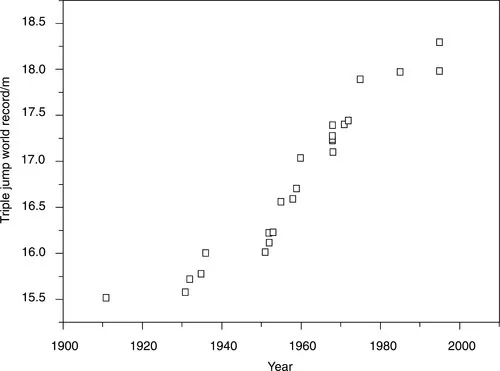
1.1 Variation of triple jump world record with time.
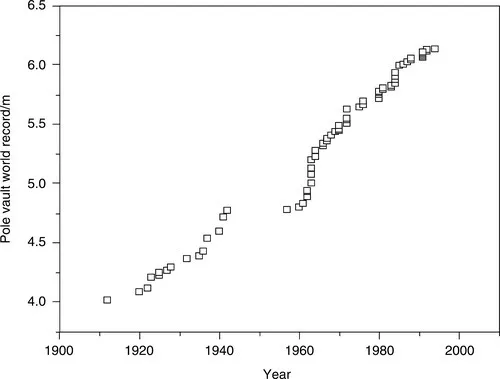
1.2 Variation of pole vault world record with time.
Evidence of the human factors can be found in the event of the pole vault; however, these factors are accompanied by additional elements, such as the design and materials used in the construction of the vaulting pole. Closer inspection of the trend shown in Fig. 1.2 reveals what is almost a step change in the world record in the post-war years. The explanation for this occurrence requires an investigation of the evolution of the construction of the vaulting poles over the last 100 years.
1.2 Materials, processing and design in the pole vault
The regulations that define the construction of vaulting poles are very liberal.1 As a result, the design has evolved significantly. Poles were originally made from solid sections of wood, but rapidly developed through the use of long lengths of bamboo. The incorporation of this natural material dramatically reduced the weight of the poles, but also limited the length of poles that could be made. In the post-war years, two innovations of materials technology occurred. In the 1950s, aluminium poles were introduced, but they were followed rapidly in the 1960s by glass fibre composites. The introduction of glass fibre poles corresponds to the step change in world record identified above, but the explanation of why this occurred requires analysis of the biomechanics of the event.2
In essence, the athlete aims to generate the maximum possible kinetic energy before the launch. When the athlete leaves the ground, kinetic energy is transformed into potential energy, which in part determines the height of the jump. Therefore, the faster the athlete runs in the sprint stage of the vault, the higher the jump height. However, there is another dimension to the event, one that derives from the materials used in the production of the pole.
If the event is examined using high speed video equipment, it is clear that a high degree of bending in the pole develops following the launch. This is made possible due to the selection of glass fibre composite as a construction material. The properties of the material include relatively high strength, intermediate stiffness and low density. Intermediate stiffness enables the pole to bend, but relatively high strength ensures that the pole will not break. If a vault with a bamboo or aluminium pole is examined photographically, there is little evidence of significant bending, due to increased bending stiffnesses in these poles. The consequence of the glass fibre composite material selection is that the stored elastic strain energy is increased because of the decreased radii of curvatures made possible as a result of high strength and low bending stiffness. Since glass fibre composites generally exhibit relatively low densities, the speed on the athlete prior to launch can be correspondingly increased, resulting in increased kinetic energy. The release of the stored strain energy, coupled with the transformation of kinetic to potential energy, helps to propel the athletes to ever-increasing heights, as shown by the step change in Fig. 1.2.
There is also a materials processing aspect to the performance of the vaulting pole. The composite material must be laminated to provide the required bending stiffness. This is accomplished by designing a stack sequence or ‘layup’ that aligns a significant proportion of the reinforcing fibres along the long axis of the pole. There are many commercial variations of stack sequence, but a common method of pole production is to use a process called filament winding. This process is based on the winding of resin-impregnated fibre tows around a mandrel at a defined winding pitch. This angle, together with the pole cross-section, determines the bending stiffness of the pole. The filament-wound structure is often supplemented by additional layers of woven material, as shown in Fig. 1.3 (shown previously in Interdisciplinary Science Reviews1).
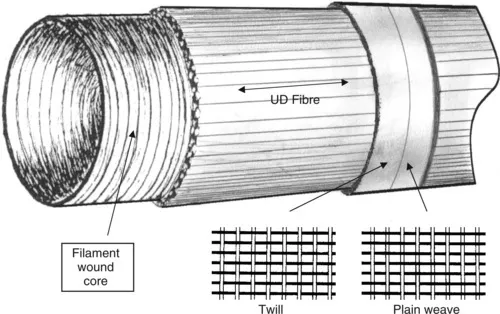
1.3 The filament wound structure.
The importance of materials processing is also evident when the athlete begins his or her descent from the bar. The energy considerations are simple: potential energy is now transformed into kinetic energy as the athlete accelerates toward the ground head first. To save the competitor from very serious injury, a large crash mat is placed in the landing area. The mat is made from low-stiffness polymer foam that absorbs the impact energy as the athlete lands. The energy absorption is a direct consequence of the foam structure in that air can be expelled from the mat and the cell walls of the foam can collapse. The cellular structure is created during the processing of the polymer, and the foam microstructure can be controlled by utilising different processing methods.
Clearly, sporting performance depends on a number of factors, both human and materials based. However, there is also an interdependence on the materials and the design of sports equipment, in that developments in materials technology can result in materials with improved properties that facilitate evolutionary or revolutionary change in design. A good example of this is in the sport of fencing.
1.3 The relationship between materials technology and design – fencing masks
Although the sport of fencing is one of the four original events of the modern Olympic Games, the International Olympic Committee recently threatened the sport with exclusion from future Games. The committee suggested that the sport should be made more accessible to television audiences by making the competitors’ faces more visible. This suggestion catalysed a change in the sport that had been slowly occurring over many years. Fencing equipment manufacturers have, for many years, desired to produce a mask that enabled clear vision of the opponent. However, numerous attempts have been made to replace the metal mesh designs, but none offered any degree of consistent safety or clarity of vision.
The design of the fencing mask was recently revolutionised by the innovation of a traditional engineering thermoplastic known as Lexan (polycarbonate).This polymer is transparent and demonstrates high impact resistance.A comparison between metal and polymer masks has been made by the Italian Fencing Federation laboratory.3 These tests showed that the polymer sections outperformed the conventional metal mesh sections. Drop tests from heights of 55 cm with a mass of 2.4 kg fastened to a steel spike (section 3 × 3 mm square with a pyramidal point angle 60°) showed that the metal mesh was penetrated, whereas the Lexan visor was only marked by the impression of the pyramidal point.Tests on complete masks also showed that the Lexan based masks did not deform, whereas the metal mesh versions did. This deformation was deemed sufficient to injure the fencer. It is clear that the use of polycarbonate has enabled a design transformation to occur; one that is a direct result of materials technology.
1.4 Overview of ‘materials in sport’
Consideration of the three sports outlined above – the triple jump, pole vault and fencing – reveals several non-human factors that affect sports performance, materials selection, processing and equipment design. These elements form the main themes of the book, with each chapter focusing on a number of the above themes. Chapters 8 and 9 introduce tennis racket frames and strings, in Chapter 9 the evolution of the frame design is discussed in terms of the materials technology and a range of construction materials are reviewed. The effects of processing are addressed by consideration of the lamination process and the final production methods. In Chapter 8, string materials and the mechanical properties are introduced. Creep and friction properties are developed and player perception is discussed. In general, the materials focus is on polymers and polymer composites.
The polymer theme is also developed in Chapters 2 and 4, where the use of polymer foams in body protection and running shoe materials is detailed. In Chapter 2, body protection, cycle helmets and football shin pads are introduced and developed as case studies. Each section covers materials selection, biomechanics and current test standards. The effect of processing on the performance of polymer foams is introduced in Chapter 4. The compression behaviour and durability of the foams is discussed in conjunction with the biomechanics of running. A range of polymeric and metallic materials are covered in the chapter on mountaineering: Chapter 11. A detailed discussion of the use of these materials in a range of items including ropes and carabiners is presented. Current research in the area is also highlighted.
The sport of cycling is discussed in Chapter 10. The discussion begins with an overview of the historical development of ...
Table of contents
- Cover image
- Title page
- Table of Contents
- Copyright page
- Preface
- Contributors
- 1: Introduction
- Part I: General uses
- Part II: Particular sports
- Index
Trusted by 375,005 students
Access to over 1.5 million titles for a fair monthly price.
Study more efficiently using our study tools.
Frequently asked questions
Yes, you can cancel anytime from the Subscription tab in your account settings on the Perlego website. Your subscription will stay active until the end of your current billing period. Learn how to cancel your subscription
No, books cannot be downloaded as external files, such as PDFs, for use outside of Perlego. However, you can download books within the Perlego app for offline reading on mobile or tablet. Learn how to download books offline
Perlego offers two plans: Essential and Complete
- Essential is ideal for learners and professionals who enjoy exploring a wide range of subjects. Access the Essential Library with 800,000+ trusted titles and best-sellers across business, personal growth, and the humanities. Includes unlimited reading time and Standard Read Aloud voice.
- Complete: Perfect for advanced learners and researchers needing full, unrestricted access. Unlock 1.5M+ books across hundreds of subjects, including academic and specialized titles. The Complete Plan also includes advanced features like Premium Read Aloud and Research Assistant.
We are an online textbook subscription service, where you can get access to an entire online library for less than the price of a single book per month. With over 1.5 million books across 990+ topics, we’ve got you covered! Learn about our mission
Look out for the read-aloud symbol on your next book to see if you can listen to it. The read-aloud tool reads text aloud for you, highlighting the text as it is being read. You can pause it, speed it up and slow it down. Learn more about Read Aloud
Yes! You can use the Perlego app on both iOS and Android devices to read anytime, anywhere — even offline. Perfect for commutes or when you’re on the go.
Please note we cannot support devices running on iOS 13 and Android 7 or earlier. Learn more about using the app
Please note we cannot support devices running on iOS 13 and Android 7 or earlier. Learn more about using the app
Yes, you can access Materials in Sports Equipment by Mike Jenkins in PDF and/or ePUB format, as well as other popular books in Technology & Engineering & Materials Science. We have over 1.5 million books available in our catalogue for you to explore.