- 464 pages
- English
- ePUB (mobile friendly)
- Available on iOS & Android
eBook - ePub
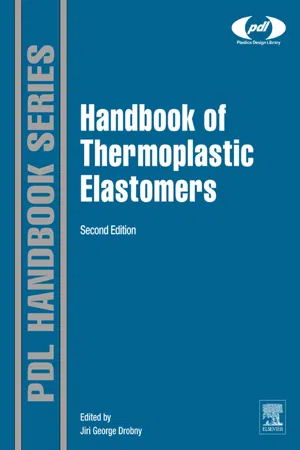
Handbook of Thermoplastic Elastomers
About this book
Handbook of Thermoplastic Elastomers, Second Edition presents a comprehensive working knowledge of thermoplastic elastomers (TPEs), providing an essential introduction for those learning the basics, but also detailed engineering data and best practice guidance for those already involved in polymerization, processing, and part manufacture.
TPEs use short, cost-effective production cycles, with reduced energy consumption compared to other polymers, and are used in a range of industries including automotive, medical, construction and many more. This handbook provides all the practical information engineers need to successfully utilize this material group in their products, as well as the required knowledge to thoroughly ground themselves in the fundamental chemistry of TPEs. The data tables included in this book assist engineers and scientists in both selecting and processing the materials for a given product or application.
In the second edition of this handbook, all chapters have been reviewed and updated. New polymers and applications have been added — particularly in the growing automotive and medical fields — and changes in chemistry and processing technology are covered.
- Provides essential knowledge of the chemistry, processing, properties, and applications for both new and established technical professionals in any industry utilizing TPEs
- Datasheets provide "at-a-glance" processing and technical information for a wide range of commercial TPEs and compounds, saving readers the need to contact suppliers
- Includes data on additional materials and applications, particularly in automotive and medical industries
Information
1
Introduction
Abstract
Thermoplastic elastomers are polymeric materials, which exhibit elasticity at ambient temperatures and can be processed as plastics by melt processing techniques. They are essentially two-phase systems. The phase separation is the result of limited compatibility of the two phases involved. When the material is heated above the melting point or melting range of the hard phase, its melt becomes homogeneous and can be shaped into desired shapes and/or products.
Keywords
Advantages and disadvantages of thermoplastic elastomers; Block copolymers; Classification and nomenclature of thermoplastic elastomers; Current demand for thermoplastic elastomers; Dynamic vulcanization; Elasticity; Elastomers; Forecast of the growth of demand for thermoplastic elastomers; Phase separation; Phase structure; Physical thermoreversible cross-links; Polymerization; Thermoplastic elastomers1.1. Elasticity and Elastomers
Rubber-like materials consist of relatively long polymeric chains having a high degree of flexibility and mobility, joined into a network structure. The flexibility and mobility allow for a very high deformability. When subjected to external stresses, the long chains may alter their configuration rather rapidly because of the high chain mobility. When the chains are linked into a network structure, the system has solid-like features, where the chains are prevented from flowing relative to each other under external stresses. As a result, a typical rubber may be stretched up to 10 times its original length. On removal of the external forces, it rapidly recovers to its original dimensions, with essentially no residual or nonrecoverable strain.
When ordinary solids, such as crystalline or glassy materials, when subjected to external forces, the distance between two atoms may be altered by only a few angstroms for the deformation to be recoverable. At higher deformations, such materials either flow or fracture. The response of rubber is entirely intramolecular, that is, the externally applied forces are transmitted to the long chains through the linkages at their extremities, change their conformations, and each chain acts as an individual spring in response to the external forces [1].
High-molecular-weight polymers form entanglements by molecular intertwining (see Fig. 1.1(A)), with a spacing (in the bulk state) characteristic of the particular molecular structure. The spacing is expressed by molecular weight between entanglements (Me). Some examples of values of the molecular weight Me for several elastomers are in Table 1.1. Thus, a high-molecular-weight polymeric melt will show transient rubber-like behavior even in the absence of any permanent intermolecular bonds [2]. In a cross-linked elastomer, many of these entanglements are permanently locked in (see Fig. 1.1(B)), and at high enough degree of cross-linking, they may be regarded fully equivalent to cross-links, and as such they contribute to the elastic response of the material.
A n...
Table of contents
- Cover image
- Title page
- Table of Contents
- Series
- Copyright
- Dedication
- Preface to the Second Edition
- Preface to the First Edition
- Acknowledgments
- 1. Introduction
- 2. Brief History of Thermoplastic Elastomers
- 3. Additives
- 4. Processing Methods Applicable to Thermoplastic Elastomers
- 5. Styrenic Block Copolymers
- 6. Thermoplastic Elastomers Prepared by Dynamic Vulcanization
- 7. Polyolefin-Based Thermoplastic Elastomers
- 8. Thermoplastic Elastomers Based on Halogen-Containing Polyolefins
- 9. Thermoplastic Polyurethane Elastomers
- 10. Thermoplastic Elastomers Based on Polyamides
- 11. Thermoplastic Polyether Ester Elastomers
- 12. Ionomeric Thermoplastic Elastomers
- 13. Other Thermoplastic Elastomers
- 14. Thermoplastic Elastomers Based on Recycled Rubber and Plastics
- 15. Applications of Thermoplastic Elastomers
- 16. Recycling of Thermoplastic Elastomers
- 17. Recent Developments and Trends
- Appendix 1. Books and Major Review Articles
- Appendix 2. Major Suppliers of Thermoplastic Elastomers and Compounds
- Appendix 3. ISO Nomenclature for Thermoplastic Elastomers
- Appendix 4. Processing Data Sheets for Commercial Thermoplastic Elastomers and Compounds
- Appendix 5. Technical Data Sheets for Commercial Thermoplastic Elastomers and Compounds
- Appendix 6. Recent TPE Patents
- Appendix 7. The 12 Principles of Green Chemistry
- Abbreviations and Acronyms
- Glossary
- Index
Trusted by 375,005 students
Access to over 1.5 million titles for a fair monthly price.
Study more efficiently using our study tools.
Frequently asked questions
Yes, you can cancel anytime from the Subscription tab in your account settings on the Perlego website. Your subscription will stay active until the end of your current billing period. Learn how to cancel your subscription
No, books cannot be downloaded as external files, such as PDFs, for use outside of Perlego. However, you can download books within the Perlego app for offline reading on mobile or tablet. Learn how to download books offline
Perlego offers two plans: Essential and Complete
- Essential is ideal for learners and professionals who enjoy exploring a wide range of subjects. Access the Essential Library with 800,000+ trusted titles and best-sellers across business, personal growth, and the humanities. Includes unlimited reading time and Standard Read Aloud voice.
- Complete: Perfect for advanced learners and researchers needing full, unrestricted access. Unlock 1.5M+ books across hundreds of subjects, including academic and specialized titles. The Complete Plan also includes advanced features like Premium Read Aloud and Research Assistant.
We are an online textbook subscription service, where you can get access to an entire online library for less than the price of a single book per month. With over 1.5 million books across 990+ topics, we’ve got you covered! Learn about our mission
Look out for the read-aloud symbol on your next book to see if you can listen to it. The read-aloud tool reads text aloud for you, highlighting the text as it is being read. You can pause it, speed it up and slow it down. Learn more about Read Aloud
Yes! You can use the Perlego app on both iOS and Android devices to read anytime, anywhere — even offline. Perfect for commutes or when you’re on the go.
Please note we cannot support devices running on iOS 13 and Android 7 or earlier. Learn more about using the app
Please note we cannot support devices running on iOS 13 and Android 7 or earlier. Learn more about using the app
Yes, you can access Handbook of Thermoplastic Elastomers by Jiri George Drobny in PDF and/or ePUB format, as well as other popular books in Technology & Engineering & Materials Science. We have over 1.5 million books available in our catalogue for you to explore.