- 214 pages
- English
- ePUB (mobile friendly)
- Available on iOS & Android
eBook - ePub
About this book
Microwave-assisted Organic Synthesis: One Hundred Reaction Procedures provides readers with a broad overview of microwave assisted Organic Synthesis, enabling students and researchers alike to produce more efficient and high yield syntheses while saving time and resources. The work addresses key problems faced by chemistry laboratories in academia and in industry, that of an ever increasing need for procedures which are low-waste, energy efficient, high yield, occur over a short reaction period, and use environmentally friendly solvents. All these factors play an important role in the development of Green Chemistry methods, and in this, Microwave-assisted Organic Synthesis: One Hundred Reaction Procedures is an excellent resource for any library.
- Provides a broad overview of microwave enhanced chemistry
- Extensive references to the source of each procedure, including equipment used, full operating procedure, and associated hazards
- Includes exercises and worked problems which can support more independent study
Information
Subtopic
Science Research & MethodologyIndex
Biological SciencesChapter 1
Interaction of microwaves with different materials
Microwaves are electromagnetic radiation placed between infrared radiation and radio frequencies, with wavelengths of 1 mm to 1 m, which corresponds to the frequencies of 300 GHz to 300 MHz, respectively. The extensive application of microwaves in the field of telecommunications means that only specially assigned frequencies are allowed to be allocated for industrial, scientific or medical applications (e.g., most of wavelength of the range between 1 and 25 cm is used for mobile phones, radar and radio-line transmissions). Currently, in order not to cause interference with telecommunication devices, household and industrial microwave ovens (applicators) are operated at either 12.2 cm (2.45 GHz) or 32.7 cm (915 MHz). However, some other frequencies are also available for heating [1]. Most common domestic microwave ovens utilize the frequency of 2.45 GHz, and this may be a reason that all commercially available microwave reactors for chemical use operate
Heating in microwave cavities is based upon the ability of some liquids and solids to absorb and transform electromagnetic energy into heat. In general, during the interaction of microwaves with materials three different behaviors of a material can be observed depending whether the material is counted among:
• electrical conductors (e.g, metals, graphite - Fig.1.2a)
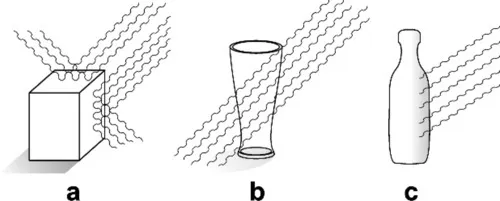
Figure 1.2 Interaction of microwaves with different materials: (a) - electrical conductor, (b) - isulator, (c) - lossy dielectric.
• insulators, which are considered as materials with good dielectric properties (extremly poor conductors)(e.g., quartz glass, porcelain, ceramics, Teflon - Fig. 1.2b)
• lossy dielectrics, which are materials that exhibit so called dielectric losses, which in turn results in heat generation in an oscillating electromagnetic field (e.g., water - Fig. 1.2c)
When a strongly conducting material (e.g., a metal) is exposed to microwave radiation, microwaves are largely reflected from its surface (Fig. 1.2a). However, the material is not effectively heated by microwaves, in response to the electric field of microwave radiation, electrons move freely on the surface of the material, and the flow of electrons can heat the material through a resistive (ohmic) heating mechanism. In opposite, in the case of insulators (e.g., porcelain), microwaves can penetrate through the material...
Table of contents
- Cover image
- Title page
- Table of Contents
- Copyright page
- Dedication
- Preface
- Acknowledgements
- Chapter 1: Interaction of microwaves with different materials
- Chapter 2: Microwave effect vs. thermal effect
- Chapter 3: Microwave equipment
- Chapter 4: Reaction vessels and glassware
- Chapter 5: Techniques for conducting chemical reactions under microwave irradiation
- Chapter 6: Safety precautions on the application of microwaves in laboratory
- Chapter 7: Reactions under microwave conditions
- Appendix
- References
- Index
Trusted by 375,005 students
Access to over 1.5 million titles for a fair monthly price.
Study more efficiently using our study tools.
Frequently asked questions
Yes, you can cancel anytime from the Subscription tab in your account settings on the Perlego website. Your subscription will stay active until the end of your current billing period. Learn how to cancel your subscription
No, books cannot be downloaded as external files, such as PDFs, for use outside of Perlego. However, you can download books within the Perlego app for offline reading on mobile or tablet. Learn how to download books offline
Perlego offers two plans: Essential and Complete
- Essential is ideal for learners and professionals who enjoy exploring a wide range of subjects. Access the Essential Library with 800,000+ trusted titles and best-sellers across business, personal growth, and the humanities. Includes unlimited reading time and Standard Read Aloud voice.
- Complete: Perfect for advanced learners and researchers needing full, unrestricted access. Unlock 1.5M+ books across hundreds of subjects, including academic and specialized titles. The Complete Plan also includes advanced features like Premium Read Aloud and Research Assistant.
We are an online textbook subscription service, where you can get access to an entire online library for less than the price of a single book per month. With over 1.5 million books across 990+ topics, we’ve got you covered! Learn about our mission
Look out for the read-aloud symbol on your next book to see if you can listen to it. The read-aloud tool reads text aloud for you, highlighting the text as it is being read. You can pause it, speed it up and slow it down. Learn more about Read Aloud
Yes! You can use the Perlego app on both iOS and Android devices to read anytime, anywhere — even offline. Perfect for commutes or when you’re on the go.
Please note we cannot support devices running on iOS 13 and Android 7 or earlier. Learn more about using the app
Please note we cannot support devices running on iOS 13 and Android 7 or earlier. Learn more about using the app
Yes, you can access Microwave-assisted Organic Synthesis by D. Bogdal in PDF and/or ePUB format, as well as other popular books in Biological Sciences & Science Research & Methodology. We have over 1.5 million books available in our catalogue for you to explore.