eBook - ePub
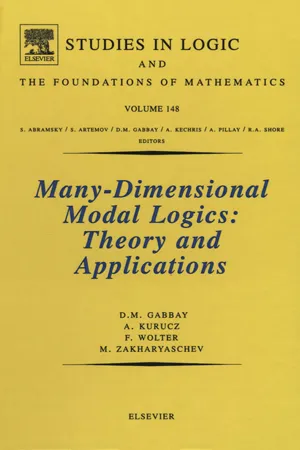
Many-Dimensional Modal Logics: Theory and Applications
- 766 pages
- English
- ePUB (mobile friendly)
- Available on iOS & Android
eBook - ePub
Many-Dimensional Modal Logics: Theory and Applications
About this book
Modal logics, originally conceived in philosophy, have recently found many applications in computer science, artificial intelligence, the foundations of mathematics, linguistics and other disciplines. Celebrated for their good computational behaviour, modal logics are used as effective formalisms for talking about time, space, knowledge, beliefs, actions, obligations, provability, etc. However, the nice computational properties can drastically change if we combine some of these formalisms into a many-dimensional system, say, to reason about knowledge bases developing in time or moving objects.To study the computational behaviour of many-dimensional modal logics is the main aim of this book. On the one hand, it is concerned with providing a solid mathematical foundation for this discipline, while on the other hand, it shows that many seemingly different applied many-dimensional systems (e.g., multi-agent systems, description logics with epistemic, temporal and dynamic operators, spatio-temporal logics, etc.) fit in perfectly with this theoretical framework, and so their computational behaviour can be analyzed using the developed machinery.We start with concrete examples of applied one- and many-dimensional modal logics such as temporal, epistemic, dynamic, description, spatial logics, and various combinations of these. Then we develop a mathematical theory for handling a spectrum of 'abstract' combinations of modal logics - fusions and products of modal logics, fragments of first-order modal and temporal logics - focusing on three major problems: decidability, axiomatizability, and computational complexity. Besides the standard methods of modal logic, the technical toolkit includes the method of quasimodels, mosaics, tilings, reductions to monadic second-order logic, algebraic logic techniques. Finally, we apply the developed machinery and obtained results to three case studies from the field of knowledge representation and reasoning: temporal epistemic logics for reasoning about multi-agent systems, modalized description logics for dynamic ontologies, and spatio-temporal logics.The genre of the book can be defined as a research monograph. It brings the reader to the front line of current research in the field by showing both recent achievements and directions of future investigations (in particular, multiple open problems). On the other hand, well-known results from modal and first-order logic are formulated without proofs and supplied with references to accessible sources.The intended audience of this book is logicians as well as those researchers who use logic in computer science and artificial intelligence. More specific application areas are, e.g., knowledge representation and reasoning, in particular, terminological, temporal and spatial reasoning, or reasoning about agents. And we also believe that researchers from certain other disciplines, say, temporal and spatial databases or geographical information systems, will benefit from this book as well.Key Features:• Integrated approach to modern modal and temporal logics and their applications in artificial intelligence and computer science• Written by internationally leading researchers in the field of pure and applied logic• Combines mathematical theory of modal logic and applications in artificial intelligence and computer science• Numerous open problems for further research• Well illustrated with pictures and tables
Information
Table of contents
- Cover image
- Title page
- Table of Contents
- Studies in Logic and The Foundations of Mathematics
- Copyright page
- Dedication
- Inside Front Cover
- Preface
- I: Introduction
- II: Fusions and products
- III: First-order modal logics
- IV: Applications to knowledge representation
- Epilogue
- Bibliography
- List of tables
- List of languages and logics
- Symbol index
- Subject index
Trusted by 375,005 students
Access to over 1.5 million titles for a fair monthly price.
Study more efficiently using our study tools.
Frequently asked questions
Yes, you can cancel anytime from the Subscription tab in your account settings on the Perlego website. Your subscription will stay active until the end of your current billing period. Learn how to cancel your subscription
No, books cannot be downloaded as external files, such as PDFs, for use outside of Perlego. However, you can download books within the Perlego app for offline reading on mobile or tablet. Learn how to download books offline
Perlego offers two plans: Essential and Complete
- Essential is ideal for learners and professionals who enjoy exploring a wide range of subjects. Access the Essential Library with 800,000+ trusted titles and best-sellers across business, personal growth, and the humanities. Includes unlimited reading time and Standard Read Aloud voice.
- Complete: Perfect for advanced learners and researchers needing full, unrestricted access. Unlock 1.5M+ books across hundreds of subjects, including academic and specialized titles. The Complete Plan also includes advanced features like Premium Read Aloud and Research Assistant.
We are an online textbook subscription service, where you can get access to an entire online library for less than the price of a single book per month. With over 1.5 million books across 990+ topics, we’ve got you covered! Learn about our mission
Look out for the read-aloud symbol on your next book to see if you can listen to it. The read-aloud tool reads text aloud for you, highlighting the text as it is being read. You can pause it, speed it up and slow it down. Learn more about Read Aloud
Yes! You can use the Perlego app on both iOS and Android devices to read anytime, anywhere — even offline. Perfect for commutes or when you’re on the go.
Please note we cannot support devices running on iOS 13 and Android 7 or earlier. Learn more about using the app
Please note we cannot support devices running on iOS 13 and Android 7 or earlier. Learn more about using the app
Yes, you can access Many-Dimensional Modal Logics: Theory and Applications by A. Kurucz,F. Wolter,M. Zakharyaschev,Dov M. Gabbay in PDF and/or ePUB format, as well as other popular books in Computer Science & Artificial Intelligence (AI) & Semantics. We have over 1.5 million books available in our catalogue for you to explore.