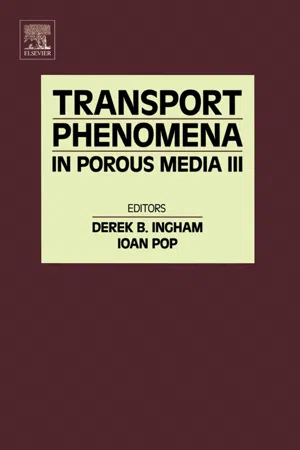
Fluid and flow problems in porous media have attracted the attention of industrialists, engineers and scientists from varying disciplines, such as chemical, environmental, and mechanical engineering, geothermal physics and food science. There has been a increasing interest in heat and fluid flows through porous media, making this book a timely and appropriate resource.Each chapter is systematically detailed to be easily grasped by a research worker with basic knowledge of fluid mechanics, heat transfer and computational and experimental methods. At the same time, the readers will be informed of the most recent research literature in the field, giving it dual usage as both a post-grad text book and professional reference.Written by the recent directors of the NATO Advanced Study Institute session on 'Emerging Technologies and Techniques in Porous Media' (June 2003), this book is a timely and essential reference for scientists and engineers within a variety of fields.
THE DOUBLE-DECOMPOSITION CONCEPT FOR TURBULENT TRANSPORT IN POROUS MEDIA
M.J.S. DE LEMOS, Instituto Tecnológico de Aeronáutica-ITA, 12228-900, São José dos Campos-SP, Brazil
Abstract
Environmental impact analyses as well as engineering equipment design can both benefit from reliable modeling of turbulent flow in porous media. A number of natural and engineering systems can be characterized by a permeable structure through which a working fluid permeates. Turbulence models proposed for such flows depend on the order of application of time- and volume-average operators. Two methodologies, following the two orders of integration, lead to different governing equations for the statistical quantities. This chapter reviews recently published methodologies to mathematically characterize turbulent transport in porous media. A new concept, called double-decomposition, is here discussed and models for turbulent transport in porous media are classified in terms of the order of application of the time- and volume-averaging operators, among other peculiarities.Within this chapter instantaneous local transport equations are reviewed for clear flow before time- and volume-averaging procedures are applied to them. The double-decomposition concept is presented and thoroughly discussed prior to the derivation of macroscopic governing equations. Equations for turbulent transport follow, showing detailed derivation for the mean and turbulent field quantities. The statistical k-
model for clear domains, used to model macroscopic turbulence effects, serves also as the basis for heat transfer modeling. Mass transfer in porous matrices is further reviewed in the light of the double-decomposition concept.
Keywords:
turbulence
porous media
modeling
nonlinear effects
double-decomposition
1.1 INTRODUCTION
It is well established in the literature that modeling of macroscopic transport for incompressible flows in porous media can be based on the volume-average methodology, see Whitaker (1999), for either heat, see Hsu and Cheng (1990), or mass transfer, see Whitaker (1966, 1967), Bear and Bachmat (1967), and Bear (1972). If the fluid phase properties fluctuate with time, in addition to presenting spatial deviations, there are two possible methodologies to follow in order to obtain macroscopic equations:
(i) application of time-average operator followed by volume-averaging, see Masuoka and Takatsu (1996), Kuwahara et al. (1996), Takatsu and Masuoka (1998), Kuwahara and Nakayama (1998), and Nakay...
Table of contents
Cover image
Title page
Table of Contents
Inside Front Cover
Copyright
Preface
Contributors
Chapter 1: THE DOUBLE-DECOMPOSITION CONCEPT FOR TURBULENT TRANSPORT IN POROUS MEDIA
Chapter 2: HEAT TRANSFER IN BIDISPERSE POROUS MEDIA
Chapter 3: FROM CONTINUUM TO POROUS–CONTINUUM: THE VISUAL RESOLUTION IMPACT ON MODELING NATURAL CONVECTION IN HETEROGENEOUS MEDIA
Chapter 4: INTEGRAL TRANSFORMS FOR NATURAL CONVECTION IN CAVITIES FILLED WITH POROUS MEDIA
Chapter 5: A POROUS MEDIUM APPROACH FOR THE THERMAL ANALYSIS OF HEAT TRANSFER DEVICES
Chapter 6: LOCAL THERMAL NON-EQUILIBRIUM IN POROUS MEDIUM CONVECTION
Chapter 7: THREE-DIMENSIONAL NUMERICAL MODELS FOR PERIODICALLY FULLY-DEVELOPED HEAT AND FLUID FLOWS WITHIN POROUS MEDIA
Chapter 8: ENTROPY GENERATION IN POROUS MEDIA
Chapter 9: THERMODIFFUSION IN POROUS MEDIA
Chapter 10: EFFECT OF VIBRATION ON THE ONSET OF DOUBLE-DIFFUSIVE CONVECTION IN POROUS MEDIA
Chapter 11: COMBUSTION IN POROUS MEDIA: FUNDAMENTALS AND APPLICATIONS
Chapter 12: REACTIVE TRANSPORT IN POROUS MEDIA—CONCEPTS AND NUMERICAL APPROACHES
Chapter 13: NUMERICAL AND ANALYTICAL ANALYSIS OF THE THERMOSOLUTAL CONVECTION IN AN ANNULAR FIELD: EFFECT OF THERMODIFFUSION
Chapter 14: PORE-SCALE TRANSPORT PHENOMENA IN POROUS MEDIA
Chapter 15: DYNAMIC SOLIDIFICATION IN A WATER-SATURATED POROUS MEDIUM COOLED FROM ABOVE
Chapter 16: APPLICATION OF FLUID FLOWS THROUGH POROUS MEDIA IN FUEL CELLS
Chapter 17: MODELLING THE EFFECTS OF FAULTS AND FRACTURES ON FLUID FLOW IN PETROLEUM RESERVOIRS
Inside Back Cover
Trusted by 375,005 students
Access to over 1.5 million titles for a fair monthly price.
Study more efficiently using our study tools.
Frequently asked questions
Yes, you can cancel anytime from the Subscription tab in your account settings on the Perlego website. Your subscription will stay active until the end of your current billing period. Learn how to cancel your subscription
No, books cannot be downloaded as external files, such as PDFs, for use outside of Perlego. However, you can download books within the Perlego app for offline reading on mobile or tablet. Learn how to download books offline
Perlego offers two plans: Essential and Complete
Essential is ideal for learners and professionals who enjoy exploring a wide range of subjects. Access the Essential Library with 800,000+ trusted titles and best-sellers across business, personal growth, and the humanities. Includes unlimited reading time and Standard Read Aloud voice.
Complete: Perfect for advanced learners and researchers needing full, unrestricted access. Unlock 1.5M+ books across hundreds of subjects, including academic and specialized titles. The Complete Plan also includes advanced features like Premium Read Aloud and Research Assistant.
Both plans are available with monthly, semester, or annual billing cycles.
We are an online textbook subscription service, where you can get access to an entire online library for less than the price of a single book per month. With over 1.5 million books across 990+ topics, we’ve got you covered! Learn about our mission
Look out for the read-aloud symbol on your next book to see if you can listen to it. The read-aloud tool reads text aloud for you, highlighting the text as it is being read. You can pause it, speed it up and slow it down. Learn more about Read Aloud
Yes! You can use the Perlego app on both iOS and Android devices to read anytime, anywhere — even offline. Perfect for commutes or when you’re on the go. Please note we cannot support devices running on iOS 13 and Android 7 or earlier. Learn more about using the app
Yes, you can access Transport Phenomena in Porous Media III by Derek B Ingham,Ioan Pop in PDF and/or ePUB format, as well as other popular books in Physical Sciences & Fluid Mechanics. We have over 1.5 million books available in our catalogue for you to explore.