eBook - ePub
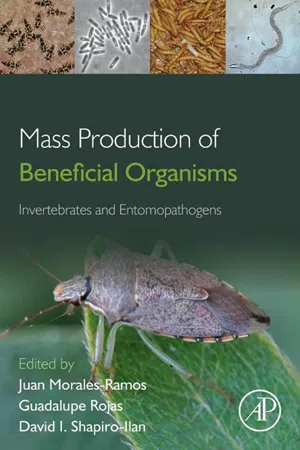
Mass Production of Beneficial Organisms
Invertebrates and Entomopathogens
- 764 pages
- English
- ePUB (mobile friendly)
- Available on iOS & Android
eBook - ePub
Mass Production of Beneficial Organisms
Invertebrates and Entomopathogens
About this book
Mass Production of Beneficial Organisms: Invertebrates and Entomopathogens is an essential reference and teaching tool for researchers in developed and developing countries working to produce "natural enemies" in biological control and integrated pest management programs.
As we become aware of the negative impact of pesticides in human health and on the environment, interest is rapidly increasing in developing biological pest control alternatives. Tremendous advances have been made in beneficial organism technology, such as insect predators and parasitoids, mite predators, entomopathogenic nematodes, fungi, bacteria, and viruses. However, developing techniques to mass produce these biological control agents is not enough if the cost of commercialization is prohibitive. Advancing mass production to the level of economic feasibility is critical, so these new technologies can compete in the open market.
This book educates academic and industry researchers, and enables further development of mass production so new technologies can compete in the open market. It is also an excellent resource for those researching beneficial arthropod mass production and technologies for other uses, including for study and application in biotechnology and biomedical research.
- Focuses on techniques for mass production of beneficial organisms and methods of evaluation and quality assessment
- Organizes and presents the most advanced and current knowledge on methods to mass produce beneficial organisms in response to the increased global demand for alternatives to chemical pesticides for biological control producers
- Includes a team of highly respected editors and authors with broad expertise in these areas
Information
Topic
Scienze biologicheSubtopic
EcologiaSection I
Outline
Chapter 1 Introduction
Chapter 2 Production of Coleopteran Predators
Chapter 3 Production of Heteropteran Predators
Chapter 4 Production of Dipteran Parasitoids
Chapter 5 Mass Rearing Bemisia Parasitoids for Support of Classical and Augmentative Biological Control Programs
Chapter 6 Mass Rearing of the Stem-Galling Wasp Tetramesa romana, a Biological Control Agent of the Invasive Weed Arundo donax
Chapter 7 Artificial Diet Development for Entomophagous Arthropods
Chapter 8 Life Tables as Tools of Evaluation and Quality Control for Arthropod Mass Production
Chapter 9 Concepts and Methods of Quality Assurance for Mass-Reared Parasitoids and Predators
Chapter 1
Introduction
Norman C. Leppla1, Juan A. Morales-Ramos2, David I. Shapiro-Ilan3 and M. Guadalupe Rojas2, 1Entomology and Nematology Department, University of Florida, Institute of Food and Agricultural Sciences, Gainesville, FL, USA, 2National Biological Control Laboratory, USDA-Agricultural Research Service, Stoneville, MS, USA, 3USDA-ARS, SAA, SE Fruit and Tree Nut Research Unit, Byron, GA, USA
Abstract
The purpose of this book is to assemble state-of-the-art mass production technologies for a wide variety of beneficial organisms in one publication and thereby stimulate new ideas for advancing the field. Technological improvements that are needed include inexpensive artificial diets, stimulation of oviposition, mechanization of egg collection and diet infestation, ways to confine and manipulate organisms, storage, packaging, shipping, and quality control and assurance of products. These kinds of challenges have been addressed for mass producing different organisms and the advancements made for one species could be applied to others.
Keywords
Antheraea pernyi; Arthropod mass production; Arthropod rearing; Autocidal control programs; Beneficial invertebrates; Biofactories; Biopesticides; Cimex lectularius; Cultured earthworm species; Entomopathogens; Government-supported arthropod mass production; Mass producing pathogens; Mass production of beneficial organisms; Mass rearing invertebrates; Microbial control agents; Tenebrio molitor; Trichogramma spp.
1.1. Challenges of Mass Producing Beneficial Organisms
Mass Production of Beneficial Organisms contains chapters on producing selected organisms useful to humankind, including arthropods, microorganisms, bees, and earthworms. It is comprised of a series of comprehensive descriptions of the industrial-level production of insects, mites, and pathogens for biological control, and beneficial invertebrate organisms for food, pollination, and other purposes. Additionally, there are reports on artificial diet development and quality assurance for arthropods, as well as entomopathogen production and formulation. The final section covers insects as food for animals, insectivores, and humans, along with solitary bees for pollination and earthworm mass culture. This is a unique assemblage of topics organized around the goal of producing large amounts of organisms for a variety of useful purposes.
Mass production of these organisms is somewhat arbitrary to define in terms of the number produced per time interval. Rather, it is characterized by the magnitude and degree of separation of the rearing processes, usually involving a single species. It takes place in large, multiroom mass rearing facilities or “biofactories” specially designed for this purpose. There is a trained labor force with at least one employee assigned to each independent rearing process, such as diet preparation or another single production activity. Depending on the species being produced, large amounts of host material, artificial diet ingredients, or growth media are used and there usually is some mechanization to make the rearing more efficient. Thus, mass production of beneficial organisms can be considered an industrial process with all of the associated logistical requirements, including substantial quantities of production materials, continuous maintenance of facilities and equipment, and distribution of high-quality products (see Chapter 9).
Principles and procedures for mass producing beneficial arthropods and microbes have developed independently, although there are commonalities. Both kinds of organisms are produced in biological systems that depend on genetically suitable founding populations, uncontaminated diets or media, mechanized equipment, controlled environments, quality assurance, packaging, and delivery to customers as effective products. The subjects encompassed in principles and procedures for developing and operating production systems for these organisms can be divided into the following: facility design and management, including health and safety; environmental biology; management of microbial contamination; nutrition and diet; population genetics; and quality control (Schneider, 2009). Unlike general principles, however, procedures are typically species-specific in terms of diet or substrate and associated culturing methods. A suitable host organism must be used in the absence of an artificial diet to rear an arthropod, and similarly beneficial microorganisms often are cultured on a defined artificial medium or, when in vitro culture is not feasible, on susceptible hosts. Regardless of species, procedures for mass rearing any beneficial organism are divided into a series of steps based on its life cycle.
Insect mass production progressed naturally from relatively small-scale rearing of insects for human and animal food, such as honey or mealworms, Tenebrio molitor L., or for their products that historically have included silk, cochineal dye, lac, and beeswax. Reliable supplies of insects that behaved normally also were needed for research and teaching (Needham et al., 1937). Blowflies, horseflies, several filth flies, mosquitoes, and the common bed bug, Cimex lectularius L., have been essential for the advancement of medical and veterinary research. These insects and vectors of human and animal pathogens, such as mosquitoes and the tsetse flies, were used to screen chemical compounds for repellency and toxicity, as well as to develop useful formulations. Drosophila melanogaster Meigen became the standard insect model for genetic research. For crop protection, large numbers of insect species were needed for studies on host plant resistance to insects, including certain pest Heteroptera, Diptera, Coleoptera, and Lepidoptera, such as the European corn borer, Ostrinia nubilalis (Hubner). Commodity treatments were developed for the Khapra beetle, Trogoderma granarium Everts, additional grain-infesting beetles and moths, several kinds of tephritid fruit flies, and many other insect species. Large quantities of the boll weevil, Anthonomus grandis Boheman, noctuid moths, the pink bollworm, Pectinophora gossypiella (Saunders), and other Coleoptera and Lepidoptera were used to develop attractants and traps. Some of these insects also provided hosts for rearing imported natural enemies in quarantine and prior to release in the field. Moreover, most predators and parasitoids used in augmentation biological control require massive amounts of natural and factitious hosts. These hosts typically are more difficult to rear consistently than the natural enemy itself. Due to this host rearing limitation, large populations of insects for release in autocidal control must be produced on artificial diets.
More than 50 species of arthropod natural enemies are produced in large enough numbers to be marketed widely in the United States (Leppla and Johnson, 2011). Many of these and additional species are sold in Europe (van Lenteren, 2003). Popular predators include several phytoseiid mites, coccinellids, cecidomyiids, and chrysopids, and the most commonly used parasitic wasps are in the taxonomic families Aphelinidae, Braconidae, Pteromalidae, and Trichogrammatidae. Predaceous mites are used extensively for biological control of phytophagous mites, fungus gnats, and thrips on potted and bedding plants in protected culture and interiorscapes. They are particularly useful for two-spotted spider mite control on ornamental, fruit, and vegetable crops. Depending on the species, lady beetles are released to control a variety of scales, mealybugs, aphids, thrips, and whiteflies. The cecidomyiid, Aphidoletes aphidimyza (Rondani), is often used for aphid biological control, as are Chrysoperla spp. Probably the most popular aphelinid is Encarsia formosa Gahan, released extensively in greenhouses to control whiteflies; Eretmocerus spp. also are available for this purpose. Applications of braconids, Aphidius spp., are made to manage a wide range of aphids. A specialized purpose for mass-reared natural enemies is the use of pteromalids for biological control of filth flies in manure and compost.
Numerous species of the lepidopteran egg parasitoid, Trichogramma spp., have been mass produced on factitious hosts in semi-mechanized rearing facilities for decades, becoming the most prevalent augmentative parasitoid in both number of production facilities and quantities produced. They typically are reared on eggs of the angoumois grain moth, Sitotroga cerealella (Oliver), or Mediterranean flour moth, Ephestia kuehniella Zeller, that infest stored grain on which they are reared, such as wheat and barley. Several biofactories in the former Soviet Union each consistently produced millions of Trichogramma spp. per day for years to control pest Lepidoptera in field crops. A highly successful European corn borer biological control project has been conducted in Germany, Switzerland, and France since about 1992 (Kabiri and Bigler, 1996). Producers of commercial natural enemies and collaborative government/grower groups throughout the world have developed a variety of simple, highly productive rearing systems for Trichogramma spp. In every situation, large containers of grain are infested with host eggs, yielding larvae that feed and eventually molt into adults that deposit eggs. The eggs are harvested, exposed to Trichogramma spp. adults, and used to maintain the colony or attached to a substrate and distributed in a crop. Periodically, eggs of the target pest are used instead of the factitious host to maintain high levels of pest parasitism.
Arthropod mass rearing reached an industrial level with the development of autocidal control and eradication of the New World screwworm fly, Cochliomy...
Table of contents
- Cover image
- Title page
- Table of Contents
- Copyright
- Dedication
- Contributors
- Section I
- Section II
- Section III
- Index
Trusted by 375,005 students
Access to over 1.5 million titles for a fair monthly price.
Study more efficiently using our study tools.
Frequently asked questions
Yes, you can cancel anytime from the Subscription tab in your account settings on the Perlego website. Your subscription will stay active until the end of your current billing period. Learn how to cancel your subscription
No, books cannot be downloaded as external files, such as PDFs, for use outside of Perlego. However, you can download books within the Perlego app for offline reading on mobile or tablet. Learn how to download books offline
Perlego offers two plans: Essential and Complete
- Essential is ideal for learners and professionals who enjoy exploring a wide range of subjects. Access the Essential Library with 800,000+ trusted titles and best-sellers across business, personal growth, and the humanities. Includes unlimited reading time and Standard Read Aloud voice.
- Complete: Perfect for advanced learners and researchers needing full, unrestricted access. Unlock 1.5M+ books across hundreds of subjects, including academic and specialized titles. The Complete Plan also includes advanced features like Premium Read Aloud and Research Assistant.
We are an online textbook subscription service, where you can get access to an entire online library for less than the price of a single book per month. With over 1.5 million books across 990+ topics, we’ve got you covered! Learn about our mission
Look out for the read-aloud symbol on your next book to see if you can listen to it. The read-aloud tool reads text aloud for you, highlighting the text as it is being read. You can pause it, speed it up and slow it down. Learn more about Read Aloud
Yes! You can use the Perlego app on both iOS and Android devices to read anytime, anywhere — even offline. Perfect for commutes or when you’re on the go.
Please note we cannot support devices running on iOS 13 and Android 7 or earlier. Learn more about using the app
Please note we cannot support devices running on iOS 13 and Android 7 or earlier. Learn more about using the app
Yes, you can access Mass Production of Beneficial Organisms by Juan A. Morales-Ramos,M. Guadalupe Rojas,David I. Shapiro-Ilan in PDF and/or ePUB format, as well as other popular books in Scienze biologiche & Ecologia. We have over 1.5 million books available in our catalogue for you to explore.