eBook - ePub
The Analytical Chemistry of Cannabis
Quality Assessment, Assurance, and Regulation of Medicinal Marijuana and Cannabinoid Preparations
- 132 pages
- English
- ePUB (mobile friendly)
- Available on iOS & Android
eBook - ePub
The Analytical Chemistry of Cannabis
Quality Assessment, Assurance, and Regulation of Medicinal Marijuana and Cannabinoid Preparations
About this book
A volume in the Emerging Issues in Analytical Chemistry series, The Analytical Chemistry of Cannabis: Quality Assessment, Assurance, and Regulation of Medicinal Marijuana and Cannabinoid Preparations provides analytical chemistry methods that address the latest issues surrounding cannabis-based products. The plethora of marketed strains of cannabis and cannabinoid-containing products, combined with the lack of industry standards and labelling requirements, adds to the general perception of poor quality control and limited product oversight. The methods described in this leading-edge volume help to support the manufacturing, labelling, and distribution of safe and consistent products with known chemical content and demonstrated performance characteristics. It treats analytical chemistry within the context of the diverse issues surrounding medicinal and recreational cannabis in a manner designed to foster understanding and rational perspective in non-scientist stakeholders as well as scientists who are concerned with bringing a necessary degree of order to a field now characterized by confusion and contradiction.
- Addresses current and emerging analytical chemistry methods - an approach that is unique among the literature on this topic
- Presents information from a broad perspective of the issues in a single compact volume
- Employs language comprehensible to non-technical stakeholders as well as to specialists in analytical chemistry
Information
Topic
Physical SciencesSubtopic
BiochemistryChapter 1
The Botany of Cannabis sativa L.
Abstract
Cannabis sativa L. is among the oldest known cultivated plants, with a long history of medical use. Cannabis produces a unique class of terpenophenolic compounds called cannabinoids, 104 of which have been isolated, the major biologically active one being Δ9-tetrahydrocannabinol. Cannabidiol, an antiepileptic, is also important. Cannabis is an annual, normally dioecious and occasionally monoecious, wind-pollinated species and is highly allogamous (cross-fertilization) in nature. Therefore, maintaining the efficacy of selected high Δ9-tetrahydrocannabinol-yielding elite varieties grown from seeds under field or greenhouse conditions is very difficult. Thus, a careful screening of elite mother clones using GC-FID and their propagation using vegetative cuttings or advanced biotechnological approaches, including micropropagation, is the most suitable way to maintain quality. This chapter describes the botany, species debate, phenotype, screening of high-yielding clones using GC-FID, indoor and outdoor cultivation, micropropagation, quality assurance of propagated plants, harvesting, processing, and storage.
Keywords
Cannabis sativa L.; cannabidiol; Δ9-tetrahydrocannabinol; indoor growing; micropropagation; outdoor growing
Cannabis sativa L. is a widespread species in nature. It is found in various habitats ranging from sea level to the temperate and alpine foothills of the Himalayas, from where it was probably spread over the last 10,000 years.1,2 The age-old cultivation makes its original distribution difficult to pinpoint.3 Cannabis has a long history of medicinal use in the Middle East and Asia, with references as far back as the 6th century BCE, and it was introduced in Western Europe as a medicine in the early 19th century to treat epilepsy, tetanus, rheumatism, migraine, asthma, trigeminal neuralgia, fatigue, and insomnia.4,5
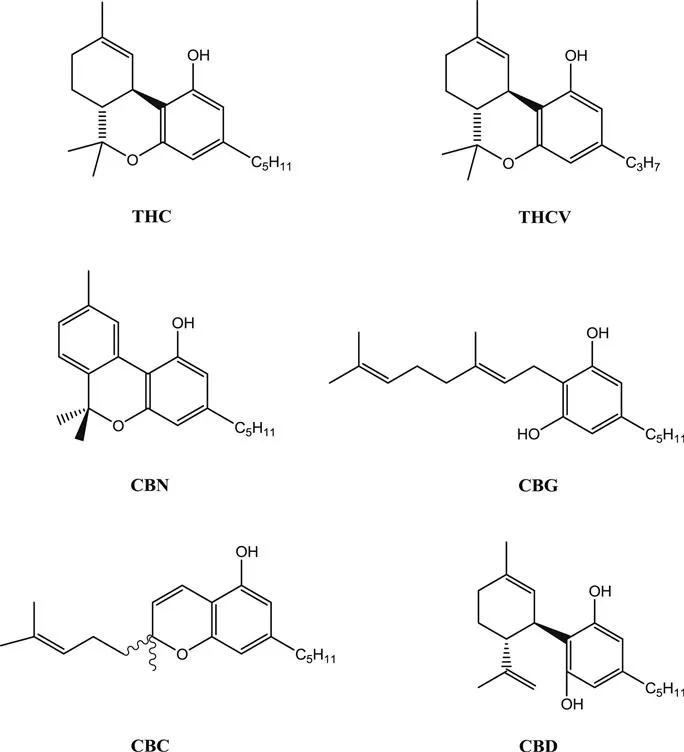
As a plant, it is valued for its hallucinogenic and medicinal properties, more recently being used for pain, glaucoma, nausea, asthma, depression, insomnia, and neuralgia.6,7 Derivatives are used in HIV/AIDS8 and multiple sclerosis.9 The pharmacology and therapeutic efficacy of cannabis preparations and its main active constituent Δ9-tetrahydrocannabinol (Δ9-THC) have been extensively reviewed.10–12 The other important cannabinoid constituent of current interest is cannabidiol (CBD). There has been a significant interest in CBD over the last few years because of its reported activity as an antiepileptic agent, particularly its promise for the treatment of intractable pediatric epilepsy.13,14 Other than Δ9-THC and CBD, tetrahydrocannabivarin (THCV), cannabinol (CBN), cannabigerol (CBG), and cannabichromene (CBC) are major isolates. Fig. 1.1 shows chemical structures.
Cannabis is also one of the oldest sources of food and textile fiber.15–17 Hemp grown for fiber was introduced in Western Asia and Egypt and subsequently in Europe between 1000 and 2000 BCE. Cultivation of hemp in Europe became widespread after 500 CE. The crop was first brought to South America (Chile) in 1545, and to North America (Port Royal, Acadia) in 1606.18 Now its cultivation is prohibited or highly regulated in the United States.
Botanical Description
Table 1.1 describes the botanical nomenclature of C. sativa L. Cannabis is a highly variable species in terms of botany, genetics, and chemical constituents. The number of species in the Cannabis genus has long been controversial. Some reports proposed Cannabis as a polytypic genus.19–22 However, based on morphological, anatomical, phytochemical, and genetic studies, it is generally treated as having a single, highly polymorphic species, C. sativa L.23–26 Other reported species are Cannabis indica Lam. and Cannabis ruderalis Janisch, but plants considered to have belonged to these species are now recognized as varieties of C. sativa L. (var. indica and var. ruderalis, respectively). Cannabis sativa and indica are widely cultivated and economically important; Cannabis ruderalis is hardier and grows in the northern Himalayas and the southern states of the former Soviet Union but is rarely cultivated for drug content.
Table 1.1
Botanical Nomenclature of Cannabis sativa L.
| Category | Botanical Nomenclature |
| Kingdom | Plantae—Plants |
| Subkingdom | Tracheobionta—Vascular plants |
| Superdivision | Spermatophyta—Seed plants |
| Division | Magnoliophyta—Flowering plants |
| Class | Magnoliopsida—Dicotyledons |
| Subclass | Hamamelididae |
| Order | Urticales |
| Family | Cannabaceae |
| Genus | Cannabis |
| Species | Cannabis sativa L. |
The main morphological difference between indica and sativa is in their leaves. The leaves of sativa are much smaller and thinner, whereas those of indica have wide fingers and are deep green, often tinged with purple; at maturity, they turn dark purple. Indica plants are shorter and bushier, usually under 6 ft tall and rarely over 8 ft Indica has short branches laden with thick, dense buds, which mature early, usually at the beginning of September in the Northern Hemisphere. Indica buds also vary in color from dark green to purple, with cooler conditions inducing more intense coloration. Indica flowers earlier. The natural distribution of indica is Afghanistan, Pakistan, India, and surrounding areas. The plants of sativa have long branches, with the lower ones spreading 4 ft or more from the central stalk, as on a conical Christmas tree. Height varies from 6 ft to more than 20 ft, with 8–12 ft being the most common. Buds are long and thin and far less densely populated than in indica, but longer, sometimes 3 ft or more. Maturation time varies considerably depending on the variety and environmental conditions. Low Δ9-THC Midwestern sativa varieties (ditchweed) mature in August and September, while equatorial varieties mature from October to December. Buds of sativa require intense light to thicken and swell; indica does not. Sativa tends to be higher in Δ9-THC and lower in CBD than indica. Sativa is found all over the world and comprises most of the drug type equatorial varieties such as Colombian, Mexican, Nigerian, and South African, where marijuana plants can be very potent. Cannabis has many local common names, some of which are given in Table 1.2.
Table 1.2
Common Cannabis Names in Different Languages
| Language | Common Names |
| Arabic | Bhang, hashish qinnib, hasheesh kenneb, qinnib, tîl |
| Chinese | Xian ma, ye ma |
| Danish | Hemp |
| Dutch | Hennep |
| English | Hemp, marihuana |
| Finnish | Hamppu |
| French | Chanvre, chanvre d’Inde, chanvre indien, chanvrier |
| German | Hanf, haschisch, indischer hanf |
| Hindi | Bhang, charas, ganja |
| Japanese | Mashinin |
| Nepalese | Charas, gajiimaa, gaanjaa |
| Portuguese | Cânhamo, maconha |
| Russian | Kannabis sativa |
| Spanish | Cáñamo, grifa, hachís, mariguana, marijuana |
| Swedish | Porkanchaa |
Normally, cannabis exhibits a dioecious (male and female flowers develop on separate plants) and occasionally a monoecious (hermaphrodite) phenotype. It flowers in the shorter days (below 12-h photoperiod) and continues growing vegetatively in the longer photoperiod. Sex is determined by heteromorphic chromosomes (males being heterogametic XY, females homogametic XX). Male flowers can be differentiated from female by their different morphological appearance. At the vegetative stage, differentiation is difficult because of morphological similarities. Molecular techniques, however, can differentiate at an early stage...
Table of contents
- Cover image
- Title page
- Table of Contents
- Copyright
- Dedication
- List of Contributors
- Foreword
- Preface
- Acknowledgments
- Chapter 1. The Botany of Cannabis sativa L.
- Chapter 2. Biosynthesis and Pharmacology of Phytocannabinoids and Related Chemical Constituents
- Chapter 3. Medical Cannabis Formulations
- Chapter 4. Analytical Methods in Formulation Development and Manufacturing
- Chapter 5. Quality Control and Stability Assessment
- Chapter 6. The Roles of Research and Regulation
- Chapter 7. The Future of Cannabinoid Therapeutics
Trusted by 375,005 students
Access to over 1.5 million titles for a fair monthly price.
Study more efficiently using our study tools.
Frequently asked questions
Yes, you can cancel anytime from the Subscription tab in your account settings on the Perlego website. Your subscription will stay active until the end of your current billing period. Learn how to cancel your subscription
No, books cannot be downloaded as external files, such as PDFs, for use outside of Perlego. However, you can download books within the Perlego app for offline reading on mobile or tablet. Learn how to download books offline
Perlego offers two plans: Essential and Complete
- Essential is ideal for learners and professionals who enjoy exploring a wide range of subjects. Access the Essential Library with 800,000+ trusted titles and best-sellers across business, personal growth, and the humanities. Includes unlimited reading time and Standard Read Aloud voice.
- Complete: Perfect for advanced learners and researchers needing full, unrestricted access. Unlock 1.5M+ books across hundreds of subjects, including academic and specialized titles. The Complete Plan also includes advanced features like Premium Read Aloud and Research Assistant.
We are an online textbook subscription service, where you can get access to an entire online library for less than the price of a single book per month. With over 1.5 million books across 990+ topics, we’ve got you covered! Learn about our mission
Look out for the read-aloud symbol on your next book to see if you can listen to it. The read-aloud tool reads text aloud for you, highlighting the text as it is being read. You can pause it, speed it up and slow it down. Learn more about Read Aloud
Yes! You can use the Perlego app on both iOS and Android devices to read anytime, anywhere — even offline. Perfect for commutes or when you’re on the go.
Please note we cannot support devices running on iOS 13 and Android 7 or earlier. Learn more about using the app
Please note we cannot support devices running on iOS 13 and Android 7 or earlier. Learn more about using the app
Yes, you can access The Analytical Chemistry of Cannabis by Brian F. Thomas,Mahmoud A. ElSohly,Mahmoud Elsohly in PDF and/or ePUB format, as well as other popular books in Physical Sciences & Biochemistry. We have over 1.5 million books available in our catalogue for you to explore.