This book provides a complete review of the current state of the art in the field of high entropy alloys (HEA). The conventional approach to alloy design is to select one principal element and add elements to it in minor quantities in order to improve the properties. In 2004, Professor J.W. Yeh and his group first reported a new approach to alloy design, which involved mixing elements in equiatomic or near-equiatomic proportions, to form multi-component alloys with no single principal element. These alloys are expected to have high configurational entropy and hence were termed as "high entropy alloys."HEAs have a broad range of structures and properties, and may find applications in structural, electrical, magnetic, high-temperature, wear-resistant, corrosion-resistant, and oxidation-resistant components. Due to their unique properties, high entropy alloys have attracted considerable attention from both academics and technologists. This book presents the fundamental knowledge present in the field, the spectrum of various alloy systems and their characteristics studied to date, current key focus areas, and the future scope of the field in terms of research and technological applications.
- Encompasses the synthesis and phase formation of high entropy alloys
- Covers design of HEAs based on thermodynamic criteria
- Discusses the structural and functional properties of HEAs
- Provides a comparison of HEAs with other multicomponent systems like intermetallics and bulk metallic glasses
A Brief History of Alloys and the Birth of High-Entropy Alloys
Alloys have helped and defined the march of civilization for over five millennia. The progress from native metals and native alloys to the accidental discovery of arsenical bronzes is a remarkable story. Numerous combinations of alloying elements were tried usually based on one principal element. Higher amounts of alloying were also used in alloys such as high-tin bronzes and ultrahigh carbon steels. From such concentrated binary alloys to multicomponent alloys marked a major advance resulting in alloy steels and superalloys in the last century. Nevertheless there was one element in major proportion in all these alloys. A revolutionary step in alloying occurred just before the beginning of the third millennium CE when Jien-Wei Yeh and Brian Cantor independently thought of multicomponent equiatomic or near-equiatomic alloys. Surprisingly, many of these alloys turned out to be solid solutions similar to the bronzes of the third millennium BCE. They have breathed new life into materials world promising an extraordinarily rich family of alloys.
Alloying is the greatest gift of metallurgy to humankind. The English language insists on unalloyed pleasures, thereby implying that the sensation of pleasure must be pure and not admixed with other emotions. Exactly the opposite rules in metallurgy, where pure metals have few uses but lot more upon alloying. The power of this idea of alloying is not confined to metals. The same principle of alloying applies in polymers and ceramics. It can be carried further by mixing two classes of materials to create a variety of composites.
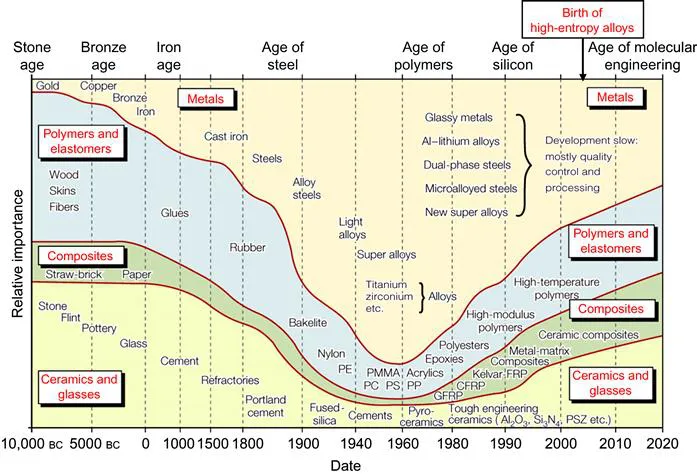
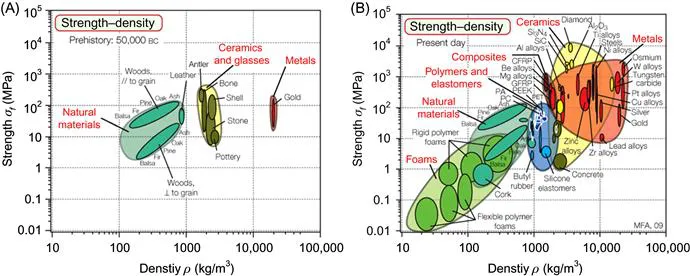
The civilizational journey of humankind began with the discovery of native metals such as gold and copper as pure metals. Nowadays we have access to an incredible number and variety of materials. Ashby map (Ashby, 2011) shown in Figure 1.1 gives a panoramic view of the development in the use of materials over 10 millennia. A graphic depiction of the different classes of materials from ceramics to metals, polymers, and more recently to composites is vividly displayed. The passage from discovery through development to design of materials can be noted. Ashby’s (2011) map in term of strength versus density shown in Figure 1.2 demonstrates the filling of material–property space in a vivid fashion from 50,000 BCE up to the present scenario. In time scale, the largest filling has occurred in the past 50 years during which envelopes of metals, ceramics, and composites had a large expansion, and new envelopes of synthetic polymers and foam materials take a significant space. But, the filled area also seems to approach some fundamental limits beyond which it is difficult to go further (Ashby, 2011).
Figure 1.1 Historical evolution of engineering materials—marked with the birth of HEAs published in Advanced Engineering Materials (Yeh et al., 2004b). Adapted from Ashby (2011).
Figure 1.2 The explosion in the diversity of materials in the modern era (Ashby, 2011); (A) prehistoric era (50,000 BCE) and (B) current status.
In many ways, the history of alloying is the history of metallurgy and materials science. Books and treatises have been written. An elegant and brief history is by Ashby (2008). Cahn (2001) has offered a magisterial survey of “The coming of materials science”. Ranganathan (2003) wrote on alloyed pleasures—an ode to alloying. In the following sections, a few episodes in this epic journey are covered.
1.2 The Coming of Alloys
Native alloys such as tumbaga and electrum are alloys of gold–copper and gold–silver, respectively. When platinum was discovered in 1735, it was compared with silver. Also, mixtures of platinum metals are found to occur in nature. It is an early example of multicomponent high-entropy alloys (HEAs), since platinum is often found as alloys with the other platinum group metals and iron mostly.
Alloying was an accidental discovery. In the primitive fires in the caves, ores of copper got mixed with ores of arsenic, zinc, and tin. The first alloy of copper and arsenic (Arsenical bronze, 3000 BCE) was entirely accidental. A more intentional alloying of tin with copper (tin bronzes in 2500 BCE) gave birth to the Bronze Age, as bronze was superior in its mechanical properties.
The seven metals found in antiquity were gold, copper, silver, iron, lead, tin, and mercury. The eighth metal, zinc, is added because of the unique Indian context but also because the discovery of other metals had to await the advent of the scientific revolution for a few centuries.
It is interesting to mention that intermetallics of copper–tin alloys had been used in ancient time. Mirrors were made of bronzes in different parts of the Old World including India and China, due to their higher hardness which makes it easy in getting mirror finish to reflect like silver. Archaeo-metallurgical investigations by Sharada Srinivasan on vessels from South Indian megaliths of the Nilgiris and Adichanallur (1000–500 BCE) showed that they were of wrought and quenched high-tin beta bronze, ranking among the earliest known artifacts. This is an early application of an intermetallic. When the sulfide ores of copper and nickel were smelted together, it led to copper–nickel alloy in the fourth century in China. Zinc was added in the twelfth century to form silvery and rust-resisting alloy known as paktong (white copper), which was widely used in Europe before stainless steel was invented.
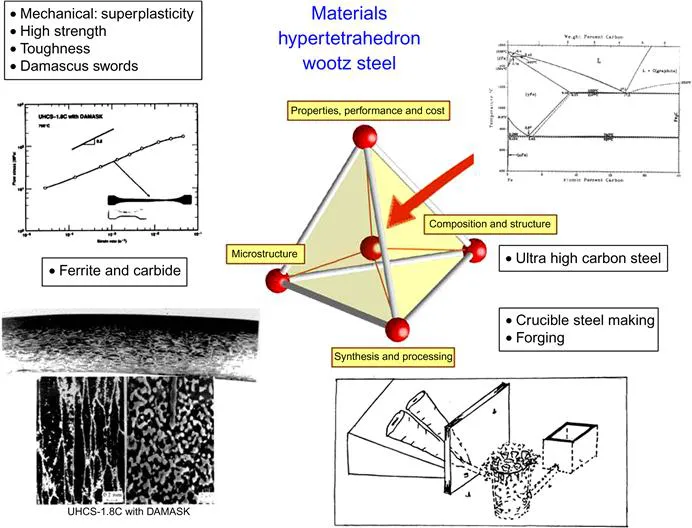
Wrought iron was produced as early as in 1000 BCE and cast iron and cast steel were produced one millennium later. Steel was an accidental alloy of iron with carbon. This is all the more astonishing as carbon was not recognized as an element until recently. This accidental discovery also led to the production of wootz steel in India around 300 BCE. This has been rightly celebrated as the most advanced material of the ancient world, as this steel was used to fashion the Damascus swords. The deciphering of wootz steel by European scientists led to the correlation between structure and properties at first and subsequently between composition, processing, structure, and properties. Figure 1.3 shows that materials hypertetrahedron that links the above four with modeling is necessary to understand the performance of wootz steel. (Ranganathan and Srinivasan, 2006; Srinivasan and Ranganathan, 2014). The facets of the ultrahigh carbon steels, Buchanan furnace, the Fe
C phase diagram, the microstructure of dendrites in the as-cast state and spheroidized cementite in the forged state, the superplastic elongation, and the Damascene marks are emphasized for the strong interconnections among them. It can be regarded as a classic example of the materials tetrahedron but including a fifth vertex of modeling (e.g., CALPHAD method to calculate phase diagram) to make it a hypertetrahedron.
Figure 1.3 The materials hypertetrahedron for Wootz Steel (Srinivasan and Ranganathan, 2014).
When the first industrial revolution began in later half of 18th century in England, more and more elements were found and produced by humankind. From these “new” elements, numerous metallic materials including engineering and advanced alloys have been developed. They were synthesized with different compositions and produced by various processing routes. Up to now, about 30 alloy systems, each system based on one principal metallic element, have been developed and used for a variety of products (Handbook Committee, 1990).
Several alloys of engineering importance have been developed. Michael Faraday created some of the first alloy steels in his efforts to reproduce the wootz steel from India and is hailed as the father of alloy steel. Aluminum alloys were produced after the commercialization of Hall-Héroult process in the mid 1880s and underwent large progress in precipitation hardenable alloys such as Al
Cu
(Mg) and Al
Zn
Mg
(Cu) for light and strong airframes in the explosive expansion of the airplane industry during and after World War I (1914–1918). High-speed steel for cutting tools was first produced in the early 1900s. To meet the challenge for even higher cutting speed, cemented or sintered carbides of WC/Co composites were introduced in the 1930s. At the same time, superalloy development began in the United States in the 1930s and was accelerated by the demands of gas turbine technology. Ferritic, austenitic, and martensitic stainless steels were almost simultaneously developed around 1910.
1.3 Special Alloys
Besides the above modern engineering alloys, several special alloy systems with specific compositions, structures and properties have been developed with intensive research in last 50 years. They are intermetallics, quasicrystals, and metallic glasses as introduced in the following sections.
1.3.1 Intermetallics and Quasicrystals
Intermetallic compounds are basically compounds of two or more metallic elements. They are brittle by nature. Besides the ancient intermetallic mirrors made of high-tin bronze mentioned in last section, they have given rise to various novel materials developments in modern time including magnetic AlNiCo alloys and the LaNi5 for nickel metal hydride batteries, and various aluminides, Ni
Al-, Ti
Al-, Fe
Al-based compounds for elevated-t...
Table of contents
Cover image
Title page
Table of Contents
Copyright
Foreword
Preface
Acknowledgements
Chapter 1. A Brief History of Alloys and the Birth of High-Entropy Alloys
Chapter 2. High-Entropy Alloys: Basic Concepts
Chapter 3. Phase Selection in High-Entropy Alloys
Chapter 4. Alloy Design in the Twenty-First Century: ICME and Materials Genome Strategies
Chapter 5. Synthesis and Processing
Chapter 6. High-Entropy Alloy Solid Solutions
Chapter 7. Intermetallics, Interstitial Compounds and Metallic Glasses in High-Entropy Alloys
Chapter 8. Structural Properties
Chapter 9. Functional Properties
Chapter 10. Applications and Future Directions
References
Appendix 1
Appendix 2
Trusted by 375,005 students
Access to over 1.5 million titles for a fair monthly price.
Study more efficiently using our study tools.
Frequently asked questions
Yes, you can cancel anytime from the Subscription tab in your account settings on the Perlego website. Your subscription will stay active until the end of your current billing period. Learn how to cancel your subscription
No, books cannot be downloaded as external files, such as PDFs, for use outside of Perlego. However, you can download books within the Perlego app for offline reading on mobile or tablet. Learn how to download books offline
Perlego offers two plans: Essential and Complete
Essential is ideal for learners and professionals who enjoy exploring a wide range of subjects. Access the Essential Library with 800,000+ trusted titles and best-sellers across business, personal growth, and the humanities. Includes unlimited reading time and Standard Read Aloud voice.
Complete: Perfect for advanced learners and researchers needing full, unrestricted access. Unlock 1.5M+ books across hundreds of subjects, including academic and specialized titles. The Complete Plan also includes advanced features like Premium Read Aloud and Research Assistant.
Both plans are available with monthly, semester, or annual billing cycles.
We are an online textbook subscription service, where you can get access to an entire online library for less than the price of a single book per month. With over 1.5 million books across 990+ topics, we’ve got you covered! Learn about our mission
Look out for the read-aloud symbol on your next book to see if you can listen to it. The read-aloud tool reads text aloud for you, highlighting the text as it is being read. You can pause it, speed it up and slow it down. Learn more about Read Aloud
Yes! You can use the Perlego app on both iOS and Android devices to read anytime, anywhere — even offline. Perfect for commutes or when you’re on the go. Please note we cannot support devices running on iOS 13 and Android 7 or earlier. Learn more about using the app
Yes, you can access High-Entropy Alloys by B.S. Murty,Jien-Wei Yeh,S. Ranganathan in PDF and/or ePUB format, as well as other popular books in Technology & Engineering & Mining Engineering. We have over 1.5 million books available in our catalogue for you to explore.