- 342 pages
- English
- ePUB (mobile friendly)
- Available on iOS & Android
eBook - ePub
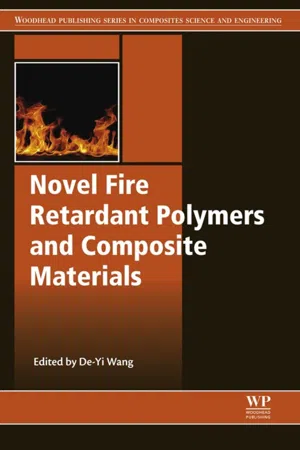
Novel Fire Retardant Polymers and Composite Materials
About this book
Novel Fire Retardant Polymers and Composite Materials reviews the latest scientific developments and technological advances in the design and manufacture of fire retardant polymers and composite materials. Fire retardant polymeric materials are used in a broad range of applications in fields such as aviation, automotive, computer, construction, electronics, and telecommunications. It is essential to have a better understanding of the scientific technology used in the design and manufacture of fire-resistant materials and their end products. This book includes the latest developments in fire retardant technologies for different polymeric material systems, such as PU, PP, PE, PLA, epoxy, rubber, textile, phenol resin, and PA, etc.
- Provides cutting-edge research in flame retardant materials, relevant to both scientific and industrial applications
- Presents the latest and most up-to-date fire retardant technologies
- Discusses the most popular fire retardant polymer systems
- Includes the latest developments in fire retardant technologies for different polymeric material systems, such as PU, PP, PE, PLA, epoxy, rubber, textile, phenol resin, and PA
Information
1
Introduction
D.-Y. Wang IMDEA Materials Institute, Getafe, Madrid, Spain
Abstract
Flame-retardant chemicals are mandatory in many products worldwide, since they protect human life and property. Over the past few decades the use of flame-retardant chemicals has increased, especially in highly populated countries such as China and India. According to a report from BCC Research (Flame Retardant Chemicals: Technologies and Global Markets), the global consumption of flame-retardant chemicals, which reached nearly £4.2 billion in 2014, should reach £5.7 billion in 2019, reflecting a five-year compound annual growth rate of 6.7%. With such strong growth, it is imperative for professionals in the field to keep to up to date with the latest advancements and applications.
Flame-retardant polymeric materials have spawned huge research interest in both scientific and industrial communities due to their broad range of applications in the fields of aviation, automotive industry, construction, electronics and telecommunications. There are already several books that introduce the theory and fundamentals of flame-retardant polymeric materials and even focus on particular polymers. However, new nano flame-retardant approaches, layer-by-layer assembly, sol–gel technique, etc., have been developed for fire-retardant polymeric materials in latest years. It is therefore essential to communicate this recent progress in the field to readers.
Keywords
Composites; Flame retardancy; Polymers
Nowadays flame-retardant chemicals are mandatory in many products worldwide, since they protect human life and property. Over the past few decades the use of flame-retardant chemicals has increased, especially in highly populated countries such as China and India. According to a report from BCC Research (Flame Retardant Chemicals: Technologies and Global Markets), the global consumption of flame-retardant chemicals, which reached nearly £4.2 billion in 2014, should reach £5.7 billion in 2019, reflecting a five-year compound annual growth rate of 6.7%. With such strong growth, it is imperative for professionals in the field to keep to up to date with the latest advancements and applications.
Flame-retardant polymeric materials have spawned huge research interest in both scientific and industrial communities due to their broad range of applications in the fields of aviation, automotive industry, construction, electronics and telecommunications. There are already several books that introduce the theory and fundamentals of flame-retardant polymeric materials and even focus on particular polymers. However, new nano flame-retardant approaches, layer-by-layer assembly, sol–gel technique, etc., have been developed for fire-retardant polymeric materials in latest years. It is therefore essential to communicate this recent progress in the field to readers.
The main objective of this book is to review the latest scientific developments and technological advances in the design and manufacture of fire-retardant polymers and composite materials. In particular, the means of reducing the fire hazards of several polymeric materials, such as epoxy (Chapter 2), coatings (Chapter 3), polyamide (Chapter 6) and polyesters (Chapter 4), are discussed. In addition to these traditional polymeric materials, recent advances in flame-retardant biobased polymers (Chapter 5) with an emphasis on polylactide (Chapter 4) are addressed. Besides the polymer matrices, fire-retardant carbon-fibre-reinforced thermoset composite materials are presented in Chapter 10, and functional fire-retardant polymer nanocomposite materials based on layered double hydroxides are the subject of Chapter 8. The book also reviews the latest developments in layer-by-layer assembly for flame-retardant foams and fabrics (Chapter 7), the sol–gel technique for flame-retardant polymers (Chapter 9) and polymer composites based on graphene nanosheet oxides (Chapter 11).
Finally, I appreciate all the efforts of the authors of the individual chapters to make this book possible. I would also like to thank the reviewers who gave so much of their time to review each chapter, as well as those at Elsevier who helped to convert a series of digital files into this hardcover book.
2
Fire-retardant high-performance epoxy-based materials
M. Ciesielski1, B. Burk2, C. Heinzmann3, and M. Döring1 1Fraunhofer Institute for Structural Durability and System Reliability LBF, Darmstadt, Germany 2Henkel AG & Co. KGaA, Heidelberg, Germany 3Bachem AG, Bubendorf, Switzerland
Abstract
Epoxy-based composites are structurally versatile materials which may fulfill the requirements of many applications, but they suffer from insufficient fire resistance and thus the addition of flame retardants (FRs) is often necessary. This chapter gives an overview of recent advancements in the design and application of halogen-free flame-retardant epoxy resins and their fiber-reinforced composites. It focuses on both novel FRs and scientific studies on flame-retardant epoxy thermosets. First, the different kinds of high-performance matrix resins, their application ranges, and selected flame-retardant formulations are presented. Next, intrinsically flame-protected epoxy resins are introduced. Advancements in the design and application of phosphorus-, nitrogen-, and silicon-based and inorganic FRs are described. Synergistic flame-retardant mixtures are also presented. Results of studies on the impact of the fiber reinforcement on the fire behavior of epoxy-based materials are given. Moreover, the influence of FRs on material properties is described. Finally, the state of the art of science and technology is discussed, along with future challenges in flame retardancy of epoxy-based materials.
Keywords
Composites; Epoxy resins; Halogen-free flame retardants; Impact on material properties; Synergistic mixtures
2.1. Application requirements and specifications for epoxy resin systems
2.1.1. Epoxy resin systems and their application
Many sectors of modern industry rely on lightweight construction materials and their continuous improvement. Special thermosetting composites may fulfill the demanding requirements of microelectronic devices, aircraft, automobiles, railway stock, wind farms, etc., including mechanic, thermal, and other relevant properties at reasonable costs. To meet the multifaceted demands on composites, a wide variety of thermosetting resins has been developed and introduced into the market, namely resins based on unsaturated polyesters, vinylesters, phenol-formaldehyde oligomers, benzoxazines, cyanate esters, polyimides, and epoxides, and blends thereof.
Among all thermosets, epoxy-based composites have the broadest range of applications. The versatility of structurally different epoxy resins, hardeners, and additives available on the market allows plenty of formulations. Additionally, combinations with several kinds of reinforcements allow the design of numerous tailor-made systems for different fields of application. However, a few specifications limit an even more extended use of epoxy-based systems, especially when outstanding material properties are essential. Due to the very large amount of hydrophilic groups present in the cured resins, epoxy composites show rather problematic hot–wet properties. Moreover, the thermal properties of epoxy composites reach their limit when the application temperature exceeds 220°C, for instance when structural parts are exposed to the heat of aircraft engines. In these special cases, cyanate ester resins or high-temperature thermosets (polyimides, bismaleinimides) are the materials of choice. However, the most serious disadvantage of epoxy-based resins and their composites is their insufficient fire resistance. This prevents the use of epoxy-based materials in fields of application where exceedingly stringent flame-retardant requirements must be met (interiors of public transport, etc.). In many other applications with demanding fire-resistant requirements (electric and electronic (E&E) devices, etc.), the addition of flame retardants (FRs) is necessary to reduce the inherent fire risk of epoxy-based materials. Hence the effectiveness of the FRs is crucial for the desired application of epoxy-based formulations.
There are only a few applications of mechanically nonreinforced, high-performance epoxy-based materials (use as a coating is not the subject of this chapter). By far the highest proportion of high-performance epoxy resin systems is used as fiber-reinforced composites. The...
Table of contents
- Cover image
- Title page
- Table of Contents
- Related titles
- Copyright
- List of contributors
- Woodhead Publishing Series in Composites Science and Engineering
- 1. Introduction
- 2. Fire-retardant high-performance epoxy-based materials
- 3. Novel fire-retardant coatings
- 4. Fire-retardant polylactic acid-based materials: Preparation, properties, and mechanism
- 5. Fire-retardant recyclable and biobased polymer composites
- 6. High-performance fire-retardant polyamide materials
- 7. Flame retardancy of flexible polyurethane foams: Traditional approaches versus layer-by-layer assemblies
- 8. Functional layered double hydroxides and their use in fire-retardant polymeric materials
- 9. Silicon-based mesoporous materials and organic–inorganic hybrid materials: From preparation to application in fire retardancy of polymeric materials
- 10. Fire-retardant carbon-fiber-reinforced thermoset composites
- 11. Flame retardance and thermal stability of polymer/graphene nanosheet oxide composites
- Index
Trusted by 375,005 students
Access to over 1.5 million titles for a fair monthly price.
Study more efficiently using our study tools.
Frequently asked questions
Yes, you can cancel anytime from the Subscription tab in your account settings on the Perlego website. Your subscription will stay active until the end of your current billing period. Learn how to cancel your subscription
No, books cannot be downloaded as external files, such as PDFs, for use outside of Perlego. However, you can download books within the Perlego app for offline reading on mobile or tablet. Learn how to download books offline
Perlego offers two plans: Essential and Complete
- Essential is ideal for learners and professionals who enjoy exploring a wide range of subjects. Access the Essential Library with 800,000+ trusted titles and best-sellers across business, personal growth, and the humanities. Includes unlimited reading time and Standard Read Aloud voice.
- Complete: Perfect for advanced learners and researchers needing full, unrestricted access. Unlock 1.5M+ books across hundreds of subjects, including academic and specialized titles. The Complete Plan also includes advanced features like Premium Read Aloud and Research Assistant.
We are an online textbook subscription service, where you can get access to an entire online library for less than the price of a single book per month. With over 1.5 million books across 990+ topics, we’ve got you covered! Learn about our mission
Look out for the read-aloud symbol on your next book to see if you can listen to it. The read-aloud tool reads text aloud for you, highlighting the text as it is being read. You can pause it, speed it up and slow it down. Learn more about Read Aloud
Yes! You can use the Perlego app on both iOS and Android devices to read anytime, anywhere — even offline. Perfect for commutes or when you’re on the go.
Please note we cannot support devices running on iOS 13 and Android 7 or earlier. Learn more about using the app
Please note we cannot support devices running on iOS 13 and Android 7 or earlier. Learn more about using the app
Yes, you can access Novel Fire Retardant Polymers and Composite Materials by De-Yi Wang in PDF and/or ePUB format, as well as other popular books in Technology & Engineering & Materials Science. We have over 1.5 million books available in our catalogue for you to explore.