- 112 pages
- English
- ePUB (mobile friendly)
- Available on iOS & Android
eBook - ePub
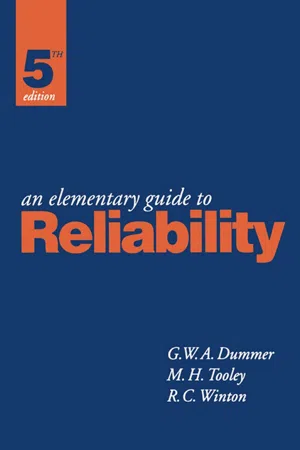
An Elementary Guide to Reliability
About this book
This classic text has now been completely revised and updated, making it an ideal introductory course in reliability for a wide range of engineering qualifications, including City & Guilds 8030 and HNC/Ds. A new chapter focuses on the role of the microprocessor and microcomputer controller, and the use of algorithms for monitoring system performance. The addition of numerous problems, self-check questions and exam-style questions makes this an extremely useful book for courses with an element of independent study.
- A basic text in reliability ideal for a wide range of engineering courses
- A classic brought fully up to date for today's students
- New self-check questions make this book suitable for independent study
Information
1
The importance of reliability
Electrical, electronic and mechanical equipment is used in a number of fields – in industry for the control of processes, in computers, in medical electronics, atomic energy, communications, navigation at sea and in the air, and in many other fields. It is essential that this equipment should operate reliably under all the conditions in which it is used. In the air navigation, military and atomic energy fields, for instance, failure could result in a dangerous situation. Very complicated systems, involving large numbers of separate units, such as avionic and aerospace electronic systems, are coming into use more and more. These systems are extremely complex and use a large number of component parts. As each individual part is liable to failure, the overall reliability will decrease unless the reliability of each component part can be improved.
Suppose, for example, it is known that one component out of half a million would break down every hour. Then an item of equipment using 100 000 of these components would break down at an average interval of 5 hours.
The requirement for reliability is different for each application. In the transatlantic cable service, for instance, the underwater amplifiers must operate for 20 years or so without failure, because the cost of raising the cable to repair a failure would be about £500 000 (since it would be necessary to send a cable ship to the location, find the failure under several miles of ocean, supply and install a new amplifier, lower the cable to the bottom again and return to port). Added to this is the loss of revenue while the cable is out of action, which might bring the total to £1 000 000, or more.
In Britain the Air Registration Board will only license aircraft to use a blind landing system if the fault rate for the total system is less than one in ten million.
In the case of military aircraft on a combat mission, or a missile flight, it is vital for the equipment to operate for the period of flight, or the mission and perhaps a battle might be lost. It has been estimated that unreliability costs the RAF alone up to £100 million each year in spares and servicing costs. In the case of an equipment controlling a chemical plant or some complex industrial process, the cost of ‘shutdown’ may be considerable in spoiled production and loss of output.
It is essential to ‘build-in’ reliability by sound design and construction and to carry out enough tests to make sure that this has been done.
The ‘availability’ or time an equipment is functioning correctly while in use depends both on reliability and on maintainability. Reliability is defined in detail in the next chapter, but may be said to be a measure of an equipment’s ability to perform its functions consistently under given conditions. Maintainability is a measure of the speed with which loss of performance is detected, diagnosed and made good, and this is discussed in Chapter 8.
Reliability is of course a most important factor in the safety of an equipment, but it is by no means the only factor. A system or equipment can ‘perform its required function’ (see definition on page 5) and yet be unsafe. There are well-documented major disasters caused not by mechanical or electronic breakdown but by human failure. Such human failures can be due to failures of operators, of maintenance staff, or of management.
Breakdowns and disasters can arise from failure of management to establish proper operating procedures and regulations. Management’s share of the responsibility for ‘failure’ has been estimated to be above 50%. They can also arise from operators’ failure, accidental or deliberate, to observe laid-down operating procedures and regulations. The results of accidental failure can be allowed for to some extent by anticipating, during the equipment design stage, what accidental operating mistakes might be made and introducing safeguards. However, it is impossible to anticipate deliberate failure to follow operating procedures, and it is essential to impress on operators and on maintenance staff, during their training, how vital it is that they never depart from laid-down procedures and regulations however safe it may appear to do so.
Figures 1.1, 1.2 and 1.3 illustrate in a lighthearted way the importance of reliability and some of its aspects.

Figure 1.1 ‘It’s only a random failure, Sir.’

Figure 1.2 One test is worth 10 000 opinions.

Figure 1.3 You are being flown by an automatic pilot.
2
Definitions of reliability
Because of the many differing operational requirements and varying environments, ‘reliability’ means different things to different people. The generally accepted definition of reliability1 is
Reliability – the characteristic of an item expressed by the probability that it will perform a required function under stated conditions for a stated period of time.
It will be noted that by definition reliability is a probability of success and this aspect is dealt with in more detail in Chapter 4.
General definitions are given below while fuller definitions are given in Chapter 12.
A ‘failure’ is any inability of a part or equipment to carry out its specified function.
An ‘item’ may be any part, subsystem, system or equipment which can be individually considered and separately tested.
An item can fail in many ways and these failures are classified as follows:
(a) Causes of failure:
(i) Misuse failure Failures attributable to the application of stresses beyond the stated capabilities of the item.
(ii) Inherent weakness failure or latent ...
Table of contents
- Cover image
- Title page
- Table of Contents
- Copyright
- Introduction
- Acknowledgements
- Chapter 1: The importance of reliability
- Chapter 2: Definitions of reliability
- Chapter 3: Some simple statistics
- Chapter 4: How reliability is calculated
- Chapter 5: The effect of operating conditions and environments
- Chapter 6: Mechanical reliability
- Chapter 7: Installation and operability
- Chapter 8: Maintainability
- Chapter 9: Reporting failures
- Chapter 10: The cost of reliability
- Chapter 11: Design of fault tolerant systems
- Chapter 12: Some useful reliability definitions
- Answers to self-assessment questions
- References for further reading
- Index
Trusted by 375,005 students
Access to over 1.5 million titles for a fair monthly price.
Study more efficiently using our study tools.
Frequently asked questions
Yes, you can cancel anytime from the Subscription tab in your account settings on the Perlego website. Your subscription will stay active until the end of your current billing period. Learn how to cancel your subscription
No, books cannot be downloaded as external files, such as PDFs, for use outside of Perlego. However, you can download books within the Perlego app for offline reading on mobile or tablet. Learn how to download books offline
Perlego offers two plans: Essential and Complete
- Essential is ideal for learners and professionals who enjoy exploring a wide range of subjects. Access the Essential Library with 800,000+ trusted titles and best-sellers across business, personal growth, and the humanities. Includes unlimited reading time and Standard Read Aloud voice.
- Complete: Perfect for advanced learners and researchers needing full, unrestricted access. Unlock 1.5M+ books across hundreds of subjects, including academic and specialized titles. The Complete Plan also includes advanced features like Premium Read Aloud and Research Assistant.
We are an online textbook subscription service, where you can get access to an entire online library for less than the price of a single book per month. With over 1.5 million books across 990+ topics, we’ve got you covered! Learn about our mission
Look out for the read-aloud symbol on your next book to see if you can listen to it. The read-aloud tool reads text aloud for you, highlighting the text as it is being read. You can pause it, speed it up and slow it down. Learn more about Read Aloud
Yes! You can use the Perlego app on both iOS and Android devices to read anytime, anywhere — even offline. Perfect for commutes or when you’re on the go.
Please note we cannot support devices running on iOS 13 and Android 7 or earlier. Learn more about using the app
Please note we cannot support devices running on iOS 13 and Android 7 or earlier. Learn more about using the app
Yes, you can access An Elementary Guide to Reliability by G. Dummer,R. Winton,Mike Tooley in PDF and/or ePUB format, as well as other popular books in Business & Management. We have over 1.5 million books available in our catalogue for you to explore.