eBook - ePub
Fire Behavior of Upholstered Furniture and Mattresses
- 450 pages
- English
- ePUB (mobile friendly)
- Available on iOS & Android
eBook - ePub
Fire Behavior of Upholstered Furniture and Mattresses
About this book
In the United States alone, deaths due to furniture and bed fires still rank as the top-most category of fire losses. The flammability of upholstered furniture is a major concern of engineers and others across a wide swath of organizations. This book was written to provide its audience with the science and engineering need to better understand the combustibility of the products they manufacture, purchase, and try to extinguish. Beginning with a brief overview of materials, safety design and standards, the text covers topics such as flame ignition, spread, toxic gases, heat release rate (HRR), test methods, fire hazard analysis, and selected regulations in the US, UK, and EU.
Information
Topic
Physical SciencesSubtopic
Thermodynamics1
Introduction
This book is a comprehensive revision of a 1985 monograph[1] authored by Babrauskas and Krasny. The intervening years saw few advances in the basic science of furniture combustion, but much work was done in applied areas, both in empirical studies and in regulatory activities. Thus, this edition is organized differently from the preceding book, and is specifically intended to provide useful information to any individuals with a responsibility for the fire safety of furniture.
Research from various parts of the world are encompassed in this book, but focus on regulation is mainly from the US perspective, with significant additional material on UK and EU activities, and more limited coverage of other parts of Europe. Other, briefer, overviews of the upholstered item fire situation in the UK and the US are found in Refs. 2–6. A comprehensive report on the results and analysis of an extensive European project on the post-ignition Combustion Behavior of Upholstered Furniture (CBUF)[7] references many important literature sources.
This chapter contains an overview of the basics of upholstery structure and fire safety design. Following this, fire statistics are presented. The chapter concludes with a brief history and status of US and EU regulations covering upholstered furniture and mattresses.
1.1.0 UPHOLSTERED FURNITURE STRUCTURE AND MATERIALS
Upholstered furniture has a complex structure, as shown in Fig. 1-1. One item can contain fifteen or more components. In the ignition process, whether it be from a cigarette (smoldering ignition) or small flame, the cover and interliner fabric, if any, and material immediately below them (one or several different padding materials) are important. As the fire progresses, other materials contribute, including the bulk of the padding as well as the frame, staples, and springs, which can affect the manner in which the burning item collapses. This in turn affects fire growth. Bedding (pillows, blankets, sheets, etc.), mattresses, and bed frames contain a different variety of materials and construction factors.
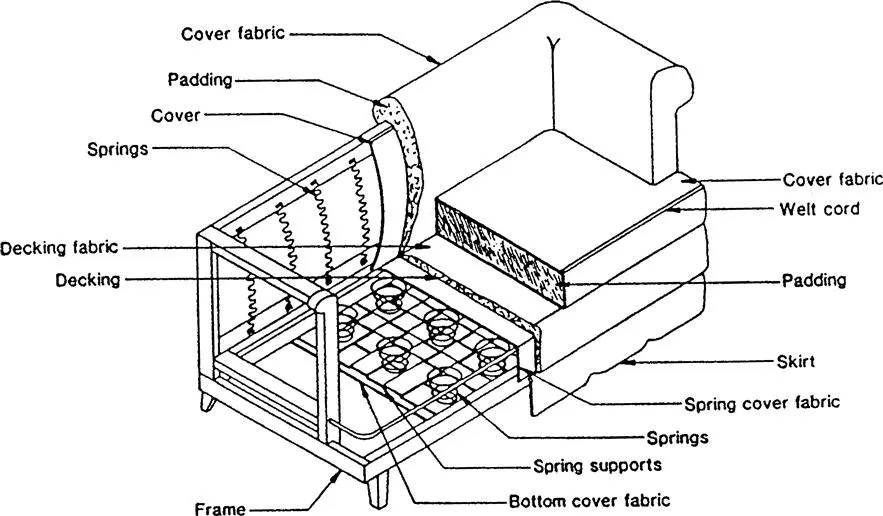
A large variety of component materials are used in upholstered furniture and mattresses. Cover fabrics can be made from char-forming fibers, such as cellulosic, acrylic, wool, and silk fibers, or from thermoplastic fibers. Among the cellulosic fibers, cotton and rayon predominate but flax, hemp, jute, etc. are also used. Thermoplastic fibers include nylon, olefin (polypropylene or polyethylene), and polyester. Fabrics using blends of more than one fiber type have become very popular in the last decade. Fabrics often contain dyes and dye auxiliaries, print auxiliaries, and other finishes, e.g., stain and water repellents, and softeners. Raw cotton fabrics contain smolder promoting alkali metal ions, as do many of the fabric finishing agents. Many fabrics have latex back-coatings.
Paddings today are predominantly polyurethane foams varying in density and additives. Polyurethane may be used as a thin layer combined with other paddings, or, more frequently, as the entire core. Cellulosic batting (mostly cotton but also containing hemp, jute, etc.), both untreated or flame retarded treated (FR), and cotton/man-made fiber blend batting are also used. Polyester batting is popular for special comfort and appearance effects.
Interliners (also often called barrier materials, fire blockers, or blocking layers) are used between the cover fabric and padding to increase ignition resistance and improve burning behavior. For cigarette ignition resistance, thin layers of polyester batting are popular (paddings of 100% polyester batting are less widely used; they tend to have excessive loft and are mostly found in uses other than seats). Flame-resistant interliners are FR-treated cotton, aluminized materials, glass fabrics, layers of FR foams, aramid non-wovens, etc.
In addition, furniture and mattresses often contain innersprings, frames (mostly wood or steel, but sometimes rigid polyurethane or high-density polypropylene), springs, or straps to hold up cushions, bottom cover fabrics (usually nonwoven or cotton fabrics), nails, and staples.
1.2.0 UPHOLSTERED FURNITURE AND MATTRESSES
Many aspects of flammability are similar for upholstered furniture and mattresses. The similarities and differences pertinent to predicting the fire performance have been analyzed in Ref. 8.
Upholstered items in residential or public occupancies, or air, maritime, and ground transportation are all subject to different functional requirements and regulations.
Upholstered items include a large variety of constructions: three-or-two seat sofas, chairs, mattresses, and some bedframes. The furniture geometry can have a large effect on progress of the fires. There are fully and partially upholstered types, recliners, and lightly upholstered office and stacking chairs. Chairs or sofas can have straight or curved sides, the seating area can be square or rounded (barrel chairs), there may or may not be upholstered armrests, etc. Loose or puckered cover fabrics have appeared in recent times, and their effect on flame and cigarette ignitability has not been established. There are also such features as open or padded seat sides, open spaces between seat and backrest, etc.
Mattresses have predominantly flat, horizontal surfaces which are not as easily ignited from flame ignition sources as the vertical surfaces. Upholstered bed frames (divan bases) are more common in Europe than in the US. Both mattresses and upholstered furniture may have depressions at the welt cord and, due to tufting, these may affect cigarette ignition propensity.
Cigarettes on mattresses may be covered inadvertently with sheets, blankets, and/or pillows. This increases the probability of smoldering ignition. These intermediary materials may also ignite more readily than mattresses from flames, and then expose the mattress to a much more severe fire than the original ignition source, e.g., a match. Fire development is also affected by the nature and materials of the bed frame. Consequently, it is more difficult to develop relevant ignition tests and standards for bedding than for upholstered furniture, which is not usually covered by extraneous items.
1.3.0 DESIGN AND FIRE SAFETY
While fire problems with upholstered furniture have been of concern for some decades, it has been mainly since the 1970s that quantitative data have been available for common materials used in upholstered items. These efforts have made it possible to treat the subject as a design or prediction problem. In a design problem, the designer is typically required to come up with materials and configurations suitable to meet a set objective, which may be resistance to ignition by cigarettes, resistance to small or large flames, or, smoke and toxic pyrolysis product release rates below some specified amount. Several means of solving such problems are:
1. Test items made from the same materials, in the same configuration, as the proposed line of furniture in a full scale facility, e.g., a room or furniture calorimeter;
2. Test large-scale mock-ups of the fabric, interliner, and padding;
3. Test bench-scale composites of the materials in item 1 and use the results in a full-scale model or correlation formula;
4. Test the fabrics and foams individually and use the results in a composite model or correlation formula to predict the results of tests of furniture composites in the Cone Calorimeter. However, the tests on the individual components require modified test procedures in the Cone Calorimeter which are not, at this writing, generally available in the testing laboratories; although the testing protocols are described in the CBUF report.[7]
In the last years, much progress has been made to eliminate the burden of full scale testing of every material/configuration combination a manufacturer may wish to produce, and to place greater reliance on strategy 3 and, possibly, strategy 4. At the end of this chapter, an overview is given of the CBUF project which is the latest of such efforts. Details of CBUF and other available literature on this subject are reviewed in Chs. 5, 6, and 8. Briefly, it is now possible, within certain limits, to estimate from bench-scale tests of both mattresses and upholstered furniture fabric/padding composites whether the actual item will support a smoldering or a flaming ignition and whether the flaming ignition will lead to a fully involved fire. Such estimates can be used to decide whether certain regulatory pass/fail levels can be met. Progress has also been made in predicting the heat release rate (HRR) of propagating furniture and mattress fires.
1.4.0 UPHOLSTERED ITEM FIRE STATISTICS
During the 1991 to 1995 period, there was an average of 446,700 home fires, 3590 civilian deaths, 20,382 civilian injuries, and $4.5 billion property damage.[576]–[579] This is a decrease of almost 150,000 fires from the 1983–1987 period, and of a 19% decrease in civilian deaths. However, the number of deaths per 100,000 fires has not been decreasing. Furthermore, the number of civilian injuries and property damage increased during this period. Civilian deaths may be reduced by better medical treatment, and the increase in property damage can perhaps be explained by the 1991 Oakland, CA, firestorm.
The table below shows the number of fires, deaths, injuries, and property damage due to upholstered item fires. As in earlier such compilations, these fires were by far the largest cause of fire deaths; ranked high in injuries and relatively low in property damage. While together they represented only about 10% of the fires, they caused about 35% of the deaths; this indicates that upholstered item fires are considerably more likely to cause death than other categories.
Death, Injuries, and Damage Due to Fires in Which Upholstered Items Were The First Item to Ignite
| Number of Fires | Civilian Deaths | Civilian Injuries | Direct Property Damage, Million$ | |
| Upholstered Furniture... | ||||
Table of contents
- Cover image
- Title page
- Table of Contents
- Copyright
- Preface
- NOTICE
- 1. Introduction
- 2. Fundamentals
- 3. Test Methods, Standards and Regulations
- 4. Ignition Sources
- 5. Effects of Test Apparatus and of Test Scale
- 6. Upholstered Item Design Engineering
- 7. Modeling
- 8. Fire Hazard Analysis
- 9. Conclusions
- Exercises and Solutions
- Abbreviations
- References
- Index
Trusted by 375,005 students
Access to over 1.5 million titles for a fair monthly price.
Study more efficiently using our study tools.
Frequently asked questions
Yes, you can cancel anytime from the Subscription tab in your account settings on the Perlego website. Your subscription will stay active until the end of your current billing period. Learn how to cancel your subscription
No, books cannot be downloaded as external files, such as PDFs, for use outside of Perlego. However, you can download books within the Perlego app for offline reading on mobile or tablet. Learn how to download books offline
Perlego offers two plans: Essential and Complete
- Essential is ideal for learners and professionals who enjoy exploring a wide range of subjects. Access the Essential Library with 800,000+ trusted titles and best-sellers across business, personal growth, and the humanities. Includes unlimited reading time and Standard Read Aloud voice.
- Complete: Perfect for advanced learners and researchers needing full, unrestricted access. Unlock 1.5M+ books across hundreds of subjects, including academic and specialized titles. The Complete Plan also includes advanced features like Premium Read Aloud and Research Assistant.
We are an online textbook subscription service, where you can get access to an entire online library for less than the price of a single book per month. With over 1.5 million books across 990+ topics, we’ve got you covered! Learn about our mission
Look out for the read-aloud symbol on your next book to see if you can listen to it. The read-aloud tool reads text aloud for you, highlighting the text as it is being read. You can pause it, speed it up and slow it down. Learn more about Read Aloud
Yes! You can use the Perlego app on both iOS and Android devices to read anytime, anywhere — even offline. Perfect for commutes or when you’re on the go.
Please note we cannot support devices running on iOS 13 and Android 7 or earlier. Learn more about using the app
Please note we cannot support devices running on iOS 13 and Android 7 or earlier. Learn more about using the app
Yes, you can access Fire Behavior of Upholstered Furniture and Mattresses by John Krasny,William Parker,Vytenis Babrauskas in PDF and/or ePUB format, as well as other popular books in Physical Sciences & Thermodynamics. We have over 1.5 million books available in our catalogue for you to explore.