- 390 pages
- English
- ePUB (mobile friendly)
- Available on iOS & Android
eBook - ePub
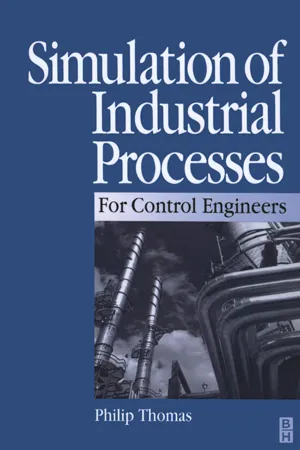
Simulation of Industrial Processes for Control Engineers
About this book
Computer simulation is the key to comprehending and controlling the full-scale industrial plant used in the chemical, oil, gas and electrical power industries. Simulation of Industrial Processes for Control Engineers shows how to use the laws of physics and chemistry to produce the equations to simulate dynamically all the most important unit operations found in process and power plant.The book explains how to model chemical reactors, nuclear reactors, distillation columns, boilers, deaerators, refrigeration vessels, storage vessels for liquids and gases, liquid and gas flow through pipes and pipe networks, liquid and gas flow through installed control valves, control valve dynamics (including nonlinear effects such as static friction), oil and gas pipelines, heat exchangers, steam and gas turbines, compressors and pumps, as well as process controllers (including three methods of integral desaturation). The phenomenon of markedly different time responses ("stiffness") is considered and various ways are presented to get around the potential problem of slow execution time. The book demonstrates how linearization may be used to give a diverse check on the correctness of the as-programmed model and explains how formal techniques of model validation may be used to produce a quantitative check on the simulation model's overall validity.The material is based on many years' experience of modelling and simulation in the chemical and power industries, supplemented in recent years by university teaching at the undergraduate and postgraduate level. Several important new results are presented. The depth is sufficient to allow real industrial problems to be solved, thus making the book attractive to engineers working in industry. But the book's step-by-step approach makes the text appropriate also for post-graduate students of control engineering and for undergraduate students in electrical, mechanical and chemical engineering who are studying process control in their second year or later.
Information
Table of contents
- Cover image
- Title page
- Table of Contents
- Copyright
- Foreword
- Notation
- Chapter 1: Introduction
- Chapter 2: Fundamental concepts of dynamic simulation
- Chapter 3: Thermodynamics and the conservation equations
- Chapter 4: Steady-state incompressible flow
- Chapter 5: Flow through ideal nozzles
- Chapter 6: Steady-state compressible flow
- Chapter 7: Control valve liquid flow
- Chapter 8: Liquid flow through the installed control valve
- Chapter 9: Control valve gas flow
- Chapter 10: Gas flow through the installed control valve
- Chapter 11: Accumulation of liquids and gases in process vessels
- Chapter 12: Two-phase systems: boiling, condensing and distillation
- Chapter 13: Chemical reactions
- Chapter 14: Turbine nozzles
- Chapter 15: Steam and gas turbines
- Chapter 16: Steam and gas turbines: simplified model
- Chapter 17: Turbo pumps and compressors
- Chapter 18: Flow networks
- Chapter 19: Pipeline dynamics
- Chapter 20: Distributed components: heat exchangers and tubular reactors
- Chapter 21: Nuclear reactors
- Chapter 22: Process controllers and control valve dynamics
- Chapter 23: Linearization
- Chapter 24: Model validation
- Appendix 1: Comparative size of energy terms
- Appendix 2: Explicit calculation of compressible flow using approximating functions
- Appendix 3: Equations for control valve flow in SI units
- Appendix 4: Comparison of Fisher Universal Gas Sizing Equation, FUGSE, with the nozzle-based model for control valve gas flow
- Appendix 5: Measurement of the internal energy of reaction and the enthalpy of reaction using calorimeters
- Appendix 6: Comparison of efficiency formulae with experimental data for convergent-only and convergent–divergent nozzles
- Appendix 7: Approximations used in modelling turbine reaction stages in off-design conditions
- Appendix 8: Fuel pin average temperature and effective heat transfer coefficient
- Appendix 9: Conditions for emergence from saturation for P + I controllers with integral desaturation
- Index
Trusted by 375,005 students
Access to over 1.5 million titles for a fair monthly price.
Study more efficiently using our study tools.
Frequently asked questions
Yes, you can cancel anytime from the Subscription tab in your account settings on the Perlego website. Your subscription will stay active until the end of your current billing period. Learn how to cancel your subscription
No, books cannot be downloaded as external files, such as PDFs, for use outside of Perlego. However, you can download books within the Perlego app for offline reading on mobile or tablet. Learn how to download books offline
Perlego offers two plans: Essential and Complete
- Essential is ideal for learners and professionals who enjoy exploring a wide range of subjects. Access the Essential Library with 800,000+ trusted titles and best-sellers across business, personal growth, and the humanities. Includes unlimited reading time and Standard Read Aloud voice.
- Complete: Perfect for advanced learners and researchers needing full, unrestricted access. Unlock 1.5M+ books across hundreds of subjects, including academic and specialized titles. The Complete Plan also includes advanced features like Premium Read Aloud and Research Assistant.
We are an online textbook subscription service, where you can get access to an entire online library for less than the price of a single book per month. With over 1.5 million books across 990+ topics, we’ve got you covered! Learn about our mission
Look out for the read-aloud symbol on your next book to see if you can listen to it. The read-aloud tool reads text aloud for you, highlighting the text as it is being read. You can pause it, speed it up and slow it down. Learn more about Read Aloud
Yes! You can use the Perlego app on both iOS and Android devices to read anytime, anywhere — even offline. Perfect for commutes or when you’re on the go.
Please note we cannot support devices running on iOS 13 and Android 7 or earlier. Learn more about using the app
Please note we cannot support devices running on iOS 13 and Android 7 or earlier. Learn more about using the app
Yes, you can access Simulation of Industrial Processes for Control Engineers by Philip J Thomas in PDF and/or ePUB format, as well as other popular books in Biological Sciences & Biotechnology. We have over 1.5 million books available in our catalogue for you to explore.