
- 754 pages
- English
- ePUB (mobile friendly)
- Available on iOS & Android
eBook - ePub
Non-Destructive Testing '92
About this book
A broad spectrum of technical papers on the most diverse nondestructive testing techniques (NDT) and correlated fields are presented in this volume. The main applications and methods of these important quality control techniques are reviewed in depth. Apart from reporting on the improvements and developments of new techniques and the rapid automatization of nondestructive testings, many papers address the environment from the point of view of inspection surveys. The 265 contributions demonstrate that nondestructive testing techniques (NDT) play a vital role, not only in the quality assurance and control of manufactured products, but also as instruments of public, environmental and industrial safety. The quality of the articles in this book attest to the contribution this conference has made in the technical interchange of experience between NDT professionals, and indicate the present accelerated rate of development of ideas and knowledge in this field.
Information
ELETRIC TECHNIQUES
Processing of cartographies from steam generator tubes using eddy current testing with an absolute coil
P. Attaouia, B. Benoista, R. Besnarda, T. Sollieira, P. Gaillarda and R. Lengelléa, aCEA CE Saclay DTA/DTM/STA/LCME 91191 GIF/YVETTE CEDEX - FRANCE; bUTC URA 817 BP 649 60206 COMPIEGNE - FRANCE
ABSTRACT
This paper deals with the processing of electromagnetic cartographies from steam generator tubes testing. These images are disturbed by background noise due to probe lift-off changes and by the rolling transition zone signal. Procedures which allow us to obtain a “flat” cartography will be presented in part one. Then, using mathematical morphology tools on the cartography, we will expose the first results dealing with sizing and orientation of the defects.
1 INTRODUCTION
As nuclear plants age, the inspection of steam generator tubes poses new problems. New defects [1] appear in the area of the tube sheet, the support plate and at the U-bend. The testing of the tube is undertaken by using an absolute coil which improves the detection and the signal resolution. The probe has a helicoidal movement to scan the inside of the tube. The data are represented for each of the signal complex coordinate as a cartography: this allows us to have a developped view of the tube [2].
These images are most often disturbed by background noise due to probe lift-off changes when there is a tube ovalization, a probe offset or a pilgrim pass process deformation. Dimensionnal variations, like rolling transition zones, also generate signals which disturb the defect analysis. This study implies one first phase of processing which consists of improving the signal to noise ratio of the image, by subtracting the low frequency components characteristic of background noise. (A particular procedure also allows us to get rid of the rolling transition signal). In the first part, we present this preprocessing and in a second part we approach the first results of the defect analysis (mathematical morphology-wise).
2 CARTOGRAPHY DECOMPOSITION
The decomposition principle is as follows: if an image is represented by a vector V and if the basis vectors vi is chosen, one can always obtain a decomposition of V into a weighted sum of each vi vector. One only has to compute the inner product between V and each vi to know its contribution. If one reasons upon a signal, one only has to choose an appropriate base functions for the decomposition. We have taken the sinusoidal functions (1, sin(x), cos(x), sin(2x), …) from which we can construct a base of bidimensionnal functions defined by all the possible products of unidimensionnal functions (for each of the longidudinal and circumferential direction).
In order to decompose the image, the window around the defect has to be removed so that the domain is no longer continous. A new corresponding base has to be constructed with functions which are no longer orthogonal but still normalized. The rebuilding of the noisy surface is made from functions which are orthogonal but no more normalized.
We can describe it as follows:

So we get the several bases of bidimensionnal functions:
| The base B1 so that | b1i, j (x, y) = fi(x) · fj(y) |
| The base B2 so that | b2i, j (x, y) = gi(x) gj(y) |
| The base B3 so that | b3i, j (x,y) = hi(x).hj(y) |
Let S be the initial surface to be decomposed.
1st step: computation of the coefficients of projection of the surface (minus the defect window) on the basic surfaces:

2nd step: choice of the maximum coefficient

3rd step: subtraction of the corresponding component from the entire surface.

The residue Res(x,y) becomes the new image S(x,y). The computation of the new coefficients allows us to substract the next component. This procedure is applied as many times as necessary to eliminate the background noise. This decomposition on a non-orthogonal base implies that the same component can be subtract several times (but non in succession).
NB: Using sinusoidal functions implies a periodicity which exists along y-axis but which is imposed along the x-axis (longitudinal axis). To avoid this, a rough flattering is applied so that the first and the last column of the image become equivalent. As for the rolling transition signals, they are for the most part eliminated by computing the mean profite along the generatrix.
Results: the figure 1 presents the data acquisition and an example of flattering.
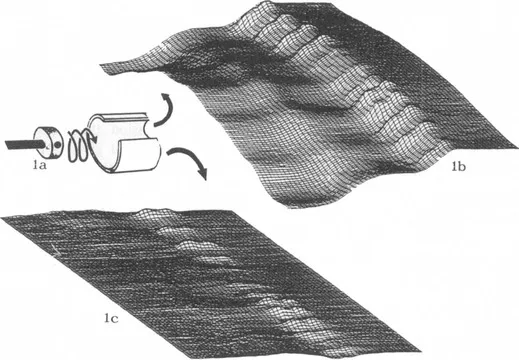
Figure 1a-c la:data acquisition, lb:original cartography, lc:"flat" cartography resulting of the processing
3 FIRST DEFECT ANALYSIS: A MORPHOLOGICAL APPROACH
After this processing which improves the signal to noise ratio, a first analysis can begin. Defects are characterized by their orientation, their dimension, their depth.
Using mathematical morphology tools on the cartographies will give us information about the first two parameters: orientation and dimension. The depth information cannot be estimated from the presented electromagnetic surfaces. We need to come back to the complex plane and to the study of the Lissajous curves obtained from rows or columns extracted from the cartographies (X and Y line).
The morphological processing lies in applying a skeletonization algorithm to the image [3]. In the first instance, we have studied some simple defects whose characteristics ar...
Table of contents
- Cover image
- Title page
- Table of Contents
- Copyright
- PREFACE
- FOREWORD
- 13th World Conference on Non-Destructive Testing 13th WCNDT
- NDT RELIABILITY - A WAY TO GO
- ACOUSTICS
- ACOUSTIC EMISSION
- ALL
- ELETRIC TECHNIQUES
- HOLOGRAPHY
- LEAK TESTING
- MAGNETIC
- OTHER
- PENETRANT
- RADIATION TECHNIQUES
- RADIOGRAPHY
- AUTHOR INDEX
Trusted by 375,005 students
Access to over 1.5 million titles for a fair monthly price.
Study more efficiently using our study tools.
Frequently asked questions
Yes, you can cancel anytime from the Subscription tab in your account settings on the Perlego website. Your subscription will stay active until the end of your current billing period. Learn how to cancel your subscription
No, books cannot be downloaded as external files, such as PDFs, for use outside of Perlego. However, you can download books within the Perlego app for offline reading on mobile or tablet. Learn how to download books offline
Perlego offers two plans: Essential and Complete
- Essential is ideal for learners and professionals who enjoy exploring a wide range of subjects. Access the Essential Library with 800,000+ trusted titles and best-sellers across business, personal growth, and the humanities. Includes unlimited reading time and Standard Read Aloud voice.
- Complete: Perfect for advanced learners and researchers needing full, unrestricted access. Unlock 1.5M+ books across hundreds of subjects, including academic and specialized titles. The Complete Plan also includes advanced features like Premium Read Aloud and Research Assistant.
We are an online textbook subscription service, where you can get access to an entire online library for less than the price of a single book per month. With over 1.5 million books across 990+ topics, we’ve got you covered! Learn about our mission
Look out for the read-aloud symbol on your next book to see if you can listen to it. The read-aloud tool reads text aloud for you, highlighting the text as it is being read. You can pause it, speed it up and slow it down. Learn more about Read Aloud
Yes! You can use the Perlego app on both iOS and Android devices to read anytime, anywhere — even offline. Perfect for commutes or when you’re on the go.
Please note we cannot support devices running on iOS 13 and Android 7 or earlier. Learn more about using the app
Please note we cannot support devices running on iOS 13 and Android 7 or earlier. Learn more about using the app
Yes, you can access Non-Destructive Testing '92 by C. Hallai,P. Kulcsar in PDF and/or ePUB format, as well as other popular books in Technology & Engineering & Industrial Health & Safety. We have over 1.5 million books available in our catalogue for you to explore.