eBook - ePub
Online Learning and Assessment in Higher Education
A Planning Guide
- 224 pages
- English
- ePUB (mobile friendly)
- Available on iOS & Android
eBook - ePub
About this book
The use of e-learning strategies in teaching is becoming increasingly popular, particularly in higher education. Online Learning and Assessment in Higher Education recognises the key decisions that need to be made by lecturers in order to introduce e-learning into their teaching. An overview of the tools for e-learning is provided, including the use of Web 2.0 and the issues surrounding the use of e-learning tools such as resources and support and institutional policy. The second part of the book focuses on e-assessment; design principles, different forms of online assessment and the benefits and limitations of e-assessment.
- Provides an accessible introduction to teaching with technology
- Addresses the basic aspects of decision-making for successful introduction of e-learning, drawing on relevant pedagogical principles from contemporary learning theories
- Crosses boundaries between the fields of higher education and educational technology (within the discipline of education), drawing on discourse from both areas
Information
1
Where to start
Introduction
Where you need to start if you are thinking about introducing technology into your teaching or assessment is really in the same place that you would start if you were planning any new teaching activity. You need to think about how students learn and the nature of good teaching practice in higher education, in conjunction with:

This information will inform your detailed planning.
In this chapter, we will begin by focusing on how students learn and the nature of good teaching practice as this will provide us with some generic principles about learning and teaching against which you can consider your own circumstances. These principles will also guide us as we reflect on issues related to online learning and assessment. We will be suggesting that the principles are relevant whatever the mode of learning, but that you nevertheless need to reconceptualise your teaching and assessment practices when you implement them online. We will consider why this is so towards the end of this chapter.
How students learn
How do you think students learn? How do you learn? Evidence from many lecture theatres around the world might suggest that learning is about students receiving knowledge from the lecturer. Indeed, as you are probably aware, during the mid-twentieth century, behaviourism was a dominant learning theory, with its roots in scientific positivism and the concept of the teacher passing objective truths to the student. This concept was very influential in the development of the field of educational technology. However, most currently accepted theories of learning in higher education suggest that learning is an internal, intentional change and that there are multiple ways of knowing. From this perspective, learning is not primarily about knowledge transmission and acquisition but, following Dewey and subsequent ‘progressive’ educators, involves the active engagement of learners in the experience of learning: ‘It is not enough to insist upon the necessity of experience, nor even of activity in experience. Everything depends upon the quality of the experience which is had’ (Dewey, 1963, p. 27).
In this tradition there have been two dominant learning theories in higher education in recent years. They are phenomenography and constructivism.1 We will briefly outline these theories now, and will add a few more theoretical perspectives in Chapter 3. In this book we support the idea that learning is embedded in the student’s experience but we take the view that, depending on your learners, your context, and the online approaches you might consider, it may be useful to have a few different theoretical lenses which might help you to conceptualise your learning design and the process of learning.
Phenomenography
Phenomenography arose from studies in the 1970s which identified ‘deep’ and ‘surface’ approaches to learning by students. It generated the field of study which came to be known as student learning research in higher education. It has been influential in the United Kingdom, Northern Europe and Australia but as Brew (2006) notes, it is virtually absent from American literature. According to this theory, the student’s perspective is fundamental to the experience of learning: the world is not external and only exists through the student’s eyes. The implication for teaching is that:
… [when] teachers mold experiences for their students with the aim of bringing about learning … the essential feature is that the teacher takes the part of the learner, sees the experience through the learner’s eyes, becomes aware of the experience through the learner’s awareness. (Marton & Booth, 1997, p. 179)
While the curriculum is the same for all students in a unit of study, the way they will ‘experience’ and ‘encounter’ it and thus ‘learn about’ it may differ. In this context it is relevant to know about the characteristics of your students which describe how they learn. You can use this information to facilitate their learning.
Constructivism
As the name implies, from a constructivist viewpoint, learning is conceptualised as an active process in which learners construct new ideas or concepts based upon their own knowledge, both old (from the past) and new. Learning is seen as occurring best when it is situated in authentic contexts. Hence, problem-based and case-based learning are founded on constructivist ideas.
Constructivism has its basis in cognitive psychology. Individual constructivism refers to the construction of meaning by individual students while the idea of social constructivism is that meaning is constructed socially through the interactions that occur in a group. Constructivism became very influential in the American educational technology literature during the 1990s, highlighting the dichotomy between ‘objectivist’ (positivist) conceptions of learning associated with behaviourism, and constructivist perspectives focusing on the engagement of the learner in the learning experience (e.g., Jonassen, 1991; Duffy & Jonassen, 1992).
Table 1.1 from Oliver (2000), based on Grabinger (1996, p. 667), summarises the main differences between ‘old’ assumptions about learning and ‘new’ (constructivist) assumptions which focus on the individual processes involved in learning.
Table 1.1
Old versus new assumptions about learning
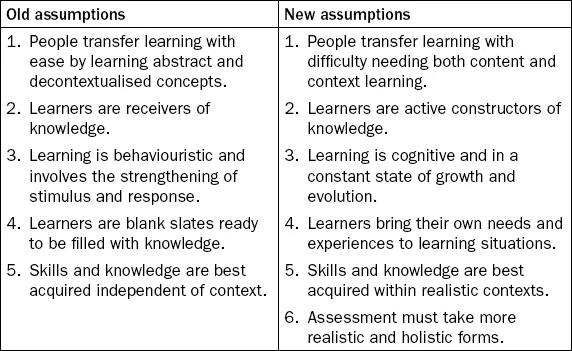
Source: Adapted from Oliver, 2000, p. 19.
Developments in online learning have resulted in further support for ideas from social constructivism to explain how students learn as they engage with each other in the online environment. This concept is based on the theoretical perspectives of Vygotsky (1978) who focused on the social and dialogical aspects of internal development. He identified a zone of proximal development (which is the distance between the actual developmental level of a learner and the level of potential development as determined through the guidance of the teacher or collaboration with peers) and recognised the importance of support or scaffolding by the teacher until the learner becomes self-regulated and independent.
Comparing phenomenography and constructivism
An important distinction between phenomenography and constructivism relates to the view of the relationship between the learner and the environm...
Table of contents
- Cover image
- Title page
- Table of Contents
- Copyright
- Preface
- Acknowledgements
- List of figures and tables
- About the authors
- Chapter 1: Where to start
- Chapter 2: Teaching with technology – considering your options
- Chapter 3: Online learning design and development
- Chapter 4: Online assessment
- Chapter 5: Evaluation
- Chapter 6: Conclusion
- Chapter 7: Introducing online learning and assessment – a planning guide
- References
- Index
Trusted by 375,005 students
Access to over 1.5 million titles for a fair monthly price.
Study more efficiently using our study tools.
Frequently asked questions
Yes, you can cancel anytime from the Subscription tab in your account settings on the Perlego website. Your subscription will stay active until the end of your current billing period. Learn how to cancel your subscription
No, books cannot be downloaded as external files, such as PDFs, for use outside of Perlego. However, you can download books within the Perlego app for offline reading on mobile or tablet. Learn how to download books offline
Perlego offers two plans: Essential and Complete
- Essential is ideal for learners and professionals who enjoy exploring a wide range of subjects. Access the Essential Library with 800,000+ trusted titles and best-sellers across business, personal growth, and the humanities. Includes unlimited reading time and Standard Read Aloud voice.
- Complete: Perfect for advanced learners and researchers needing full, unrestricted access. Unlock 1.5M+ books across hundreds of subjects, including academic and specialized titles. The Complete Plan also includes advanced features like Premium Read Aloud and Research Assistant.
We are an online textbook subscription service, where you can get access to an entire online library for less than the price of a single book per month. With over 1.5 million books across 990+ topics, we’ve got you covered! Learn about our mission
Look out for the read-aloud symbol on your next book to see if you can listen to it. The read-aloud tool reads text aloud for you, highlighting the text as it is being read. You can pause it, speed it up and slow it down. Learn more about Read Aloud
Yes! You can use the Perlego app on both iOS and Android devices to read anytime, anywhere — even offline. Perfect for commutes or when you’re on the go.
Please note we cannot support devices running on iOS 13 and Android 7 or earlier. Learn more about using the app
Please note we cannot support devices running on iOS 13 and Android 7 or earlier. Learn more about using the app
Yes, you can access Online Learning and Assessment in Higher Education by Robyn Benson,Charlotte Brack in PDF and/or ePUB format, as well as other popular books in Languages & Linguistics & Computer Science General. We have over 1.5 million books available in our catalogue for you to explore.