- 460 pages
- English
- ePUB (mobile friendly)
- Available on iOS & Android
eBook - ePub
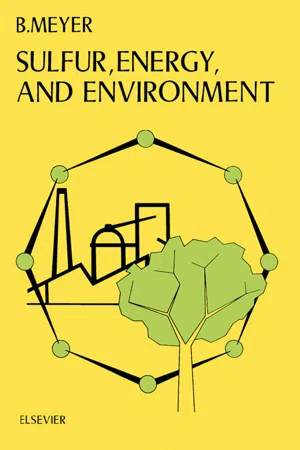
Sulfur, Energy, and Environment
About this book
Sulfur, Energy, and Environment is a guide to the properties of sulfur; its three important compounds; and a review of the production, use, and recovery of sulfur in relation to energy production and environmental protection. After a brief introduction to the history of sulfur, the chemical properties of the element and some important compounds are reviewed, using common analytical methods. Sulfur is a strategic chemical in many modern applications and may make headway into high-volume non-chemical uses as it is being modified according to our changing technology and needs. The sources of sulfur and where it frequently occurs is explained. This discussion is followed by citing reviews of the four most important cycles, that is, the global sulfur cycle, hydrosphere, atmospheric sulfur budget, and the anthropogenic sulfur cycle. Sulfur production methods, coal combustion chemistry, and flue gas desulfurization are then described. The many uses of sulfur are described, including in medicine, agriculture, chemical industry, and the plastic industry. However, throughout the production of sulfur, problems affecting the environment occur, so environmental control and legislation are also discussed. Finally, the trends of sulfur research, production, use and recovery, role of chemistry, and the future overall area where science, energy, chemistry, and the environment exist together are presented. Chemists and chemistry students, industrialists, and environmental planners will find this guide to sulfur helpful. Lecturers in chemistry and researchers in the many fields of application of sulfur will likewise benefit from it.
Information
Chapter 1
Introduction
Publisher Summary
This chapter describes the chemical properties of sulfur and their relation to the production, use, and recovery of the element. Both basic chemistry and industrial use of sulfur influence energy production and the extent to which the environment can be protected. Thus, sulfur is an important parameter in the choice of new technology and in determining practically enforceable environmental laws. Sulfur is an important plant nutrient because it is a vital component of several proteins. Its shortage stunts the growth of plants and reduces crop yield. The basic chemical properties of sulfur remain the same regardless of the manner in which it is used. Thus, sulfur chemistry is the link between the various applications and uses of the element and establishes the intrinsic limits of any process in which sulfur is involved. If the basic sulfur chemistry is resulting in undesirable products, or the thermodynamics or kinetics are unfavorable, all efforts including legislation, political pressure, money, or engineering are in vain.
This book deals with elemental sulfur. It describes the chemical properties of sulfur and their relation to the production, use, and recovery of the element. Both basic chemistry and industrial use of sulfur influence energy production and the extent to which the environment can be protected. Thus, sulfur is an important parameter in the choice of new technology and in determining practically enforceable environmental laws. The purpose of this book is to delineate the role of sulfur at a time when technological transitions and social adjustments are setting the framework of society for the next hundred years.
In 1976 almost fifty million tons of sulfur were produced worldwide. Most of this was used to manufacture sulfuric acid, which is unchallenged as the leading industrial chemical. Its production steadily increased from 5 tons in 1750 to 110 million tons in 1976. However, this smooth overall growth does not properly reflect development, which was marked by stagnant as well as dynamic periods. In the 18th and 19th Centuries sulfur production was centered in Sicily. Frasch’s development of a clean and cheap sulfur production process made the Sicilian industry obsolete, and within ten years Louisiana and Texas had become the world centers for sulfur production. They retained this position unchallenged for 60 years, until 1960, when production of sour natural gas made Canada and France major producers of sulfur. With this development, an initially unwanted by-product became the major source of the leading industrial chemical. Currently, and for at least the next ten years, oil production in the Middle East will yield important quantities of sulfur, probably equalling the stepped-up production in Poland, which is implementing increasingly modern techniques based on traditional production methods.
Sulfur production from sour gas and oil is based on the Claus process, which was patented in 1882. Even before that time, the manufacture of sulfuric acid had reached essentially the present stage of chemical art. Since then sulfur chemistry and industrial inorganic chemistry have remained almost stagnant in comparison to other fields of basic chemistry and other sciences which have proceeded through a period of unique growth. Only during the last fifteen years has sulfur chemistry slowly revived. Recent progress has indeed been surprising: twelve new solid allotropes of the element have been synthesized, some 20 components of elemental sulfur vapor have been identified, and substantial progress has been made in the understanding of liquid sulfur.
At the same time, energy consumption has increased at a similarly spectacular rate. During the dynamic 1960’s, when all progress and values were re-examined, the public suddenly became aware that involuntary release of sulfur dioxide from coal burning power plants—mainly into the air of the northern hemisphere—equaled the intentional world sulfur production. The public became fearful of the enormous quantities of efferent sulfur, because it did not realize that the total sulfur involved in all of man’s recorded activities is smaller than the sulfur dioxide emission resulting from any of the large volcanic eruptions of Mt. Katmai in Alaska in 1912, Mt. Hekla in Iceland in 1947, or Mt. Agnug in Bali in 1963. The conflict between consumption and conservation brought into the open the emotional origin and the political potential of technical terms such as power, waste, and pollution, and an increasing government effort to regulate industries and abate pollution was demanded.
Today, a large number of highly competent and skilled specialists in industry, government, and education struggle to translate the results of a hundred years of progress in diverse fields of science into technology acceptable under the new standards of society. It is the goal of this book to help these researchers find their way through the increasingly incoherent literature of the last ten years, and gain access to work related to their fields. It is too early at this time to gain a full overview, but this book constitutes an effort to make a modest start and point out the direction of developments which are under way. It is hoped that it can support those working in the field as well as newcomers in their momentous task, which will determine the chemical basis for the large scale technology to be used during the next hundred years. This task will also influence the role of sulfur, and the nature and quality of human life. Since the work involves coordinating results from a variety of divergent sciences, it seems reminiscent of the task of salvaging the Tower of Babel.
Changing Traditions
A hundred-fifty years ago, sulfur was widely used in industry and in the chemistry lab, and could be found in the medicine cabinet of every home. Sulfur alone filled a third of the inorganic chemistry texts. During the following decades it maintained its position as the leading industrial chemical, but it disappeared from public view, from chemistry labs, and finally from college chemistry textbooks. One of the three leading U.S. college general chemistry textbooks of 1970 contains only six sentences on sulfur, of which two are incorrect. During the same time academic interest in sulfur also waned; ten years ago at the 20 academically highest ranking U.S. universities, a total of only three inorganic or physical chemistry professors conducted research focussing on sulfur. Most of the progress resulted from basic research which was conducted as a side activity by a small group of little-noticed but outstanding industrial scientists whose main responsibility was supervising plant production.
In the meantime oil, gas and sulfur production became cheaper, and abundant energy became available to exploit technology developped during recent wars for mass production. This, and the rapidly growing influence of media and international communication fostered a hunger for consumption of manufactured goods, which in turn caused quick economic growth. Sputnik caused demand for quick implementation of new technology and instant mass education. This proved to be socially disruptive, because democracy and free enterprise depend on equilibrating forces which require more time than was available.
At the time when manufacturers, in response to earlier trends, used linear extrapolation to compute anticipated needs, perfected better process methods, and finished building larger manufacturing facilities, products became obsolete. Industry responded by diversifying and intruding in...
Table of contents
- Cover image
- Title page
- Table of Contents
- Copyright
- Preface
- Chapter 1: Introduction
- Chapter 2: History
- Chapter 3: Properties
- Chapter 4: Analytical Chemistry
- Chapter 5: Occurrence and Sources of Sulfur
- Chapter 6: The Sulfur Cycles
- Chapter 7: Sulfur Production
- Chapter 8: Recovery from Combustion Gases
- Chapter 9: Environmental Control and Legislation
- Chapter 10: Medical Use and Health Effects
- Chapter 11: Sulfur in Agriculture and Food
- Chapter 12: Industrial Uses of Sulfur and Its Compounds
- Chapter 13: Sulfur Polymers
- Chapter 14: Sulfur Containing Materials
- Chapter 15: Future Trends
- Appendix
- Bibliography
- Author Index
- Subject Index
Trusted by 375,005 students
Access to over 1.5 million titles for a fair monthly price.
Study more efficiently using our study tools.
Frequently asked questions
Yes, you can cancel anytime from the Subscription tab in your account settings on the Perlego website. Your subscription will stay active until the end of your current billing period. Learn how to cancel your subscription
No, books cannot be downloaded as external files, such as PDFs, for use outside of Perlego. However, you can download books within the Perlego app for offline reading on mobile or tablet. Learn how to download books offline
Perlego offers two plans: Essential and Complete
- Essential is ideal for learners and professionals who enjoy exploring a wide range of subjects. Access the Essential Library with 800,000+ trusted titles and best-sellers across business, personal growth, and the humanities. Includes unlimited reading time and Standard Read Aloud voice.
- Complete: Perfect for advanced learners and researchers needing full, unrestricted access. Unlock 1.5M+ books across hundreds of subjects, including academic and specialized titles. The Complete Plan also includes advanced features like Premium Read Aloud and Research Assistant.
We are an online textbook subscription service, where you can get access to an entire online library for less than the price of a single book per month. With over 1.5 million books across 990+ topics, we’ve got you covered! Learn about our mission
Look out for the read-aloud symbol on your next book to see if you can listen to it. The read-aloud tool reads text aloud for you, highlighting the text as it is being read. You can pause it, speed it up and slow it down. Learn more about Read Aloud
Yes! You can use the Perlego app on both iOS and Android devices to read anytime, anywhere — even offline. Perfect for commutes or when you’re on the go.
Please note we cannot support devices running on iOS 13 and Android 7 or earlier. Learn more about using the app
Please note we cannot support devices running on iOS 13 and Android 7 or earlier. Learn more about using the app
Yes, you can access Sulfur, Energy, and Environment by Beat Meyer in PDF and/or ePUB format, as well as other popular books in Technology & Engineering & Environmental Science. We have over 1.5 million books available in our catalogue for you to explore.