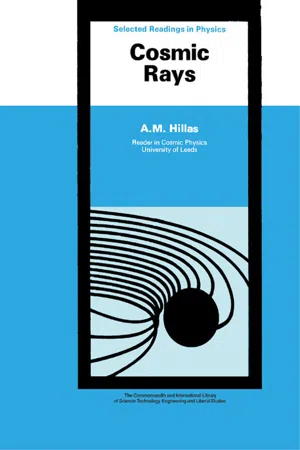
eBook - ePub
Cosmic Rays
The Commonwealth and International Library: Selected Readings in Physics
- 308 pages
- English
- ePUB (mobile friendly)
- Available on iOS & Android
eBook - ePub
Cosmic Rays
The Commonwealth and International Library: Selected Readings in Physics
About this book
Cosmic Rays is a two-part book that first elucidates the discovery, nature, and particles produced by cosmic rays. This part also looks into the primary cosmic radiation; radio waves from the galaxy; extensive air showers; origin of cosmic rays; and other cosmic radiations. Part 2 consists of reprinted papers involving cosmic rays. Papers 1 to 10 treat the nature of the radiation, arranged chronologically; in Papers 11 to 16 the scene moves away from the Earth.
Information
Topic
Ciencias físicasSubtopic
FísicaPART 1
Outline
Chapter I: Discovery
Chapter II: The Nature of the Radiation
Chapter III: Particles Produced by the Cosmic Rays
Chapter IV: The Primary Cosmic Radiation
Chapter V: Radio Waves from the Galaxy
Chapter VI: Extensive Air Showers
Chapter VII: The Origin of Cosmic Rays
Chapter VIII: Local Peculiarities
Chapter IX: Other Cosmic Radiations
References
I
Discovery
Publisher Summary
This chapter reviews the discovery of cosmic rays. Elster and Geitel in Berlin had pioneered the study of electrical conduction in the open air and had deduced that this resulted from the presence of positive and negative ions in the air. Attempts to interpret variations of the conductivity with geographical location, altitude, time, and atmospheric conditions were complicated by the fact that it depended not only on the concentration of ions but also on their variable mobility. However, Geitel and C.T.R. Wilson found that some ionization was present even in closed vessels containing air. When much of the ionization had been traced to radioactive impurities and deposits, but the residual amount was uncertain, Hess in Vienna and Kolhörster in Berlin undertook the preparation of very remarkable ascents in open balloons to find how high the radiation penetrated. The chapter also discusses a few experiments that were carried out by Millikan and Cameron that involved measurements of the ionization produced in electrometers lowered into snow-fed lakes in California, which were thought to be free from radioactive contamination.
THE history of the investigation of cosmic rays is remarkable for the variety of the new phenomena revealed or illuminated, so one is prepared for some original turn of events whenever a new method or domain of observation is opened up. It is of interest to see this happening as we pass through the eras of Geiger–Müller counters, cloud chambers, emulsions, radio-telescopes, and so on, and as the site of the observations is extended. But first, we see what can be done with an electroscope.
1.1 The penetrating radiation
Around 1900 the phenomena of ionization and electrical conduction in gases were under investigation in several laboratories; the electron was a new discovery, the phenomena of radioactivity were becoming established, though without a fundamental understanding in terms of atomic nuclei, and the effectiveness of certain radiations in producing ionization in air was known.
Elster and Geitel in Berlin had pioneered the study of electrical conduction in the open air and had deduced that this resulted from the presence of positive and negative ions in the air. Attempts to interpret variations of the conductivity with geographical location, altitude, time and atmospheric conditions, and so to trace its source, were complicated by the fact that it depended not only on the concentration of ions but also on their variable mobility. This bedevilled many experiments for the next decade. However, Geitel and C. T. R. Wilson, also interested in atmospheric electricity, found that some ionization was present even in closed vessels containing air, even in the dark, Wilson concluding that 20 ion pairs must be formed per cm3 per second. These conclusions were drawn from observations of the rate at which a charged gold leaf electroscope lost its charge even when protected against surface leakage. Wilson’s account continues (Wilson, 1901):
“The experiments with this apparatus were carried out at Peebles. The mean rate of leak when the apparatus was in an ordinary room amounted to 6·6 divisions of the micrometer scale per hour. An experiment made in the Caledonian Railway tunnel near Peebles (at night after the traffic had ceased) gave a leakage of 7·0 divisions per hour, the fall of potential amounting to 14 scale divisions in the two hours for which the experiment lasted. The difference is well within the range of experimental errors. There is thus no evidence of any falling off of the rate of production of ions in the vessel, although there were many feet of solid rock overhead.
“It is unlikely, therefore, that the ionization is due to radiation which has traversed our atmosphere; it seems to be, as Geitel concludes, a property of air itself.”
A worthy attempt—but it turned out (Elster and Geitel) that air in cellars and caves was especially conducting due to traces of radioactive emanation constantly seeping from the ground. It was clear that radioactive contamination played an important part in these observations. Perhaps all matter was to some extent radioactive.
Rutherford, then working in Montreal, himself observed the residual ionization in electroscopes, and found that some could be cut out by a lead shield (Rutherford and Cooke, 1903) indicating that part was due to γ-rays from the walls of his building, but inside a 5-ton mass of lead there remained 6 ions cm−3 s−1. As late as the first edition of his book on radioactive substances (Rutherford, 1913) he concludes, however, that “the very weak activity actually observed is in all probability to be ascribed to the presence of traces of radioactive matter as impurities” —in the walls of the vessel. It may seem that Rutherford missed the mark, but the conclusion appears to be essentially correct, in so far as it refers to observations near sea level. Most of the effects observed were not due to an external radiation (which, it now appears, contributes one-quarter of Rutherford’s residual ionization). It seems fortunate that most experiments around this time showed sufficient inaccuracy and unrepeatable results to stimulate further investigation over varying conditions and especially at higher altitudes. One observation in particular which spurred the search for an external radiation was a considerable diurnal variation in the ionization observed by several workers, pointing to the possibility of an extra-terrestrial source. However, the results were not reproducible: the variation was affected by atmospheric conditions and precipitation, and was much reduced as observing methods improved.
It should be remembered that the known ionizing agents arising from radioactive materials were α-particles, which leave a very heavy trail of ions along their tracks, and are stopped by ∼ 5 cm of air or a sheet of paper, β-particles, which expend their energy in ionization more gradually, and γ-rays, much the most penetrating, which would be cut down by a factor 10 in intensity by a few centimetres of lead, their ionization resulting only from secondary fast electrons ejected from materials they traverse.
To make more accurate measurements of the small amount of ionization Wulf developed a very sensitive electrometer in which the main part consisted of two quartz fibres fastened together at their ends, made slightly conducting, and carrying a small weight. When charged, the fibres bowed apart, and the very small electrical capacitance made the instrument sensitive to very small charges; and patient investigation showed that careful cleaning of zinc vessels gave less radioactive contamination and lower ionization rates.
This was the instrument used by most workers. It was possible to detect changes in ionization of a few ions cm−3 s−1.
The ionization fell considerably over lake water or over a glacier (the experiments gave considerable scope for travel). As both should be relatively free from radioactive contamination, it became clear that much of the ionization arose from γ-rays emitted from radioactive tra...
Table of contents
- Cover image
- Title page
- Table of Contents
- Copyright
- Preface
- PART 1
- PART 2
- Index
Trusted by 375,005 students
Access to over 1.5 million titles for a fair monthly price.
Study more efficiently using our study tools.
Frequently asked questions
Yes, you can cancel anytime from the Subscription tab in your account settings on the Perlego website. Your subscription will stay active until the end of your current billing period. Learn how to cancel your subscription
No, books cannot be downloaded as external files, such as PDFs, for use outside of Perlego. However, you can download books within the Perlego app for offline reading on mobile or tablet. Learn how to download books offline
Perlego offers two plans: Essential and Complete
- Essential is ideal for learners and professionals who enjoy exploring a wide range of subjects. Access the Essential Library with 800,000+ trusted titles and best-sellers across business, personal growth, and the humanities. Includes unlimited reading time and Standard Read Aloud voice.
- Complete: Perfect for advanced learners and researchers needing full, unrestricted access. Unlock 1.5M+ books across hundreds of subjects, including academic and specialized titles. The Complete Plan also includes advanced features like Premium Read Aloud and Research Assistant.
We are an online textbook subscription service, where you can get access to an entire online library for less than the price of a single book per month. With over 1.5 million books across 990+ topics, we’ve got you covered! Learn about our mission
Look out for the read-aloud symbol on your next book to see if you can listen to it. The read-aloud tool reads text aloud for you, highlighting the text as it is being read. You can pause it, speed it up and slow it down. Learn more about Read Aloud
Yes! You can use the Perlego app on both iOS and Android devices to read anytime, anywhere — even offline. Perfect for commutes or when you’re on the go.
Please note we cannot support devices running on iOS 13 and Android 7 or earlier. Learn more about using the app
Please note we cannot support devices running on iOS 13 and Android 7 or earlier. Learn more about using the app
Yes, you can access Cosmic Rays by A. M. Hillas, Robert Robinson,Dean Athelstan Spilhaus,D. Ter Haar in PDF and/or ePUB format, as well as other popular books in Ciencias físicas & Física. We have over 1.5 million books available in our catalogue for you to explore.