Theory and Modeling of Dispersed Multiphase Turbulent Reacting Flows gives a systematic account of the fundamentals of multiphase flows, turbulent flows and combustion theory. It presents the latest advances of models and theories in the field of dispersed multiphase turbulent reacting flow, covering basic equations of multiphase turbulent reacting flows, modeling of turbulent flows, modeling of multiphase turbulent flows, modeling of turbulent combusting flows, and numerical methods for simulation of multiphase turbulent reacting flows, etc. The book is ideal for graduated students, researchers and engineers in many disciplines in power and mechanical engineering.
- Provides a combination of multiphase fluid dynamics, turbulence theory and combustion theory
- Covers physical phenomena, numerical modeling theory and methods, and their applications
- Presents applications in a wide range of engineering facilities, such as utility and industrial furnaces, gas-turbine and rocket engines, internal combustion engines, chemical reactors, and cyclone separators, etc.
To simulate dispersed multiphase turbulent reacting flows, at first it is necessary to understand some fundamentals of dispersed multiphase flows. This chapter gives some knowledge in this aspect, as particle/droplet size and its distribution, apparent density and volume fraction, particle drag and heat and mass transfer, and single-particle dynamics.
Keywords
particle size; particle apparent density; particle volume fraction; particle drag; particle mass and heat transfer; particle dynamics
1.1 Particle/Spray Basic Properties
To characterize gas-particle or gas-spray flows, it is necessary first to describe the particle/spray basic properties [1–4] as follows.
1.1.1 Particle/Droplet Size and Its Distribution
The particle/droplet size distribution is frequently expressed by the semiempirical Rosin–Rammler formula as:
(1.1)
(1.1)
where R(dk) is the weight fraction of particles with sizes larger than dk, n is the index of nonuniformness, and
is a characteristic size. Both n and
are determined by experiments. The derivative of R(dk) is
(1.2)
(1.2)
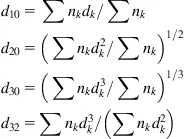
which expresses the differential particle size distribution, and R(dk) is the integral size distribution. The mean particle sizes can be defined as:
(1.3)
(1.3)
where
are diameter-averaged, surface-averaged, volume-averaged, and Sauter mean sizes, respectively. The Sauter diameter is most widely used in engineering. The typical particle sizes are:
Coal particles in fluidized beds
1–10 mm
Liquid spray
10–200 μm
Pulverized coal
1–100 μm
Soot particles
1–5 μm
1.1.2 Apparent Density and Volume Fraction
For gas-particle/dr...
Table of contents
Cover image
Title page
Table of Contents
Copyright
Preface
Nomenclature
Introduction
Chapter 1. Some Fundamentals of Dispersed Multiphase Flows
Chapter 2. Basic Concepts and Description of Turbulence
Chapter 3. Fundamentals of Combustion Theory
Chapter 4. Basic Equations of Multiphase Turbulent Reacting Flows
Chapter 5. Modeling of Single-Phase Turbulence
Chapter 6. Modeling of Dispersed Multiphase Turbulent Flows
Chapter 7. Modeling of Turbulent Combustion
Chapter 8. The Solution Procedure for Modeling Multiphase Turbulent Reacting Flows
Chapter 9. Simulation of Flows and Combustion in Practical Fluid Machines, Combustors, and Furnaces
Index
Trusted by 375,005 students
Access to over 1.5 million titles for a fair monthly price.
Study more efficiently using our study tools.
Frequently asked questions
Yes, you can cancel anytime from the Subscription tab in your account settings on the Perlego website. Your subscription will stay active until the end of your current billing period. Learn how to cancel your subscription
No, books cannot be downloaded as external files, such as PDFs, for use outside of Perlego. However, you can download books within the Perlego app for offline reading on mobile or tablet. Learn how to download books offline
Perlego offers two plans: Essential and Complete
Essential is ideal for learners and professionals who enjoy exploring a wide range of subjects. Access the Essential Library with 800,000+ trusted titles and best-sellers across business, personal growth, and the humanities. Includes unlimited reading time and Standard Read Aloud voice.
Complete: Perfect for advanced learners and researchers needing full, unrestricted access. Unlock 1.5M+ books across hundreds of subjects, including academic and specialized titles. The Complete Plan also includes advanced features like Premium Read Aloud and Research Assistant.
Both plans are available with monthly, semester, or annual billing cycles.
We are an online textbook subscription service, where you can get access to an entire online library for less than the price of a single book per month. With over 1.5 million books across 990+ topics, we’ve got you covered! Learn about our mission
Look out for the read-aloud symbol on your next book to see if you can listen to it. The read-aloud tool reads text aloud for you, highlighting the text as it is being read. You can pause it, speed it up and slow it down. Learn more about Read Aloud
Yes! You can use the Perlego app on both iOS and Android devices to read anytime, anywhere — even offline. Perfect for commutes or when you’re on the go. Please note we cannot support devices running on iOS 13 and Android 7 or earlier. Learn more about using the app
Yes, you can access Theory and Modeling of Dispersed Multiphase Turbulent Reacting Flows by Lixing Zhou in PDF and/or ePUB format, as well as other popular books in Technology & Engineering & Physics. We have over 1.5 million books available in our catalogue for you to explore.