- 660 pages
- English
- ePUB (mobile friendly)
- Available on iOS & Android
eBook - ePub
Handbook of Silicon Wafer Cleaning Technology
About this book
The second Edition of the Handbook of Silicon Wafer Cleaning Technology is intended to provide knowledge of wet, plasma, and other surface conditioning techniques used to manufacture integrated circuits. The integration of the clean processes into the device manufacturing flow will be presented with respect to other manufacturing steps such as thermal, implant, etching, and photolithography processes. The Handbook discusses both wet and plasma-based cleaning technologies that are used for removing contamination, particles, residue, and photoresist from wafer surfaces. Both the process and the equipment are covered. A review of the current cleaning technologies is included. Also, advanced cleaning technologies that are under investigation for next generation processing are covered; including supercritical fluid, laser, and cryoaerosol cleaning techniques. Additionally theoretical aspects of the cleaning technologies and how these processes affect the wafer is discussed such as device damage and surface roughening will be discussed. The analysis of the wafers surface is outlined. A discussion of the new materials and the changes required for the surface conditioning process used for manufacturing is also included.
- Focused on silicon wafer cleaning techniques including wet, plasma, and other surface conditioning techniques used to manufacture integrated circuits
- As this book covers the major technologies for removing contaminants, it is a reliable reference for anyone that manufactures integrated circuits, or supplies the semiconductor and microelectronics industries
- Covers processes and equipment, as well as new materials and changes required for the surface conditioning process
- Editors are two of the top names in the field and are both extensively published
- Discusses next generation processing techniques including supercritical fluid, laser, and cryoaerosol
Information
PART I
INTRODUCTION AND OVERVIEW
1 Overview and Evolution of Silicon Wafer Cleaning Technology
1.1 Introduction
The preparation of ultraclean Si (silicon) surfaces by cleaning and surface conditioning for the manufacturing of integrated circuits (IC) has undergone considerable changes since we published the first edition of this book in 1993. The driving forces for these changes have been the ever-increasing requirements for producing advanced Si devices with improved performance, reliability, and cost. The feature sizes of these circuits have been scaled down to below 100 nm and the device structure may incorporate multilevel metallization layers with Cu (copper) and special dielectric materials.
The earlier Si wafer cleaning processes have evolved from aqueous-chemical (the so-called “wet chemical“) to alternative dry cleaning processes for metallized device wafers. These processes include gas-phase procedures, such as plasma reactions for stripping organic photoresist masking layers and their residues. The application of cryogenic aerosols and supercritical fluids for removing particle contaminants for applications where aqueous chemistry cannot be used is being investigated.
The understanding of surface contamination and defectivity and the role of particle adhesion, deposition, measurement, and removal have been substantially advanced during the past 14 years. The same is true for the ancillary analytical and control aspects, including the elucidation of the chemical composition of Si and SiO2 surfaces, the measurement of the effects of electrically active contaminants, and the instrumental analysis of ultra-trace surface impurities.
While it is the purpose of this book to have experts of the various fields address these exciting developments in depth, the objective of the present chapter is to broadly review the advances achieved specifically in Si wafer cleaning technology and to outline chronologically its evolution from the 1950s to the present. Some portions of the basic material presented in the first edition of this book have been retained, but are updated and expanded to reflect the new developments. Wet-chemical processes are still the most widely used method for Si wafer cleaning in the semiconductor industry today. Therefore, special emphasis is placed in treating wet-processes in this chapter. Dry-cleaning processes will be briefly surveyed with references to the pertinent chapters in this book.
1.2 Importance of Clean and Conditioned Wafer Surfaces
The importance of clean substrate surfaces in the fabrication of semiconductor microelectronic devices has been recognized since the dawn of solid state device technology in the 1950s. It is now well known that the device performance, reliability, and product yield of Si circuits are critically affected by the presence of chemical contaminants and particulate impurities on the wafer or device surface. Effective techniques for cleaning Si wafers before thermal treatment such as oxidation, after patterning by etching, after ion implantation, and before and after film deposition are now more important than ever before because of extreme sensitivity of the semiconductor surface and the nanometer sizes of the device features. As a consequence, the preparation of ultraclean Si wafers has become one of the key technologies in the fabrication of ULSI (ultra-large scale integration) Si circuits.
The term “ultraclean” may be defined in terms of the concentration of both chemical contaminants and particles on the wafer surface. The International Technology Roadmap for Semiconductors (ITRS) [1, 2], shown in Tables 1.2-1-1.2-4, specifies metrics that define the impact on yield based on contamination and defectivity for both front end of line processing (Table 1.2-1 and 1.2-2) and for complete interconnect surface preparation (Table 1.2-3 and 1.2-4).
Table 1.2-1 Front End Processing Surface Preparation Technology Requirements (1): Near-Term Processes
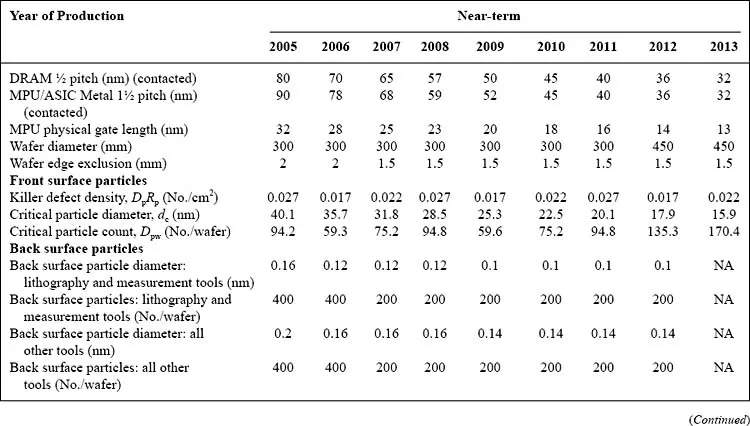
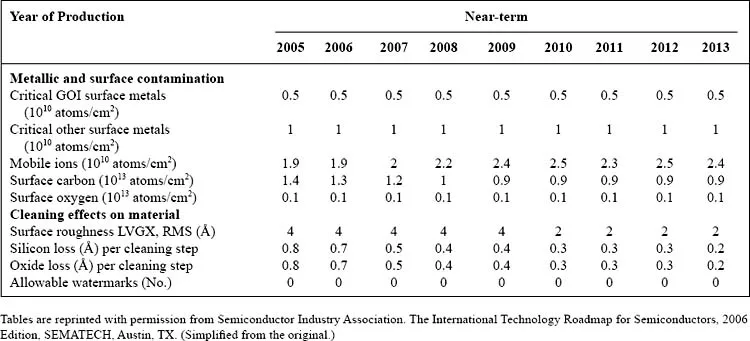
Table 1.2-2 Front End Processing Surface Preparation Technology Requirements (1): Long-Term, Processes
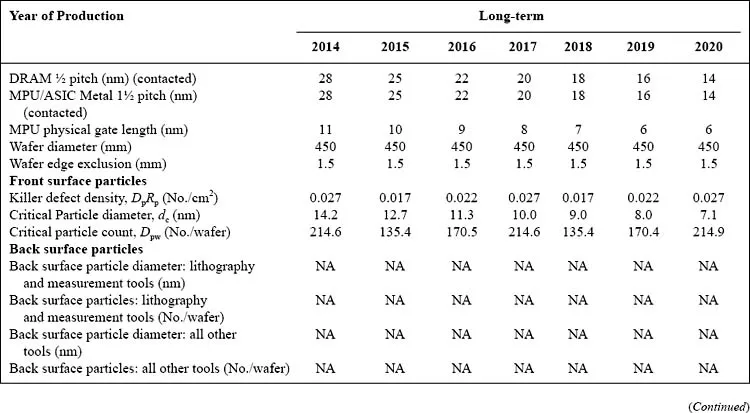
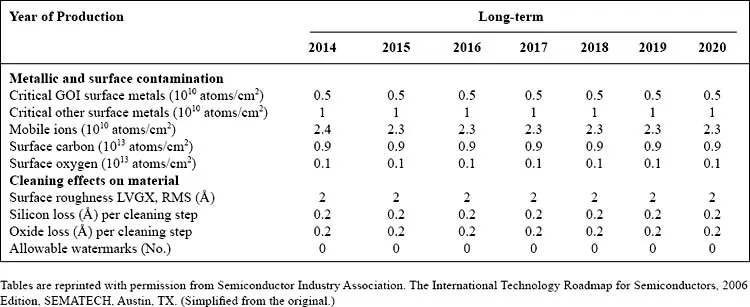
Table 1.2-3 Interconnect Surface Preparation Technology Requirements (2): Near-Term Processes
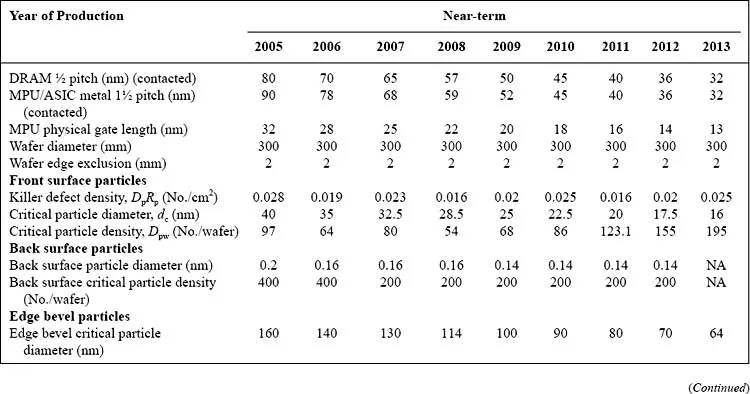
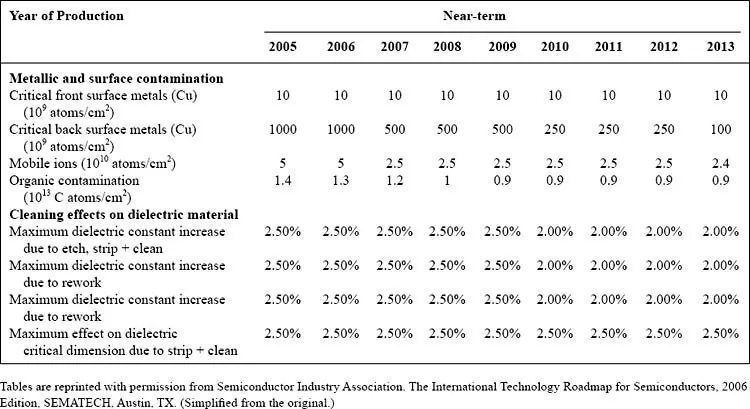
Table 1.2-4 Interconnect Surface Preparation Technology Requirements (2): Long-Term Processes
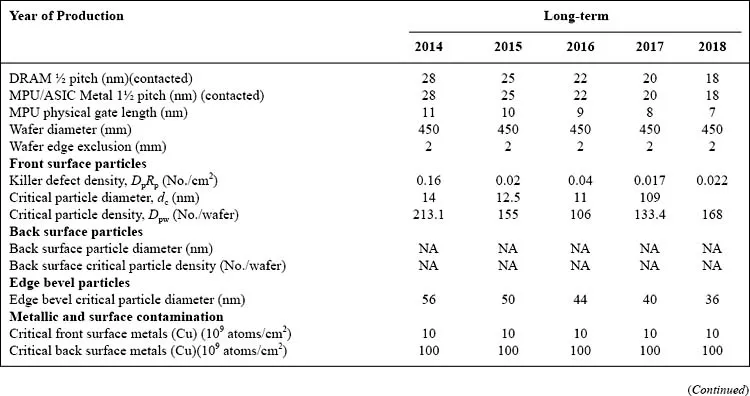
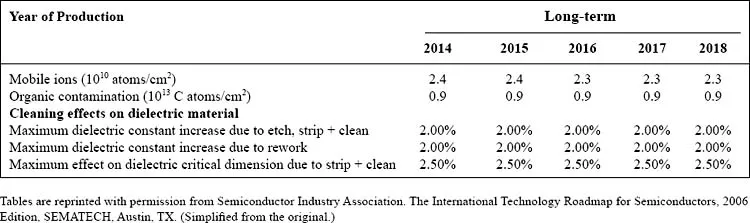
For the 32-nm node the total metallic impurities should be, for example, less than 0.5 × 10¹⁰ atoms/cm2. Particles larger than 0.11 μm in size should be fewer than approximately 0.1/cm2, which translates to fewer than 30 particles per 300-mm wafer. These extremely low numbers are impressive indeed! The reason for such stringent specifications is the fact that the overall device quality is critically affected by trace impurities. Each of the hundreds of processing steps in the fabrication of advanced Si circuits can contribute to contamination. With each advancing year, the node size has been decreased to allow a more densely packed array of device features, while the device chip size has been increasing to accommodate a larger number of circuits. At the same time the permissible maximum concentrations of chemical surface impurities have been lowered. The size of particle contaminants and their density per unit area have also been specified to decrease. Therefore, the demands of surface purity are becoming continually greater and more critical, but are also more difficult to attain.
The term “surface conditioning” may need some clarification. In recent years one has become to realize that the process of cleaning may do more than just remove impurities from the surface. It can prepare the surface chemically for the next process step. For examp...
Table of contents
- Cover image
- Title page
- Table of Contents
- Copyright
- Foreword
- Preface to the Second Edition
- Preface to First Edition
- PART I: INTRODUCTION AND OVERVIEW
- PART II: WET CHEMICAL PROCESS
- PART III: DRY CLEANING PROCESSES
- PART IV: ANALYTICAL AND CONTROL ASPECTS
- PART V: DIRECTIONS FOR THE NEAR FUTURE
- Book Editors and Chapters Authors
- Index
- Materials Science and Process Technology Series
Trusted by 375,005 students
Access to over 1.5 million titles for a fair monthly price.
Study more efficiently using our study tools.
Frequently asked questions
Yes, you can cancel anytime from the Subscription tab in your account settings on the Perlego website. Your subscription will stay active until the end of your current billing period. Learn how to cancel your subscription
No, books cannot be downloaded as external files, such as PDFs, for use outside of Perlego. However, you can download books within the Perlego app for offline reading on mobile or tablet. Learn how to download books offline
Perlego offers two plans: Essential and Complete
- Essential is ideal for learners and professionals who enjoy exploring a wide range of subjects. Access the Essential Library with 800,000+ trusted titles and best-sellers across business, personal growth, and the humanities. Includes unlimited reading time and Standard Read Aloud voice.
- Complete: Perfect for advanced learners and researchers needing full, unrestricted access. Unlock 1.5M+ books across hundreds of subjects, including academic and specialized titles. The Complete Plan also includes advanced features like Premium Read Aloud and Research Assistant.
We are an online textbook subscription service, where you can get access to an entire online library for less than the price of a single book per month. With over 1.5 million books across 990+ topics, we’ve got you covered! Learn about our mission
Look out for the read-aloud symbol on your next book to see if you can listen to it. The read-aloud tool reads text aloud for you, highlighting the text as it is being read. You can pause it, speed it up and slow it down. Learn more about Read Aloud
Yes! You can use the Perlego app on both iOS and Android devices to read anytime, anywhere — even offline. Perfect for commutes or when you’re on the go.
Please note we cannot support devices running on iOS 13 and Android 7 or earlier. Learn more about using the app
Please note we cannot support devices running on iOS 13 and Android 7 or earlier. Learn more about using the app
Yes, you can access Handbook of Silicon Wafer Cleaning Technology by Karen Reinhardt,Werner Kern in PDF and/or ePUB format, as well as other popular books in Technology & Engineering & Industrial Engineering. We have over 1.5 million books available in our catalogue for you to explore.