eBook - ePub
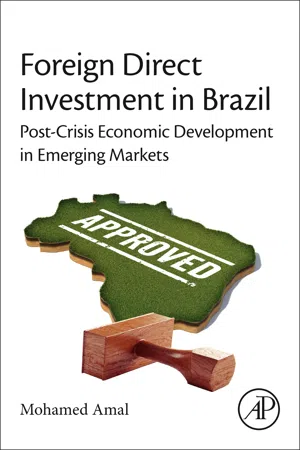
Foreign Direct Investment in Brazil
Post-Crisis Economic Development in Emerging Markets
- 230 pages
- English
- ePUB (mobile friendly)
- Available on iOS & Android
eBook - ePub
Foreign Direct Investment in Brazil
Post-Crisis Economic Development in Emerging Markets
About this book
Foreign Direct Investment in Brazil: Post-Crisis Economic Development in Emerging Markets explores both the inward and outward ways foreign direct investment (FDI) can help Brazil sustain economic growth and development in the sometimes hostile post-global crisis era. Inward and outward FDI have major roles to play in reviving Brazil's growth momentum and the country's transition to a new growth paradigm less dependent on commodity exports. The book provides a comprehensive discussion on the analytical framework of FDI and the policy environment influencing the patterns and development of FDI in Brazil. It compares Brazil to other developing countries, but its focus rests on how, and to what extent, the global crisis is shaping the Brazilian institutional environment and its implications for FDI.
- Covers an important contemporary development issue focusing on the experience of one of the fastest growing and largest emerging economies in the world
- Presents econometric findings using data at different levels of aggregation
- Provides an in-depth study on the determinants of FDI and their relations to institutions
- Explores both the inward and outward ways foreign direct investment (FDI) can help Brazil sustain economic growth and development in the sometimes hostile post-global crisis era
Information
Chapter 1
Introduction
Abstract
The aim of this book is to provide an understanding of the determinants of inward and outward foreign direct investment (FDI) from the particular perspective of institutional theory. We attempt to explore the different avenues by which institutions affect FDI, and under which conditions they may accelerate or restrain the internationalization of firms.
Keywords
inward FDI
outward FDI
institutions
economic development
The aim of this book is to provide an understanding of the determinants of inward and outward foreign direct investment (FDI) from the particular perspective of institutional theory. We attempt to explore the different avenues by which institutions affect FDI, and under which conditions they may accelerate or restrain the internationalization of firms.
We faced three major challenges during the investigation.
The first challenge was theoretical in nature. We tried to set up a general model that captures inward and outward FDI. This was a relatively hard task, since the logic and strategic rationale of MNCs operating in an emerging country may differ significantly from the rationale of MNCs from an emerging country, operating in another emerging country (South–South), or operating in a developed country (South–North). Our study is based on aggregate data and deals with FDI theory rather than with pure international business theories. However, we understand that the questions raised by several scholars (Ramamurti and Singh, 2009; Cuervo-Cazurra and Ramamurti, 2014) about the extent to which we can apply the foundational models and theories of MNCs to the understanding of emerging MNCs (MNCs from emerging economies) also remain key when we focus the analysis on the aggregate, instead of the microeconomic level. This means that since most of the FDI theories were based initially on the case of developed countries, under which conditions can we explore such models to understand FDI from emerging economies?
To overcome such a challenge we tried two specific avenues. First, we introduced the basic assumptions of institutional theory into general FDI theory (Dunning and Lundan, 2008). This avenue has been relatively well trodden in many studies of FDI in emerging countries, using different indicators and techniques (Daude and Stein, 2007; Thomas and Grosse, 2001; Amal and Seabra, 2007; Amal et al., 2010). However, it is still challenging when it comes to addressing outward FDI from emerging economies.
The second avenue was to explore some contributions on distance in the international business literature (Kostova, 1997; Hotho and Pedersen, 2012; Cuervo-Cazurra, 2008). Studies, particularly in the case of emerging MNCs, have provided important insights for how cultural and institutional distances shape the FDI strategies of firms.
The second challenge is methodological in nature. Since we used aggregate data, our analysis of FDI strategies remains relatively limited. We attempted in different ways to draw some evidence about FDI motives based on an econometric assessment of the data. We added to our quantitative approach in-depth interpretation of the sectoral and regional distribution of FDI, by using several sources of data, such as United Conference of Trade and Development (UNCTAD) and Economic Commission of Latin America and the Caribbean (ECLAC) reports on the strategies of MNCs.
The understanding of FDI motives remains a relatively controversial topic, particularly when looking at the new global economic set-up of competitiveness. Firms face different levels of constraints, which they have to manage by a complex web of strategies, instead of a unilateral market approach. This can be explained by the need for more active or voluntary embeddedness, by seeking to establish specific alliances with local firms and local institutions for R&D and innovation (Van Tulder, 2015).
On the other hand, some authors (Cuervo-Cazurra and Narula, 2015) have claimed a rethinking of Dunning’s typology of FDI strategies; however, we understand, in line with Meyer (2015), that the four FDI strategies (market seeking, resource seeking, efficiency seeking, and asset seeking) remain powerful tools to capture the ways in which MNCs approach different countries. However, because of the tendency of MNCs to face growing challenges in managing the complexity of different levels of interaction (headquarters versus different agents; local embeddedness of the subsidiary versus global integration), they must manage “multiple embeddedness” across heterogeneous contexts at both MNC and subsidiary levels, which may drive MNCs to adopt multiple strategies in the same location.
The third challenge is related to the implications of inward and outward FDI for economic development. While in the classical perspective the question has been focused on the impacts of FDI on economic development, in the recent literature scholars have been looking to provide insight on the conditions under which FDI can contribute to or accelerate economic development (Lall and Narula, 2013). Thus, the question of FDI determinants and their relationships to economic development become more distinctive, particularly in a context where developing countries have achieved, or most of them at least, substantial economic reforms, mainly driven by liberalization-oriented policies.
To overcome such a challenge we adopt the national absorptive capacity perspective (Narula, 2004) to establish the connections between location advantages, strategies of firms, and economic development. Furthermore, the question remains of how outward FDI can contribute to economic development. We attempt to suggest some avenues for the assessment of this specific question, particularly the role of reverse innovation as a foundational model of technology transfer and spillover effects on the local development of emerging economies. Unfortunately, the database is still very limited and the time series r...
Table of contents
- Cover
- Title page
- Table of Contents
- Copyright
- Dedication
- Acknowledgments
- Chapter 1: Introduction
- Chapter 2: Determinants of Foreign Direct Investment: Theoretical Approaches
- Chapter 3: General Institutional Framework of Foreign Direct Investment in Brazil
- Chapter 4: Determinants of Inward FDI in Brazil
- Chapter 5: Evolution and Determinants of OFDI
- Chapter 6: FDI and Economic Growth
- Chapter 7: Conclusions
- Index
Trusted by 375,005 students
Access to over 1.5 million titles for a fair monthly price.
Study more efficiently using our study tools.
Frequently asked questions
Yes, you can cancel anytime from the Subscription tab in your account settings on the Perlego website. Your subscription will stay active until the end of your current billing period. Learn how to cancel your subscription
No, books cannot be downloaded as external files, such as PDFs, for use outside of Perlego. However, you can download books within the Perlego app for offline reading on mobile or tablet. Learn how to download books offline
Perlego offers two plans: Essential and Complete
- Essential is ideal for learners and professionals who enjoy exploring a wide range of subjects. Access the Essential Library with 800,000+ trusted titles and best-sellers across business, personal growth, and the humanities. Includes unlimited reading time and Standard Read Aloud voice.
- Complete: Perfect for advanced learners and researchers needing full, unrestricted access. Unlock 1.5M+ books across hundreds of subjects, including academic and specialized titles. The Complete Plan also includes advanced features like Premium Read Aloud and Research Assistant.
We are an online textbook subscription service, where you can get access to an entire online library for less than the price of a single book per month. With over 1.5 million books across 990+ topics, we’ve got you covered! Learn about our mission
Look out for the read-aloud symbol on your next book to see if you can listen to it. The read-aloud tool reads text aloud for you, highlighting the text as it is being read. You can pause it, speed it up and slow it down. Learn more about Read Aloud
Yes! You can use the Perlego app on both iOS and Android devices to read anytime, anywhere — even offline. Perfect for commutes or when you’re on the go.
Please note we cannot support devices running on iOS 13 and Android 7 or earlier. Learn more about using the app
Please note we cannot support devices running on iOS 13 and Android 7 or earlier. Learn more about using the app
Yes, you can access Foreign Direct Investment in Brazil by Mohamed Amal in PDF and/or ePUB format, as well as other popular books in Business & Finance. We have over 1.5 million books available in our catalogue for you to explore.